Resource Allocation (Grade 10 NSC Matric Economics): Revision Notes
📚Revision Notes
Resource Allocation
Understanding resource allocation and scarcity
Resource allocation is one of the most fundamental concepts in economics. It deals with how societies decide what to produce, how to produce it, and for whom to produce it, given that resources are limited.
The core challenge we face is scarcity. This means there are never enough resources to produce everything that people want, even when an economy is working at full capacity. Because of scarcity, we must make choices about how to use our limited resources most effectively.
To help us understand these choices and their consequences, economists use Production Possibility Curves (PPCs). These visual tools show us the concepts of scarcity, choice, and opportunity cost in a clear, easy-to-understand way.
Note
Why Resource Allocation Matters
Every economy - whether it's a household, business, or entire country - faces the same fundamental problem: unlimited wants but limited resources. This forces everyone to make decisions about priorities and trade-offs.
Key terms you need to know
Inputs are the production factors that businesses use to create products. These include things like labour, land, capital equipment, and raw materials.
Outputs are the final goods or services that result from the production process. These are what consumers actually buy and use.
The production possibility curve
A Production Possibility Curve (PPC) shows the maximum number of any two products that an economy can produce using all its available resources efficiently. The PPC helps us visualise the opportunity cost of producing more of one good, which means we must produce less of another.
Important
Core PPC Concept
A PPC illustrates the fundamental economic principle that resources are scarce, so increasing production of one good requires reducing production of another. This trade-off relationship is called opportunity cost.
Key assumptions of the PPC
The PPC model is built on four important assumptions:
- Full resource utilisation: The economy is using all its available resources and producing goods at the lowest possible cost
- Fixed resources: The total amount of production factors (land, labour, capital) remains constant
- Fixed technology: The level of technology and production methods stays the same
- Two products only: The economy produces just two types of goods or services
Note
Remember the CAFE Acronym
- Capacity is fully used
- All resources are employed
- Fixed amount of resources
- Economy makes only two products
Reading and interpreting a PPC
Let's look at a practical example using a country that can only produce food and clothing.
Example
Worked Example: Interpreting PPC Points
Using the food and clothing production example:
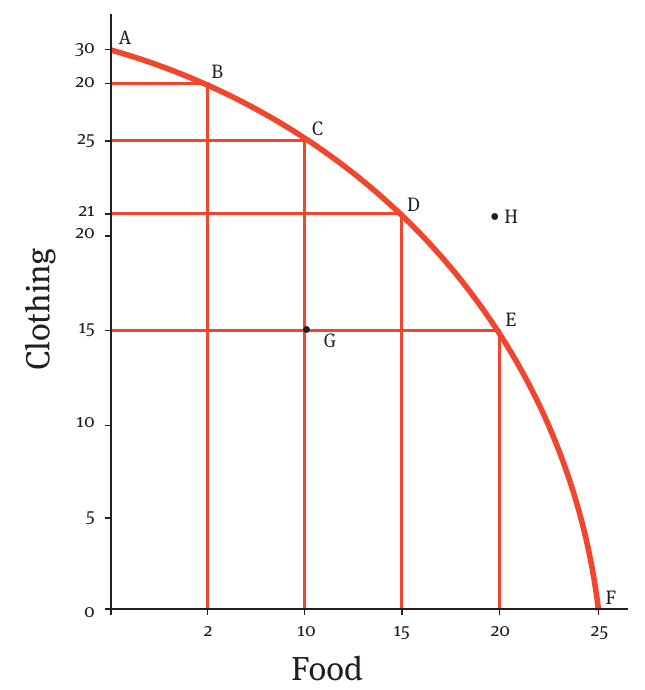
Efficient Production (Points A-F on the curve):
- Point A: 30 units clothing, 0 units food - All resources used for clothing
- Point C: 20 units clothing, 15 units food - Balanced production mix
- Point F: 0 units clothing, 25 units food - All resources used for food
Inefficient Production (Point G inside the curve):
- Point G: 15 units clothing, 10 units food - Wasted resources or unemployment
Impossible Production (Point H outside the curve):
- Point H: Cannot be achieved with current resources and technology
This diagram shows several important classifications:
Points on the curve (A, B, C, D, E, F): These represent efficient production combinations. The country is using all its resources effectively and cannot produce more of one good without reducing production of the other.
Point G (inside the curve): This shows inefficient production. At this point, the country produces 15 units of clothing and 10 units of food, but it's not using all available resources. There are wasted or unemployed resources.
Point H (outside the curve): This represents an impossible combination with current resources and technology. The country simply doesn't have enough productive capacity to achieve this level of output.
Shape of a PPC
PPCs can have different shapes depending on how resources transfer between producing different goods:
- Straight line: Resources can easily move between producing the two goods with the same trade-off rate
- Convex curve (bulging outwards): This is most common and shows that resources don't transfer equally well between different uses
- Concave curve (curving inwards): Less common, showing economies of scale
The shape depends on several factors within the economy, including available physical resources, skills and technology levels, workforce motivation, and past investments in infrastructure and innovation.
Note
Why Most PPCs Are Convex
Most real-world PPCs curve outward because resources aren't equally good at producing different things. For example, farmland is great for growing food but terrible for making clothing, while factory equipment is perfect for manufacturing but useless for agriculture.
Changes in the production possibility curve
The position and shape of a PPC can change due to various factors:
Internal factors are things the producer or country can control, such as:
- Number of workers employed
- Size and capacity of factories
- Training and education programmes
External factors are beyond direct control, such as:
- Natural disasters affecting production
- Changes in fuel prices
- International economic conditions
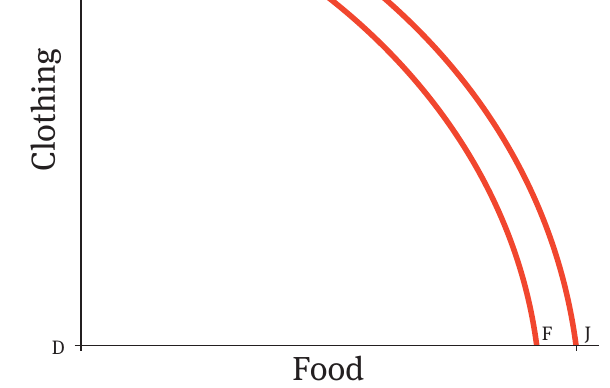
When there's an improvement that affects only one product (like better farming techniques for food production), the PPC shifts outward only on that axis, creating a new curve that allows more of that specific product to be produced.
Important
PPC Shifts vs Movements
- Movement along the PPC: Changing what you produce with the same resources
- Shift of the entire PPC: Change in the total productive capacity of the economy
- Partial shift: Improvement that affects only one type of production
Economic growth and the PPC
Economic growth occurs when an economy's productive capacity increases. This happens through:
- More resources: Discovering new natural resources or increasing the workforce
- Better quality resources: Improving education, training, or upgrading equipment
- Improved technology: Developing new production methods or innovations
When economic growth occurs, the entire PPC shifts outward to the right. This means the economy can now produce more of both goods than before.
International trade also allows countries to consume beyond their own production possibilities. By specialising in producing goods they're most efficient at and trading with other countries, nations can access combinations of goods that would be impossible to produce domestically.
South African context
Consider South Africa's choices between producing agricultural products (like maize and wheat) versus manufacturing goods (like textiles and machinery). The country must decide how to allocate its land, labour, and capital between these sectors.
Note
South African PPC Factors
Factors like drought, skills development programmes, and infrastructure investment all affect where South Africa's PPC is positioned and how it might shift over time. For example, the recent energy crisis and load-shedding have temporarily shifted South Africa's PPC inward by reducing manufacturing capacity.
Exam tips
- Always label your PPC diagrams clearly with specific products on each axis
- Remember that points inside the curve show inefficiency or unemployment
- Points outside the curve are currently impossible but may become achievable through economic growth
- Be able to explain what causes the PPC to shift inward (economic decline) or outward (economic growth)
- Practice drawing and explaining different PPC scenarios
Summary
Key Points to Remember:
- Scarcity forces all societies to make choices about how to use limited resources
- PPCs show the maximum production combinations possible with available resources and technology
- Points on the curve are efficient, points inside are inefficient, and points outside are currently impossible
- Opportunity cost increases as you produce more of one good at the expense of another
- Economic growth shifts the entire PPC outward, creating new possibilities for production and consumption
- Trade allows consumption beyond the PPC by specialising in comparative advantages