Overview (Grade 10 NSC Matric History): Revision Notes
📚Revision Notes
Overview
Introduction to transformation in southern Africa
The period after 1750 marked a dramatic turning point in southern African history. This era saw massive political, social, and military changes that completely reshaped the region. Understanding these transformations is crucial for grasping how modern South Africa developed.
Note
This period represents one of the most significant political transformations in African history, comparable to major revolutionary periods in other parts of the world.

The big picture: What changed after 1750?
Before 1750, southern Africa was home to various groups living relatively independently:
- The San - hunter-gatherer communities
- The Khoekhoe - pastoralist societies
- 'Bantu' speaking peoples - agricultural communities including the Tswana and others
- Portuguese explorers and traders - early European contact
- Dutch settlers - establishing permanent European presence
However, by 1835, the entire political landscape had been revolutionised through warfare, migration, and the rise of powerful new kingdoms.
Important
The transformation was so complete that the political map of southern Africa in 1835 bore almost no resemblance to what existed in 1750. This was not gradual change, but revolutionary upheaval.
The Mfecane/Difaqane: A period of revolutionary change
What was the Mfecane?
The Mfecane (meaning "crushing" in Nguni languages) or Difaqane (in Sotho languages) was a period of intense political upheaval and transformation between approximately 1750-1835. Think of it as southern Africa's own political revolution, similar to what was happening in Europe at the same time.

Note
The dual naming of this period reflects the linguistic diversity of southern Africa - Nguni-speaking peoples used "Mfecane" while Sotho-speaking groups called it "Difaqane," but both terms capture the sense of crushing or scattering that characterized this era.
Key causes and characteristics
The transformation began when:
- The Tswana and Ndwandwe emerged as powerful interior tribes
- These groups used amabutho (age-regiment military systems) for warfare
- Competition for resources and territory intensified
- New military tactics and leadership styles developed
Shaka and the rise of the Zulu state
The revolutionary leader
Shaka became the most influential figure of this period.
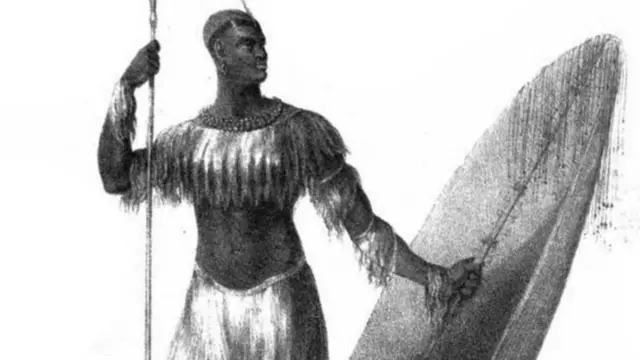
This dynamic military leader:
- Rose to power in the early 1800s
- Introduced completely new military tactics and weapons
- Either defeated and absorbed neighbouring tribes or forced them to flee
- Created the powerful Zulu state through conquest and political organisation
Example
Shaka's Rise to Power: A Military Revolution
When Shaka came to power around 1816, he completely transformed Zulu military practices:
Step 1: Weapon Innovation - Replaced long throwing spears with short stabbing spears (assegai)
Step 2: Formation Changes - Introduced the "horns of the beast" battle formation where warriors would encircle enemies
Step 3: Military Discipline - Created highly trained age-regiments (amabutho) with strict hierarchy
Result: The Zulu became the dominant military force in the region within just a few years.
Military innovations
Shaka's military reforms included:
- New weapons: The short stabbing spear (assegai) replaced long throwing spears
- Formation fighting: Close-combat tactics using the "horns of the beast" strategy
- Disciplined armies: Strict military training and organisation
- Total warfare: Complete destruction or absorption of enemies
Important
Shaka's military innovations were so effective that they were adopted by kingdoms across southern Africa, fundamentally changing the nature of warfare in the region.
New kingdoms emerge from the chaos
The great migration and state formation
As Shaka's power expanded, many groups fled his armies, leading to the formation of new kingdoms across the region.
The Ndebele kingdom:
- Formed by Mzilikazi, who broke away from Shaka's control
- Established a powerful kingdom in the northern interior
- Adopted Zulu military tactics and political systems
The Sotho kingdom:
- Led by Moshoeshoe, a skilled diplomat and military leader
- United various Sotho-speaking groups for protection
- Successfully defended against both African and European threats
Other developments:
- Boer, Kora, and Griqua raiders became active in the region
- Various smaller states and chiefdoms formed across the interior
- Trade networks and alliances constantly shifted
Note
The success of leaders like Mzilikazi and Moshoeshoe shows that the Mfecane period wasn't just about destruction - it was also about creative state-building and diplomatic innovation.
Timeline of transformation
Unit 1: The starting point (around 1750)
- Diverse groups living across southern Africa
- Relatively stable traditional societies
- Limited European presence mainly at the coast
Unit 2: Early political changes (1750-1820)
- Tswana chiefdoms expand their influence
- Rise of the Ndwandwe under leader Zwide
- Increased competition for resources
Unit 3: Revolutionary period (1820-1835)
- Breakdown of the Ndwandwe kingdom
- Shaka consolidates Zulu power under Dingane's later rule
- Formation of the Ndebele kingdom under Mzilikazi
- Emergence of the Sotho kingdom under Moshoeshoe
- Intensification of raiding and conflict
Unit 4: Lasting legacies
- How Shaka is remembered in history
- His impact on southern African political development
- Continuing influence on modern South Africa
The bigger picture: Why this matters
These transformations were crucial because they:
- Created the foundation for modern South African ethnic and political identities
- Established patterns of conflict and cooperation that lasted for centuries
- Demonstrated African agency and innovation in political organisation
- Set the stage for later interactions with expanding European colonial powers
The period shows how African societies were not passive victims of historical change, but active creators of their own political destiny through military innovation, diplomatic skill, and adaptive leadership.
Important
This period demonstrates that major political transformations in Africa were driven by African leaders and innovations, not just external forces. The creativity and adaptability shown by leaders like Shaka, Mzilikazi, and Moshoeshoe had lasting impacts on the region.
Study tips for exams
When answering questions about this topic:
- Always provide dates - The transformation period spans 1750-1835
- Name key leaders - Shaka, Mzilikazi, Moshoeshoe, Zwide
- Explain causes and consequences - What caused changes and what resulted
- Use the correct terminology - Mfecane/Difaqane, amabutho, assegai
- Show the connections - How events in one area affected others
Summary
Key Points to Remember:
- The Mfecane/Difaqane (1750-1835) completely transformed southern Africa's political landscape through warfare and migration
- Shaka's military innovations created the powerful Zulu state and influenced military tactics across the region
- The period led to the formation of major new kingdoms: Zulu, Ndebele, and Sotho states
- Leaders like Mzilikazi and Moshoeshoe successfully established lasting political structures that survived colonial conquest
- These transformations show African political creativity and adaptation, not just European influence