Converting Units of Measurement Using Given Conversion Factors (Grade 10 NSC Matric Mathematical Literacy): Revision Notes
📚Revision Notes
Converting Units of Measurement Using Given Conversion Factors
What are conversion factors?
Conversion factors are fixed ratios that allow you to change from one unit of measurement to another without changing the actual quantity. These factors are essential tools in mathematics and everyday life, especially when working with recipes, medicine dosages, or any situation where precise measurements matter.
When you use conversion factors, you're essentially multiplying or dividing by a specific number to express the same quantity in different units. The key principle is that the actual amount stays the same - only the units change.
Note
Understanding conversion factors is crucial for success in mathematics and practical applications. Think of them as translation tools that help you "speak" different measurement languages while keeping the meaning the same.
Cooking conversions
Cooking provides an excellent practical example of unit conversion. Recipes often use different measuring systems, and you need to convert between them accurately to achieve desired results.
Common measuring tools
In cooking, we use specialised measuring tools that come in standard sizes. Understanding these tools is crucial for accurate conversions.
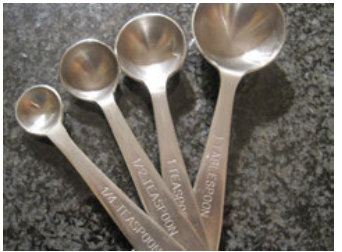
Measuring spoons come in different sizes and are used for smaller quantities of ingredients like spices, vanilla essence, or baking powder.
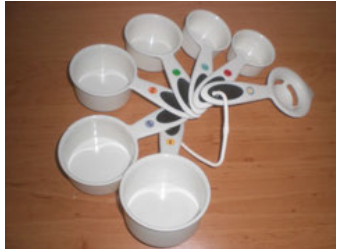
Measuring cups are larger and used for ingredients like flour, milk, or oil. They typically come in nested sets with different capacities.
Standard conversion factors for cooking
The most important conversion factors you need to understand for cooking are:
| Unit | Equivalent in millilitres |
|---|---|
| 1 cup | 250 ml |
| 1 tablespoon (tbsp) | 15 ml |
| 1 teaspoon (tsp) | 5 ml |
Important
Important for exams: These conversion factors will always be provided in your NSC exam, so you don't need to memorise them for the test. However, understanding how to use them correctly is essential for success.
Understanding heaped measurements
Sometimes recipes call for "heaped" or "rounded" measurements. This means the ingredient doesn't need to be level with the top of the measuring spoon - you can have a small mound of the ingredient sitting above the rim.
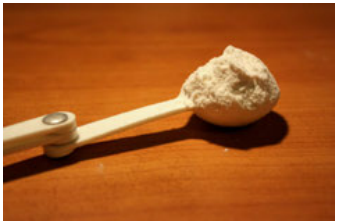
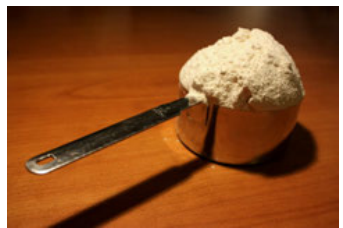
A heaped measurement typically contains slightly more than the standard measurement, but for most cooking purposes, this difference is acceptable and often expected.
Step-by-step conversion process
When converting between cooking measurements, follow this systematic approach to ensure accuracy every time.
Important
Critical Rule to Remember:
- To convert from larger units to smaller units: multiply
- To convert from smaller units to larger units: divide
Method 1: Single unit conversions
- Step 1: Identify what you're converting from and to
- Step 2: Find the appropriate conversion factor
- Step 3: Apply the correct operation (multiply or divide)
Method 2: Mixed unit conversions
When converting to multiple units (like cups and tablespoons), follow this process:
- Step 1: Divide by the largest unit first
- Step 2: Calculate the remainder
- Step 3: Convert the remainder to the smaller unit
- Step 4: Combine your answers
Worked examples
Let's work through several examples to understand the conversion process clearly. Each example demonstrates different scenarios you might encounter.
Example
Worked Example 1: Converting cups to millilitres
Question: Mbali needs 3 cups of flour to bake a cake. How many ml of flour does she need?
Solution:
- Conversion factor:
- Calculation:
- Answer:
Example
Worked Example 2: Converting millilitres to cups
Question: How much is 1250 ml of milk, in cups?
Solution:
- Conversion factor:
- Calculation:
- Answer:
Example
Worked Example 3: Converting millilitres to tablespoons
Question: Ruth has 45 ml of sugar. How many tbsp of sugar does she have?
Solution:
- Conversion factor:
- Calculation:
- Answer:
Example
Worked Example 4: Converting teaspoons to millilitres
Question: Ayanda needs to take 20 ml of cough syrup in the evening. How many teaspoons must she take?
Solution:
- Conversion factor:
- Calculation:
- Answer:
Example
Worked Example 5: Mixed unit conversion
Question: Convert 530 ml of mealie meal into cups and tbsp.
Solution: Step 1: Convert to cups first (largest unit)
- This gives us whole cups
Step 2: Find the remainder
- Remainder:
Step 3: Convert remainder to tablespoons
Step 4: Combine the answer
- Answer:
Example
Worked Example 6: Multiple measurements total
Question: Eric made 3 cups and 5 tbsp of vegetable soup for lunch. How many ml of soup does he have?
Solution: Step 1: Convert each measurement to ml
Step 2: Add the totals
- Answer:
Exam tips and strategies
Success in unit conversion questions requires both understanding the concept and avoiding common pitfalls. Here are essential strategies for exam success.
Important
Common mistakes to avoid:
- Mixing up conversion factors: Remember that cups are largest (250 ml), then tablespoons (15 ml), then teaspoons (5 ml)
- Wrong operation: When going from big to small units, multiply. When going from small to big units, divide
- Not showing working: Always show your calculations step by step
- Forgetting units: Include the correct units in your final answer
Exam strategies:
Note
Proven exam strategies:
- Double-check your conversion factors - they should be given in the question
- Work systematically - don't try to do multiple conversions in your head
- Check if your answer makes sense - 1000 ml should be 4 cups, not 40 cups
- Use the mixed unit method when asked to convert to multiple units
Memory aids:
- Size order: Cup (biggest) → Tablespoon (middle) → Teaspoon (smallest)
- Number pattern: 250, 15, 5 - each is much smaller than the previous
- Practical thinking: A cup of tea is much more than a spoon of medicine
Summary
Key Points to Remember:
- Conversion factors are ratios that help you change units without changing the actual quantity
- Key cooking conversions: , ,
- For single conversions: multiply when going to smaller units, divide when going to larger units
- For mixed conversions: start with the largest unit, find the remainder, then convert the remainder to smaller units
- Always show your working and include units in your final answer - this is essential for exam success