Weather Predictions (Grade 10 NSC Matric Mathematical Literacy): Revision Notes
📚Revision Notes
Weather Predictions
Understanding weather probability
When you hear a weather forecast saying there is a 60% chance of rain, this percentage represents a probability based on historical weather data. Weather predictions are not just guesses - they are calculated using mathematical probability principles that we study in this chapter.
Note
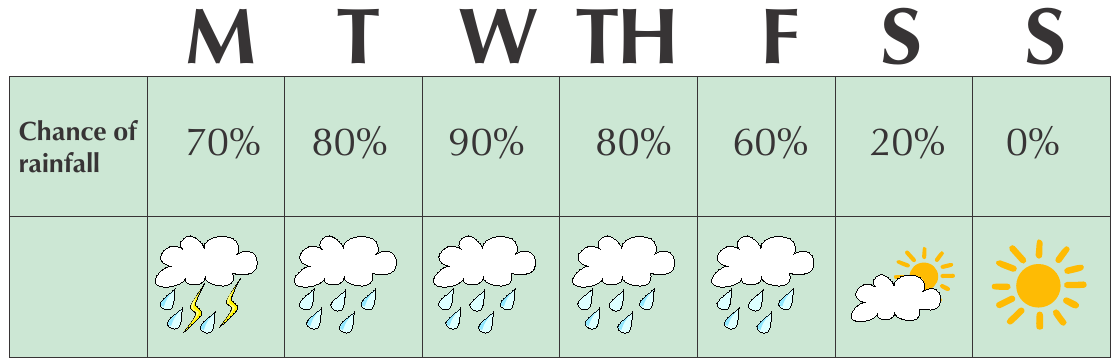
The weather forecast table shows probability percentages for different days of the week. These percentages tell us how likely it is that rain will occur on each particular day based on historical data analysis.
How weather forecasts are calculated
Note
Database: An organised collection of information that has been collected over time and arranged so it can be easily accessed, updated and managed. A database may take the form of paper (like a telephone book) or computer storage (like Facebook storing friends' information and photos).
The South African Weather Service creates weather predictions by following these steps:
- Collect historical data: They examine their database of past weather records
- Find similar conditions: They look for days that had the same weather characteristics (temperature, pressure, humidity, etc.) as the current day
- Calculate probability: They count how many of those similar days actually had rain
- Express as percentage: They convert this into a probability percentage
Calculating weather probability
Important
The fundamental probability formula used in weather predictions is:
Example
Worked Example 1: Basic Rain Probability
If the weather service has data for 100 days with similar weather conditions, and it rained on 60 of those days, then:
- Favourable outcomes (rainy days) = 60
- Total possible outcomes (similar days) = 100
- Probability of rain = or 60%
Example
Worked Example 2: Complementary Probability
If there is a 60% chance of rain, what is the probability it will not rain?
Since all probabilities must add up to 100%:
- Probability of rain = 60%
- Probability of no rain = 100% - 60% = 40%
This shows us that a 60% chance of rain means it is more likely to rain than not, but there is still a significant chance (40%) that it won't rain.
Example
Worked Example 3: Interpreting Different Probability Levels
From the weather forecast table:
- Monday: 70% chance of rain = Rain is very likely
- Friday: 60% chance of rain = Rain is more likely than not
- Saturday: 20% chance of rain = Rain is unlikely
- Sunday: 0% chance of rain = No rain expected
Understanding probability in context
Note
A 50% probability means an event has an equal chance of occurring or not occurring. When the probability is:
- Greater than 50% = The event is more likely to happen
- Less than 50% = The event is less likely to happen
- Equal to 50% = The event has equal chances of happening or not happening
Real-world applications
Weather probability is used in various practical situations:

Note
Fire danger ratings at national parks also use weather-based probability assessments. The fire danger dial shows different risk levels based on weather conditions, helping park managers make safety decisions.
Example
Worked Example 4: Weekly Weather Planning
Looking at the forecast table:
- Days with high rain probability (70-90%) = Monday to Thursday
- Days with low rain probability (0-20%) = Saturday and Sunday
- Best days for outdoor activities = Weekend (Saturday and Sunday)
This helps people plan activities based on mathematical probability rather than just hoping for good weather.
Example
Worked Example 5: Understanding Forecast Accuracy
If a forecast predicts 80% chance of rain (like Tuesday and Thursday in the table):
- This means that in similar weather conditions, it rained 8 out of 10 times
- There is still a 20% chance it won't rain
- The forecast is based on data, not certainty
Important
Critical Understanding: Weather forecasts are mathematical predictions based on historical data, not guarantees. Even a 90% chance of rain means there's still a 10% possibility it won't rain.
Summary
Key Exam Tips:
- Remember the formula:
- Complementary probabilities: Always add up to 100%
- Interpretation matters: 60% doesn't guarantee rain, it just makes it more likely than not
- Historical data: Weather predictions rely on past records stored in databases
Summary
Key Points to Remember:
- Weather predictions use probability calculations based on historical data stored in databases
- The probability formula (favourable outcomes ÷ total outcomes) applies to weather forecasting
- Complementary probabilities always add up to 100% (if 70% chance of rain, then 30% chance of no rain)
- Probabilities greater than 50% indicate the event is more likely to occur than not
- Weather forecasts are mathematical predictions, not guarantees - there's always some uncertainty