Real, Rational, and Irrational Numbers (Grade 10 NSC Matric Mathematics): Revision Notes
📚Revision Notes
Real, Rational, and Irrational Numbers
Note
Understanding the different types of numbers and how they relate to each other is fundamental to mathematics. The real number system organises all numbers we commonly work with into different categories based on their properties.
The real number system
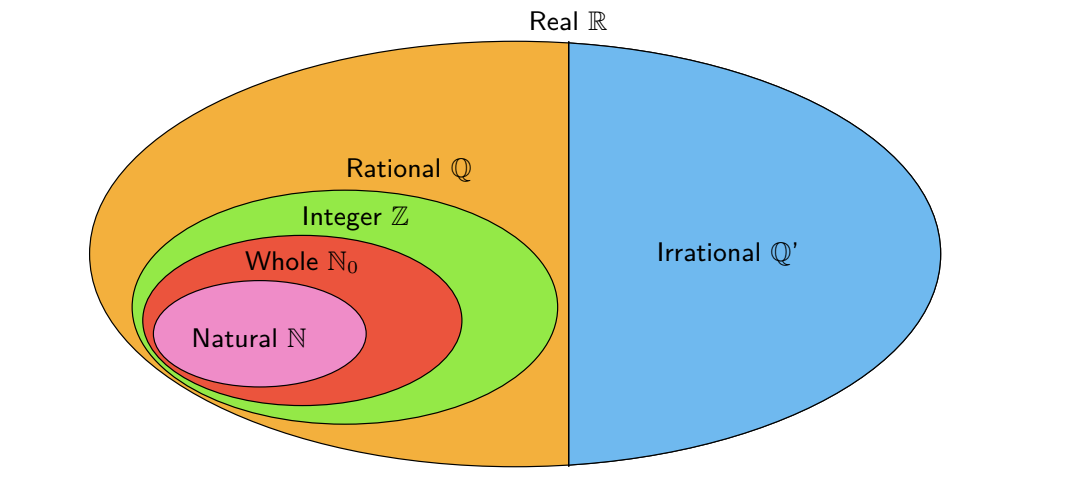
The real number system creates a logical hierarchy where each type of number builds upon the previous types. This systematic organisation helps us understand the relationships between different categories of numbers.
Note
Understanding the Hierarchy
The diagram above shows how different number sets fit together. Each inner set is completely contained within the outer sets, creating a hierarchy of number types. This nested structure means that every natural number is also a whole number, every whole number is also an integer, and so on.
Number set definitions
Natural numbers (ℕ)
Natural numbers are the counting numbers we use in everyday life: . These are the numbers you would use to count objects or people.
Whole numbers (ℕ₀)
Whole numbers include all natural numbers plus zero: . The zero makes this set "whole" by including the concept of nothing.
Integers (ℤ)
Integers include all whole numbers and their negative counterparts: . This set extends in both directions from zero.
Real numbers (ℝ)
Real numbers include all numbers that can be represented on a number line. This encompasses both rational and irrational numbers.
Non-real numbers
Important
Non-Real Numbers Warning
Not all numbers are real numbers. The square root of a negative number is called a non-real or imaginary number. For example, , , and are all non-real numbers and cannot be placed on the standard number line.
Rational numbers
Definition
A rational number is any number that can be expressed as a fraction:
where and are integers and .
Note
Memory Aid: Rational = Ratio
The word "rational" comes from "ratio", helping you remember that these numbers can be written as a ratio of two integers. This connection makes it easier to identify rational numbers.
Key properties
Examples of rational numbers include:
- , , , ,
Notice that all integers are also rational numbers because they can be written with a denominator of 1.
Decimal representations of rational numbers
Rational numbers have specific patterns when written as decimals:
Terminating decimals: These end after a certain number of decimal places. For example, .
Recurring decimals: These have a repeating pattern of digits. The fraction or
You can use a dot or bar over the repeated digits to show the pattern: or .
Irrational numbers
Definition
Irrational numbers are numbers that cannot be written as a fraction where both the numerator and denominator are integers.
Examples and identification
Common examples of irrational numbers include:
- , , (square roots of non-perfect squares)
- (pi)
- (the golden ratio)
When written as decimals, irrational numbers continue forever without any repeating pattern.
Note
Identifying Rational vs Irrational Numbers
Here's a simple method to determine if a number is rational or irrational:
- Write the number in decimal form
- If the decimal terminates, it's rational
- If the decimal continues forever but has a repeating pattern, it's rational
- If the decimal continues forever with no repeating pattern, it's irrational
Converting decimals to fractions
Terminating decimals
Each digit after the decimal point represents a fraction with a denominator that's a power of 10.
For example:
Recurring decimals
Converting recurring decimals requires more steps. Here's the systematic method:
Example
Worked Example 1: Converting to a fraction
Step 1: Let
Step 2: Multiply both sides by 10:
Step 3: Subtract the original equation:
Step 4: Simplify: , so
Example
Worked Example 2: Converting to a fraction
Step 1: Let
Step 2: Since three digits repeat, multiply by 1000:
Step 3: Subtract:
Step 4: Simplify: , so
Important
General Rule for Recurring Decimals
The key is to match the number of repeating digits:
- If one digit recurs, multiply by 10
- If two digits recur, multiply by 100
- If three digits recur, multiply by 1000
- And so on...
Worked example: Identifying number types
Example
Worked Example: Classifying Numbers
Question: Which of the following are not rational numbers?
Solution:
- Irrational - decimal does not terminate and has no repeated pattern
- Rational - decimal terminates
- Irrational - decimal does not terminate and has no repeated pattern
- Rational - all integers are rational
- Rational - decimal has repeated pattern (73)
- Rational - decimal terminates
Summary
Key Points to Remember:
-
The real number system is organised in a hierarchy: Natural ⊂ Whole ⊂ Integers ⊂ Rational ⊂ Real, with Irrational numbers forming the other half of Real numbers
-
Rational numbers can be written as fractions where both and are integers and
-
Rational numbers as decimals either terminate or have a repeating pattern
-
Irrational numbers cannot be written as fractions and have non-terminating, non-repeating decimal representations
-
To convert recurring decimals to fractions, multiply by the appropriate power of 10 based on how many digits repeat, then subtract and solve