Overview of Euclidean Geometry (Grade 10 NSC Matric Mathematics): Revision Notes
📚Revision Notes
Overview of Euclidean Geometry
What is Euclidean geometry?
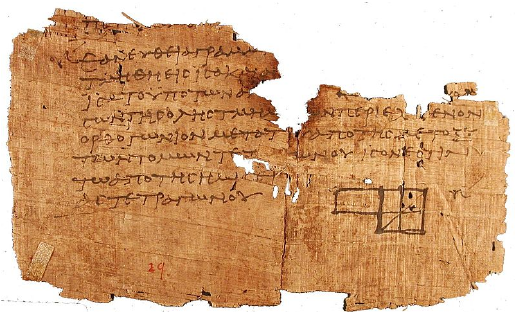
Euclidean geometry is a branch of mathematics that studies shapes and spatial relationships using logical reasoning. The word "geometry" comes from Greek words meaning "earth" and "measure", showing its practical origins in measuring land and objects.
This type of geometry is based on a system of logical deductions from axioms and theorems. Euclidean geometry was developed by the ancient Greek mathematician Euclid and forms the foundation of most geometry we learn today.
Applications of Euclidean geometry
Note
Euclidean geometry has many practical uses in the modern world:
- Surveying: Still widely used for measuring land and creating maps
- Architecture: Essential for designing buildings and structures
- Art: Helps create realistic perspective and proportions
- Packaging: Determines optimal arrangements for different objects
Fundamental measurements
In Euclidean geometry, we work with two basic types of measurement:
Note
Core Measurements in Euclidean Geometry:
- Angles - measured in degrees ()
- Distances - measured in standard units like metres or centimetres
Angles
Definition and notation
Important
An angle is formed when two rays (or line segments) meet at a point. This meeting point is called the vertex.
We can label angles in different ways:
- Using a single letter at the vertex (e.g., )
- Using three letters with the vertex in the middle (e.g., , where B is the vertex)
- Using the symbol, which is a shorthand way to write "angle"
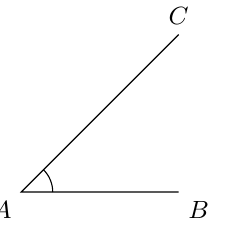
Angles are measured in degrees, shown with the symbol. This measurement tells us how much one ray has turned from the other around the vertex.
Types of angles
Understanding different angle types is crucial for solving geometry problems. Here are the main categories:
Acute angle: Any angle greater than and less than
- Range:
Right angle: The standard corner angle
- Exactly
- Shown with a small square symbol at the vertex
- Forms the corner of a rectangle
Obtuse angle: Larger than a right angle but smaller than a straight line
- Range:
Straight angle: Forms a straight line
- Exactly
- The two rays point in exactly opposite directions
Reflex angle: An angle greater than but less than
- Range:
Properties of intersecting lines
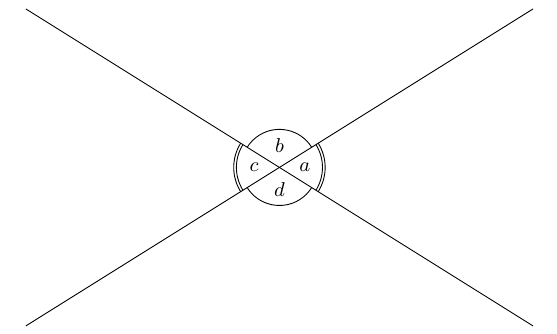
When two straight lines cross each other, they create four angles with special relationships:
Note
Key Angle Relationships:
Adjacent angles: Two angles that share a vertex and have one side in common. Adjacent angles that form a straight line always add up to (supplementary).
Vertically opposite angles: Angles that are directly across from each other when two lines intersect. These angles are always equal.
Important
Essential Angle Properties:
Supplementary angles: Any two angles that add up to .
Complementary angles: Any two angles that add up to .
Angles around a point: All angles around a single point add up to .
Parallel lines and transversals
Parallel lines
Important
Parallel lines are lines that never meet, even when extended indefinitely. They maintain the same distance apart at all points in Euclidean geometry.
We show parallel lines using arrow symbols pointing in the same direction.
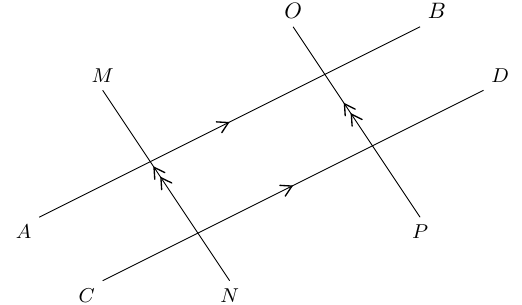
In mathematical notation, we write parallel lines using the symbol . For example: means line AB is parallel to line CD.
Transversal lines
A transversal is a line that intersects two or more coplanar lines (often parallel lines). When this happens, it creates eight angles with special relationships.
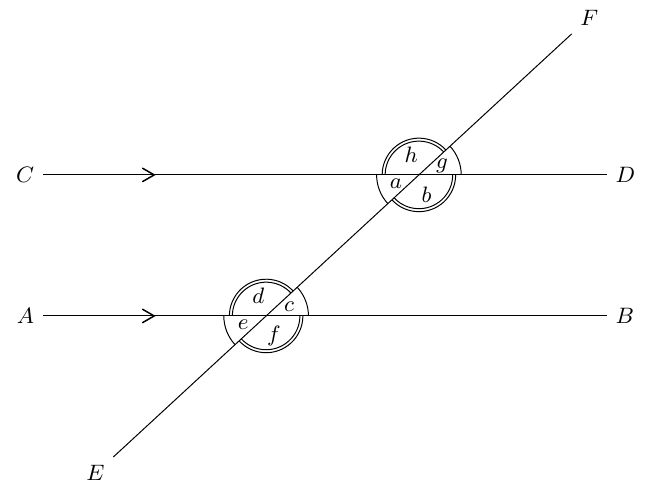
Angle relationships with parallel lines
When a transversal cuts through parallel lines, several important angle relationships emerge:
Note
Angle Classifications:
Interior angles: Angles that lie between the two parallel lines. These are "inside" the parallel lines.
Exterior angles: Angles that lie outside the parallel lines.
Important
Critical Angle Relationships:
Corresponding angles: Angles in the same relative position at each intersection.
- These angles are equal when a transversal cuts parallel lines
- They form an "F" shape pattern
- If , then the lines are parallel
Co-interior angles: Angles on the same side of the transversal and between the parallel lines (also called same-side interior angles).
- These angles are supplementary (add to )
- They form a "C" shape pattern
- If , then the lines are parallel
Alternate interior angles: Interior angles on opposite sides of the transversal.
- These angles are equal when a transversal cuts parallel lines
- They form a "Z" shape pattern
- If , then the lines are parallel
Testing if lines are parallel
Note
Proving Lines are Parallel:
You can prove two lines are parallel if any of these conditions are met:
- Corresponding angles are equal
- Alternate interior angles are equal
- Co-interior angles are supplementary (add to )
Worked example: Finding unknown angles
Example
Worked Example: Finding Unknown Angles with Parallel Lines
Let's work through a practical problem using parallel line properties.
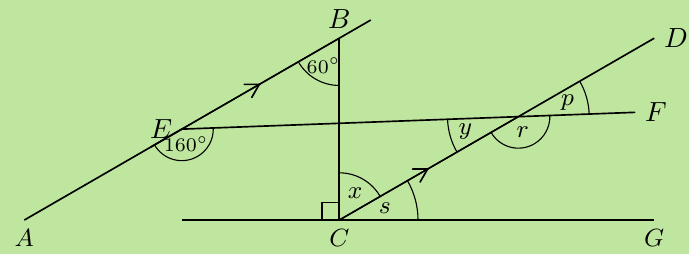
Problem: Find all unknown angles when , given that one angle is and another is .
Step 1: Identify the given information and parallel lines
- (given)
- (given; used to find other angles using alternate angles)
- (co-interior angles with )
Step 2: Calculate unknown angles systematically
- Since , then
- (vertically opposite angles)
- (corresponding angles with )
- (angles on a straight line, including a right angle in the diagram)
- , so
Step 3: Verify your answers Check that corresponding angles are equal, co-interior angles are supplementary, and alternate angles are equal.
Summary
Key Points to Remember:
-
Euclidean geometry uses logical deduction from axioms and theorems to study shapes and spatial relationships, with applications in surveying, architecture, and design.
-
Angles are formed when two rays meet at a vertex, and are measured in degrees from to .
-
When two lines intersect, vertically opposite angles are equal, and adjacent angles that form a straight line are supplementary (add to ).
-
Parallel lines never meet in Euclidean geometry and are shown with arrow symbols or the notation.
-
When a transversal cuts parallel lines, corresponding angles are equal, alternate interior angles are equal, and co-interior angles are supplementary.