Probability (Grade 10 NSC Matric Mathematics): Revision Notes
📚Revision Notes
Probability Identities
Understanding the Sample Space
The sample space is the set of all possible outcomes that can occur in a probability experiment. This is a fundamental concept because it forms the foundation for calculating all probabilities.
Since the sample space contains every possible outcome, the probability of observing any outcome from the sample space must equal 1. This gives us our first important identity:
Where S represents the sample space. This makes logical sense - something from the sample space must happen, so the probability is certain (100% or 1).
Note
The sample space concept is crucial because it establishes the total "universe" of possibilities for any probability experiment. Every other probability calculation depends on this foundation.
The Union Identity for Two Events
When we want to find the probability that either event A or event B (or both) will occur, we use the union identity. The union of two events A and B is written as A ∪ B.
The Main Formula
Important
The Union Identity (Addition Rule):
This formula tells us that to find the probability of A or B occurring, we:
- Add the probability of A occurring
- Add the probability of B occurring
- Subtract the probability of both A and B occurring together (the intersection)
Why Do We Subtract the Intersection?
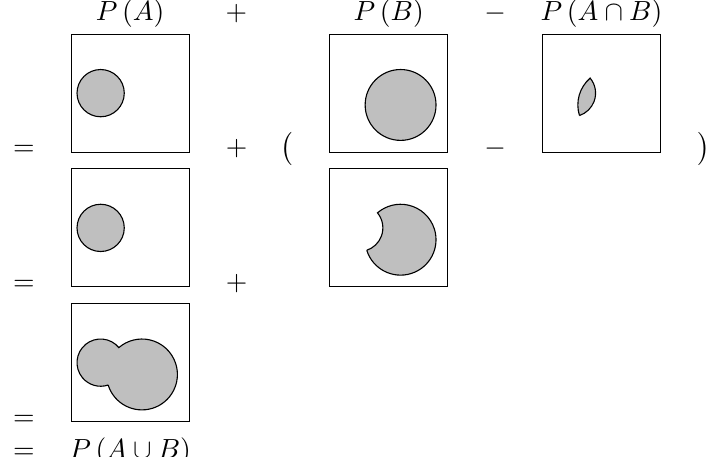
The reason we subtract P(A ∩ B) is to avoid double-counting. When we add P(A) and P(B), we count the overlap region twice. The intersection represents the outcomes that belong to both events, so we must subtract it once to get the correct total.
Note
Memory Aid: Think of it as "Add the parts, subtract the overlap" - this simple phrase captures the essence of why we need the subtraction step in the union formula.
This visual proof using Venn diagrams shows exactly why the subtraction is necessary. The diagram demonstrates how P(A) + P(B) includes the intersection twice, so we subtract P(A ∩ B) to get the true union.
Visual Proof Using Venn Diagrams
Let's examine how the union identity works step by step using Venn diagrams:
Note
Step-by-Step Visual Proof:
Step 1: Start with P(A) - this includes the entire circle A
Step 2: Add P(B) - this includes the entire circle B, but now we've counted the overlap twice
Step 3: Subtract P(A ∩ B) - this removes the double-counted intersection once
Step 4: The result is P(A ∪ B) - the combined area without double-counting
The visual representation makes it clear that P(A) + P(B) - P(A ∩ B) equals the total shaded area representing A ∪ B.
Worked Example: Verifying the Identity

Example
Worked Example: Dice Probability Verification
Problem Setup: We have two events from a dice experiment:
- Event A contains outcomes {1, 2, 5, 6}
- Event B contains outcomes {1, 5}
- The sample space contains 36 possible outcomes (two dice)
Step 1: Calculate Individual Probabilities
Using the formula P(Event) = n(Event)/n(S):
Step 2: Verify the Identity
Now we check if P(A ∪ B) = P(A) + P(B) - P(A ∩ B):
Left-hand side (LHS): P(A ∪ B) = 14/36
Right-hand side (RHS): P(A) + P(B) - P(A ∩ B)
= 5/36 + 11/36 - 2/36
= 16/36 - 2/36
= 14/36
Since LHS = RHS, the identity is verified!
Key Formulas to Remember
Summary
Essential Probability Formulas:
Sample space identity:
Union identity (Addition Rule):
Basic probability formula:
Exam Tips
Important
Critical Points for Success:
- Always subtract the intersection when finding P(A ∪ B) - this is the most common mistake
- Draw a Venn diagram if you're unsure - it helps visualise why we subtract
- Check your answer by verifying the identity works both ways
- Remember that probabilities must be between 0 and 1 - if your answer is outside this range, check your calculations
Remember!
Summary
Key Points to Remember:
- The sample space contains all possible outcomes, so P(S) = 1
- To find P(A ∪ B), add the individual probabilities then subtract the intersection to avoid double-counting
- Venn diagrams provide a clear visual way to understand why we subtract P(A ∩ B)
- The union identity P(A ∪ B) = P(A) + P(B) - P(A ∩ B) is fundamental to probability calculations
- Always verify your calculations by checking that the identity holds true