Reciprocal Ratios (Grade 10 NSC Matric Mathematics): Revision Notes
📚Revision Notes
Reciprocal Ratios
What are reciprocal ratios?
Reciprocal ratios are the inverse functions of the three basic trigonometric ratios. Each of the three trigonometric ratios (sine, cosine, and tangent) has a corresponding reciprocal ratio. These reciprocals are called cosecant (cosec), secant (sec), and cotangent (cot).
Note
Understanding reciprocal ratios is essential because they help us solve trigonometric equations more efficiently and appear frequently in more advanced mathematics.
The three reciprocal ratios
Cosecant (cosec)
Cosecant is the reciprocal of sine:
Secant (sec)
Secant is the reciprocal of cosine:
Cotangent (cot)
Cotangent is the reciprocal of tangent:
Reciprocal ratios in right-angled triangles
Just like the basic trigonometric ratios, we can define reciprocal ratios using the sides of a right-angled triangle:
- Cosecant:
- Secant:
- Cotangent:
Note
Notice how these definitions mirror the basic trigonometric ratios, but with the sides flipped in the fraction. This direct relationship makes them easy to remember once you know the basic ratios.
Important identity relationships
Important
The most important property of reciprocal ratios is that when you multiply a trigonometric ratio by its reciprocal, the result is always 1:
These relationships are extremely useful for solving trigonometric equations and simplifying expressions.
Worked examples
Let's use this right-angled triangle to calculate reciprocal ratios:
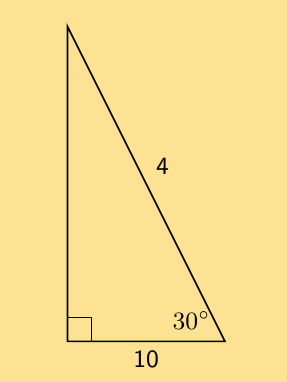
From the triangle, we can identify the given measurements and work through the calculations systematically.
Example
Worked Example 1: Finding the opposite side
From the triangle, we can identify:
- Hypotenuse = 4
- Adjacent side (to the 30° angle) = 10
- We need to find the opposite side using Pythagoras' theorem
Using Pythagoras' theorem:
Wait - this gives us a problem! The hypotenuse (4) is shorter than the adjacent side (10), which is impossible in a right-angled triangle.
Looking more carefully, the hypotenuse should be the longest side. Let me assume the side labelled "4" is actually the opposite side, and we need to find the hypotenuse.
Using Pythagoras:
Therefore:
Example
Worked Example 2: Calculating reciprocal ratios for the 30° angle
Now we can calculate the reciprocal ratios:
Cosecant:
Secant:
Cotangent:
Example
Worked Example 3: Verifying using basic ratios
We can verify our cotangent calculation using the basic ratio:
✓
Exam tips
Note
Essential exam strategies:
- Remember the relationships: Each reciprocal ratio is simply 1 divided by the corresponding basic ratio
- Use the identity properties: If you know one ratio, you can easily find its reciprocal
- Check your triangle measurements: Make sure the hypotenuse is the longest side
- Be careful with notation: Cosecant can be abbreviated as "csc" in some textbooks
Summary
Key Points to Remember:
- Cosecant is the reciprocal of sine:
- Secant is the reciprocal of cosine:
- Cotangent is the reciprocal of tangent:
- Multiplying any trigonometric ratio by its reciprocal always equals 1
- Reciprocal ratios can be calculated using triangle sides just like basic trigonometric ratios