Special Angles (Grade 10 NSC Matric Mathematics): Revision Notes
📚Revision Notes
Special Angles
What are special angles?
Special angles are specific angles in trigonometry that have exact trigonometric ratios which can be calculated without using a calculator. The three most important special angles are 30°, 45°, and 60°.
These angles are considered "special" because:
- Their trigonometric values are exact (not decimal approximations)
- They come from well-known right-angled triangles
- They appear frequently in mathematics exams
- They help solve trigonometric problems quickly and accurately
Note
Understanding special angles is fundamental to mastering trigonometry. These exact values will save you time in exams and provide the foundation for more advanced trigonometric concepts.
Special right triangles
Special angles come from two fundamental right-angled triangles. Understanding these triangles is essential for remembering the exact trigonometric values.
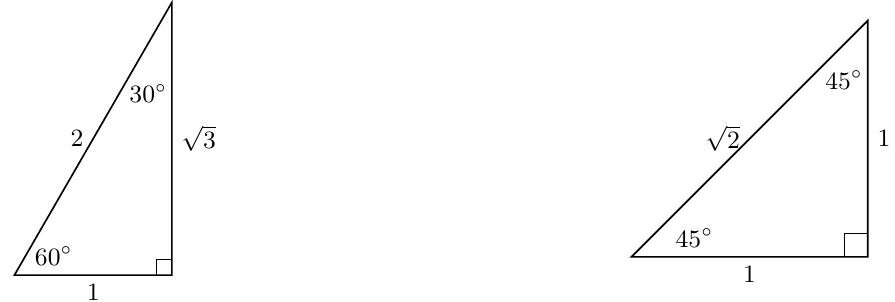
The 30°-60°-90° triangle
This triangle has angles of 30°, 60°, and 90°. The sides are in the ratio 1 : √3 : 2.
- Shortest side (opposite 30°): 1 unit
- Medium side (opposite 60°): √3 units
- Hypotenuse (opposite 90°): 2 units
Important
Key point: Remember that the hypotenuse is always twice the length of the shortest side.
The 45°-45°-90° triangle
This triangle has angles of 45°, 45°, and 90°. It's an isosceles right triangle where the two legs are equal.
- Both legs: 1 unit each
- Hypotenuse: √2 units
Important
Key point: The sides are in the ratio 1 : 1 : √2.
Exact trigonometric values
Using the special right triangles above, we can determine the exact values for sine, cosine, and tangent of the special angles.
For 30°:
For 45°:
For 60°:
Memory techniques
Pattern for sine values
Notice the pattern for as the angle increases from 30° to 60°:
Note
Pattern Recognition: The numerators follow the pattern: 1, √2, √3. This ascending pattern makes sine values easier to remember!
Pattern for cosine values
The cosine values are the reverse of the sine values:
- (same as )
- (same as )
- (same as )
Note
Complementary Angle Relationship: This reverse pattern occurs because . So , and so on.
Tangent values
Remember:
- (rationalised form: )
- (because )
Worked examples
Example
Worked Example 1: Using special angles in calculations
Question: Calculate the exact value of .
Solution: Step 1: Identify the special angle values
Step 2: Add the values
Example
Worked Example 2: Simplifying expressions with special angles
Question: Simplify .
Solution: Step 1: Substitute the exact values
Step 2: Multiply
Example
Worked Example 3: Solving equations with special angles
Question: If and , find the value of .
Solution:
From our table of special angles, we know that .
Therefore, .
Exam tips
Here are some practical strategies for working with special angles in examinations:
- Learn the exact values: Memorise the table of values for 30°, 45°, and 60°
- Draw the triangles: If you forget a value, quickly sketch the appropriate special triangle
- Check your work: Use the fact that to verify your answers
- Rationalize denominators: Express as when required
- Look for special angles: In exam questions, watch for angles that are multiples or combinations of 30°, 45°, and 60°
Note
Time-Saving Tip: Recognising special angles quickly can save precious minutes in timed exams. Practice identifying these angles in different contexts until it becomes automatic.
Common exam traps
Important
Common Mistakes to Avoid:
- Don't confuse with - remember the patterns
- Be careful with radians: These angles can also be expressed in radians (, , )
- Check quadrants: In advanced problems, remember that trigonometric values change signs in different quadrants
- Exact vs. decimal: Always give exact values unless specifically asked for decimal approximations
Remember!
Summary
Key Points to Remember:
- Special angles (30°, 45°, 60°) have exact trigonometric values that don't require a calculator
- The 30°-60°-90° triangle has sides in the ratio 1 : √3 : 2
- The 45°-45°-90° triangle has sides in the ratio 1 : 1 : √2
- Sine values increase from 30° to 60°, while cosine values decrease
- These exact values are essential tools for solving trigonometric problems efficiently in exams