Development Terminology (Grade 11 NSC Matric Geography): Revision Notes
📚Revision Notes
Development Terminology
Understanding how countries are classified and described in terms of their development status is fundamental to studying development geography. Different terminology has evolved over time to categorize countries based on their economic, social, and technological progress.
What does development mean?
Development is a concept that means different things to different people, but most definitions share common elements. Development involves the efficient use of resources to improve the standard of living and quality of life of a nation. It represents a continuous process of improvement and growth that affects various aspects of society including economic prosperity, social wellbeing, and technological advancement.
Note
Development is multidimensional - it's not just about economic growth, but encompasses improvements in healthcare, education, infrastructure, and overall quality of life for a nation's population.
Traditional classification system
Developed countries
Developed countries are nations that have achieved high levels of economic and social progress. These countries are richer and more industrialized compared to developing nations. Their populations typically enjoy high standards of living with good access to healthcare, education, and modern services. Most developed countries are located in the northern hemisphere, including regions like North America, Western Europe, Australia, and Japan.
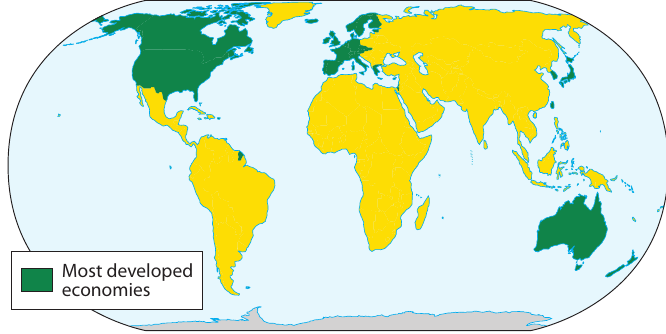
The global pattern shows a clear geographical distribution where developed nations are concentrated in certain regions of the world.
Developing countries
Developing countries face significant challenges in effectively utilizing their available resources. These nations typically have smaller industrial sectors, lower national incomes, and populations experiencing lower standards of living compared to developed countries. Many developing countries are concentrated in the southern hemisphere, including large portions of Africa, South America, and parts of Asia.
Important
The terms "developed" and "developing" are increasingly seen as oversimplified, as they don't capture the complexity and variation within these broad categories.
Industrialized countries
Some countries have experienced such rapid economic growth through industrialization that they no longer fit neatly into the traditional developed or developing categories. These industrialized countries have undergone dramatic economic transformation, moving from agriculture-based economies to large-scale industrial production. Examples include countries like China and Brazil, where rapid industrialization has led to significant economic growth and improved living standards for many citizens.
Modern classification system
Geographers today prefer to use more precise terminology when describing development status, moving away from the simpler developed/developing distinction.
More economically developed countries (MEDCs)
MEDCs represent the most recent term used to classify countries with advanced economic development. These countries share several important characteristics:
Important
Key Characteristics of MEDCs:
- They use their natural and human resources very efficiently
- They have achieved high levels of industrialization
- Their populations enjoy high standards of living
- They possess excellent education, healthcare, and transportation systems
- They manufacture and export goods to global markets
- Their governments are typically stable and able to provide financial aid to other countries

Access to clean, safe water delivered directly to homes represents the kind of infrastructure that characterizes MEDCs.
Less economically developed countries (LEDCs)
LEDCs face ongoing challenges in achieving economic and social development. Key characteristics include:
Important
Key Characteristics of LEDCs:
- High levels of poverty among significant portions of the population
- Weak or inadequate education, healthcare, and transport systems
- Heavy reliance on exporting raw materials rather than manufactured goods
- Limited ability to produce manufactured goods domestically
- Dependence on financial aid from MEDCs to support development projects
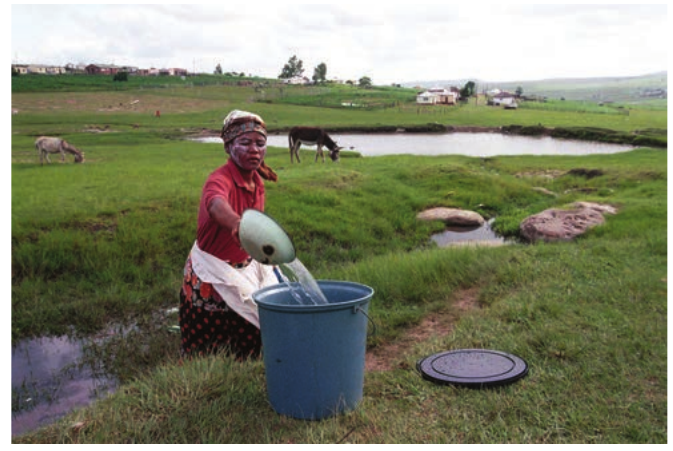
In many LEDCs, people must travel long distances and spend considerable time collecting water from natural sources, highlighting infrastructure challenges.
Understanding development through comparison
Comparing specific countries helps illustrate the real differences between development levels. When examining countries like New Zealand (an MEDC) and Honduras (an LEDC), the contrasts become clear across multiple indicators.
Example
Worked Example: Comparing Development Levels
New Zealand (MEDC) vs Honduras (LEDC)
Step 1: Examine income levels
- MEDCs typically show much higher per capita earnings
- Income disparities are often dramatic between the two categories
Step 2: Analyze healthcare systems
- MEDCs have more doctors per capita and better health outcomes
- LEDCs often struggle with limited medical infrastructure
Step 3: Assess education and infrastructure
- MEDCs provide better access to education and modern services
- LEDCs face challenges in providing basic services to all citizens
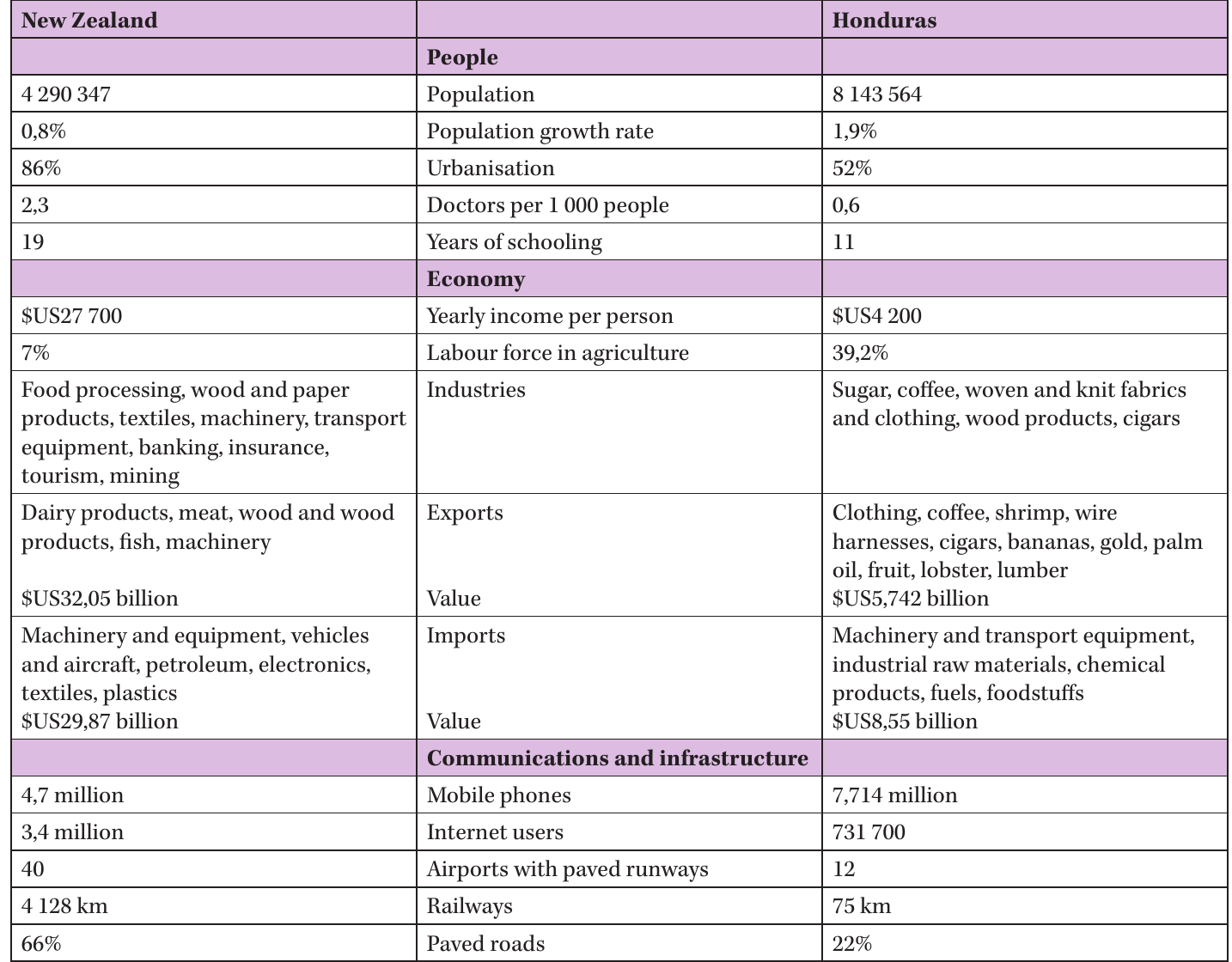
Such comparisons reveal significant differences in income levels, healthcare access, education opportunities, and infrastructure development.
Global development patterns
The world shows a distinct geographical pattern often referred to as the North-South divide. Generally, countries in the northern hemisphere tend to be more economically developed, while those in the southern hemisphere face greater development challenges. However, this pattern has exceptions and continues to evolve as some countries experience rapid economic growth.
Note
The North-South divide is a geographical generalization - there are important exceptions, such as Australia and New Zealand in the south being highly developed, while some northern countries face development challenges.
The speed of development varies significantly between countries, even within the same broad category. Some nations are advancing quickly through industrialization and economic reform, while others face ongoing obstacles to improving living standards for their populations.
Summary
Key Points to Remember:
- Development terminology has evolved from simple "developed/developing" to more nuanced "MEDC/LEDC" classifications
- MEDCs are characterized by efficient resource use, high industrialization, and excellent infrastructure
- LEDCs often struggle with poverty, weak systems, and dependence on raw material exports
- A clear North-South global pattern exists, though with important exceptions
- Development is a continuous process that occurs at different speeds in different countries