Types of Trading Relationships (Grade 11 NSC Matric Geography): Revision Notes
📚Revision Notes
Types of Trading Relationships
International trade plays a crucial role in every country's economic development and growth. Countries engage in different types of trading relationships depending on their economic policies, development goals, and need to protect domestic industries. Understanding these various trading arrangements helps us see how global commerce operates and affects both developed and developing nations.
Note
Understanding different trading relationships is essential for analyzing how countries interact economically and how these relationships affect both producers and consumers worldwide.
Free trade
Free trade represents commerce between nations that occurs without government-imposed restrictions or barriers. In this system, countries open their borders to allow goods and services to move freely between them, creating opportunities for increased economic cooperation and growth.
Nations with similar economic systems often establish free trade agreements to formalize these unrestricted trading relationships. These agreements create trading blocs that facilitate easier movement of goods, services, and sometimes people across borders.
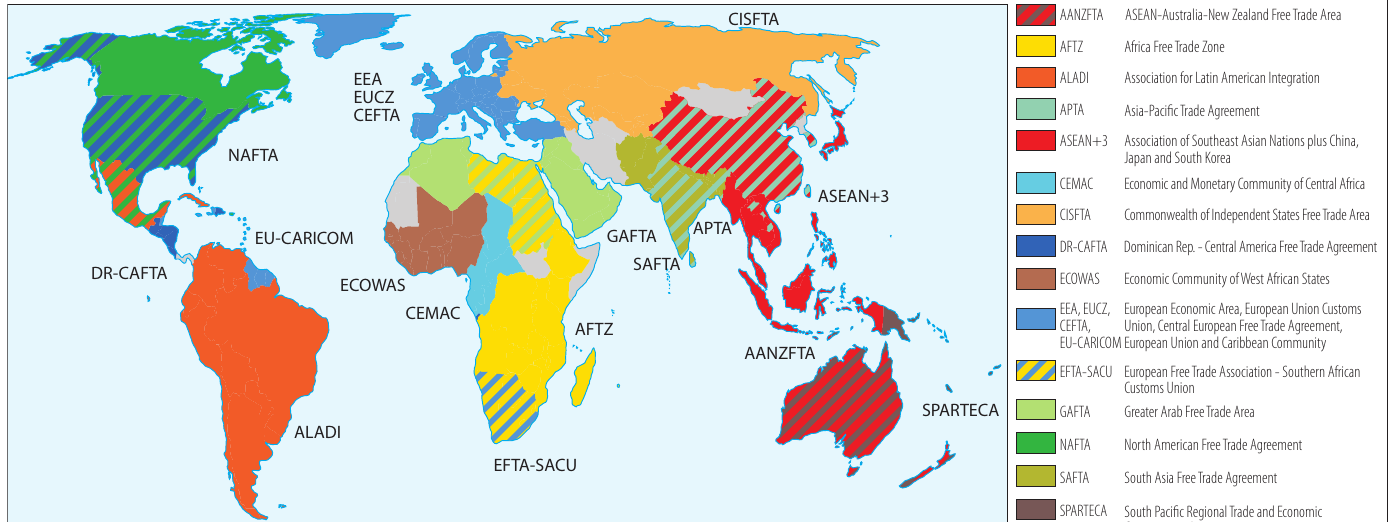
The global landscape shows numerous free trade agreements and economic partnerships. Major trading blocs include NAFTA in North America, the European Union arrangements, ASEAN in Southeast Asia, and various African economic communities. Each of these agreements represents countries working together to reduce trade restrictions and promote economic integration.
Important
While free trade can boost economic growth and provide consumers with more choices at lower prices, it can also create challenges for domestic industries that struggle to compete with cheaper foreign goods.
Trade barriers
While free trade offers many benefits, it can also create challenges for domestic industries. When cheaper foreign goods enter a market, local businesses may struggle to compete, leading to job losses and business closures. To address these concerns, governments often implement trade barriers to protect their domestic industries from international competition.
Tariffs
Tariffs function as taxes imposed on imported goods, making foreign products more expensive than locally produced alternatives. This price increase gives domestic producers a competitive advantage in their home market.

A practical example can be seen in South Africa's approach to Chinese imports. When inexpensive Chinese clothing flooded the South African market, many local clothing manufacturers faced serious difficulties and some went out of business. In response, the South African government implemented tariffs on Chinese headwear and clothing. For instance, during 2011, South African tariffs on headwear and t-shirts from China reached 35% and 40% respectively.
Note
Governments often prefer tariffs over other trade barriers because they generate revenue while being relatively straightforward to monitor and enforce. However, tariffs can also make goods more expensive for consumers.
Quotas
Quotas work differently from tariffs by setting specific limits on the quantity of imported goods allowed into a country during a particular time period. Rather than making imports more expensive, quotas restrict the actual volume of foreign goods that can enter the market.
When demand for a product exceeds what the quota allows, interesting situations can develop. For example, if soccer balls become very popular during a major tournament, but the import quota limits the supply, demand may exceed availability. This can sometimes lead to illegal smuggling as people try to bring goods into the country outside official channels.
Important
The effectiveness of quotas depends on local production capacity. If domestic production cannot meet demand when import quotas are reduced, consumers may face higher prices or shortages.
Example
Case Study: US Sugar Import Quotas
The United States provides a clear example of how quotas work in practice. To address sugar supply shortages and rising retail prices, the US government increased its sugar import quota by 120,000 tonnes, including 1,421 tonnes specifically from India.
Interestingly, sugar represents the only major agricultural commodity in the US that faces import quotas, with these limits specifically designed to benefit domestic sugar growers.
Subsidies
Subsidies represent a different approach to supporting domestic industries. Instead of restricting imports, governments provide financial assistance directly to local producers. This support helps reduce production costs, allowing domestic products to compete more effectively with imported alternatives.
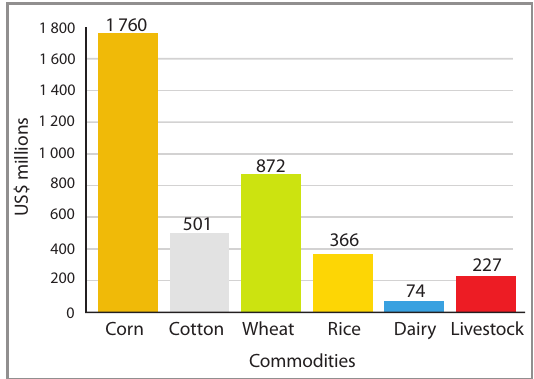
Agricultural subsidies are particularly common in developed countries like the United States, Europe, and Japan. The scale of this support can be substantial - in 2010, the US government spent $5.9 billion on agricultural subsidies. This amount exceeded the combined GDP of some smaller nations like Lesotho and Swaziland.
Different commodities receive varying levels of subsidy support. Corn receives the highest subsidies, followed by wheat, cotton, rice, livestock, and dairy products. These subsidies help American farmers remain competitive in global markets while keeping domestic prices relatively stable.
Important
Subsidies can create unintended consequences for international trade. In countries where local farmers don't receive government support, subsidized imports may actually become cheaper than locally produced goods, potentially driving local farmers out of business and reducing food security.
The impact extends beyond individual farmers to entire regions. For example, cotton farmers in West Africa have reportedly lost significant income because they cannot compete with subsidized cotton from developed nations. This demonstrates how trade policies in one country can have far-reaching effects on agricultural communities worldwide.
Fair trade
Fair trade represents an alternative approach to international commerce that focuses on supporting producers in developing countries rather than simply seeking the lowest prices. This trading system recognizes the challenges that farmers and workers in less economically developed countries face when trying to access global markets.

Rather than traditional nation-to-nation trade relationships, fair trade creates direct connections between producers and consumers. This approach aims to provide farmers in developing countries with better opportunities to trade competitively while supporting sustainable development in their communities.
Fair trade operates on several key principles that distinguish it from conventional trading relationships:
- Creating opportunities involves directly connecting producers to markets in more economically developed countries, bypassing intermediaries who might reduce farmers' profits
- Fair and stable prices ensure that producers receive compensation that reflects their production costs and includes fair wages
- Social development emphasizes long-term partnerships that allow farmers to reinvest their income into community-building projects
- Gender equality ensures that women receive equal pay for their work and have equal opportunities to participate in farming cooperatives
- Sustainability promotes environmentally responsible production methods that protect natural resources for future generations
Example
Case Study: Rosie Lembusi and Her Coffee Cooperative
Rosie Lembusi's experience illustrates how fair trade can transform individual lives and entire communities. As a 50-year-old mother of six children, Rosie grows high-quality Arabica coffee alongside 100 other farmers in her area.
Before Fair Trade:
- Low and unpredictable income from coffee crop
- Payment was often delayed
- Sometimes buyers would cheat her out of fair compensation
After Joining the Cooperative:
- Now receives 500 shillings per kilogram - significantly more than before
- Guaranteed payment above market price
- Additional community premium of 200 shillings per kilogram
- Training in organic farming methods provided
Personal Impact:
- Can afford school uniforms and books for her children, Irene and Matrin
- Able to make improvements to her home and family life
- Financial stability throughout the year with structured payment system
This case study demonstrates how fair trade creates benefits beyond just higher prices - it provides training, community development, financial stability, and hope for future generations.
Summary
Key Points to Remember:
- Free trade removes barriers between countries, allowing goods and services to move freely and creating economic partnerships worldwide
- Trade barriers (tariffs, quotas, and subsidies) are government tools used to protect domestic industries from foreign competition, but they can also affect consumers and international relationships
- Tariffs make imported goods more expensive through taxation, while quotas limit the actual quantity of imports allowed into a country
- Subsidies support domestic producers financially, helping them compete with imports, but can disadvantage farmers in countries without such support
- Fair trade focuses on ethical relationships that support producers in developing countries through fair prices, sustainable practices, and community development programs