South Africa's Long-Term Energy Needs (Grade 11 NSC Matric Geography): Revision Notes
📚Revision Notes
South Africa's Long-Term Energy Needs
Current energy situation and challenges
South Africa currently has the ability to generate approximately 40,000 MW of electricity. However, the country faced significant energy challenges in 2008 when electricity demand exceeded what could be supplied domestically. This forced South Africa to import power from neighboring countries and implement load-shedding to reduce demand.
Note
The 2008 energy crisis was a turning point for South Africa, highlighting the urgent need for energy infrastructure development and diversification of power sources.
Looking ahead, electricity demand is expected to grow dramatically, potentially doubling to reach 80,000 MW within the next 20 to 30 years. To address this growing need, the government has committed to investing billions of rands in new power stations and energy infrastructure.
South Africa's energy mix in 2011
In 2011, South Africa's electricity generation was heavily dominated by coal, which provided about 90% of the country's power. The remaining 10% came from a combination of nuclear power (5%) and hydroelectric power (5%). At this time, natural gas and renewable energy sources contributed virtually nothing to the national energy mix.
Important
This heavy reliance on coal presented several challenges, including high carbon emissions and environmental concerns. It also made South Africa vulnerable to coal supply disruptions and price fluctuations.
The Integrated Resource Plan (IRP)
To address these challenges and plan for future energy security, the South African government published its comprehensive energy policy in 2011, known as the Integrated Resource Plan (IRP). This strategic document outlines the country's energy development plans through to 2030.
The IRP aims to achieve three main objectives: increase overall electricity production to meet growing demand, reduce carbon gas emissions from power generation, and ensure reliable electricity access for all parts of South Africa.
Future energy plans by source
The government has developed specific expansion plans for different types of energy sources:
Coal power expansion
Eskom, South Africa's main electricity utility, began construction on two major new coal-fired power stations called Medupi and Kusile. Each facility is designed to generate approximately 4,800 MW of electricity. Additionally, Eskom plans to restart three coal power stations that were previously shut down during the 1990s.
Nuclear power development
South Africa is considering the construction of five or six additional nuclear power plants to significantly expand its nuclear energy capacity. This represents a major increase from the current single nuclear facility.
Note
This nuclear expansion represents one of the most ambitious aspects of South Africa's energy transformation, potentially making nuclear power the second-largest electricity source by 2030.
Natural gas integration
Plans include building two gas turbine facilities that will use natural gas as fuel. This will introduce a new energy source to South Africa's electricity generation mix.
Hydroelectric power maintenance
There are currently no plans to expand South Africa's eight existing hydroelectric power plants. However, this position might change in the future as the costs and benefits of different power generation methods are reassessed.
Planned energy mix for 2030
The government's vision for 2030 shows a significantly more diversified energy portfolio compared to 2011.
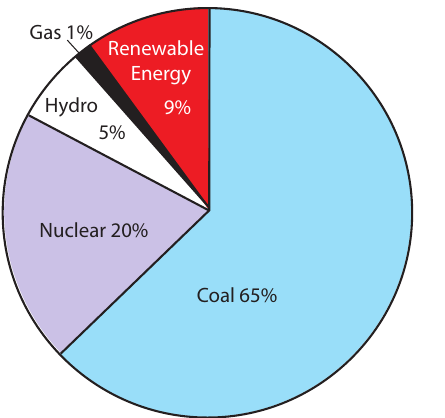
By 2030, coal is planned to decrease from 90% to 65% of total electricity generation, though it will remain the dominant source. Nuclear power is expected to expand dramatically to provide 20% of electricity needs. Renewable energy sources, which were virtually absent in 2011, are projected to contribute 9% of the energy mix. Hydroelectric power will maintain its 5% contribution, while natural gas will provide 1% of electricity generation.
Important
This represents a fundamental shift toward energy diversification, reducing South Africa's heavy dependence on coal while introducing cleaner energy sources and improving energy security.
Key energy statistics
South Africa's electricity system is massive in scale. The country produces approximately 245,000 gigawatt hours of electricity annually. To put this in perspective, one gigawatt is equivalent to 1,000 million watts of electrical power.
Note
This enormous electricity production makes South Africa one of the largest electricity producers on the African continent and supports the country's industrial economy and growing population.
Remember!
Summary
Key Points to Remember:
-
South Africa's electricity demand is expected to double to 80,000 MW by 2030, requiring massive infrastructure investment
-
The country is transitioning from 90% coal dependence in 2011 to a more diverse energy mix with 65% coal by 2030
-
The Integrated Resource Plan (IRP) is the government's roadmap for achieving energy security while reducing emissions
-
Nuclear power will expand significantly from 5% to 20% of the energy mix, making it the second-largest electricity source after coal
-
Renewable energy sources will emerge as a meaningful contributor, growing from virtually nothing to 9% of electricity generation by 2030