World Pressure Patterns (Grade 11 NSC Matric Geography): Revision Notes
📚Revision Notes
World Pressure Patterns
Understanding atmospheric pressure
Atmospheric pressure is the force created by the weight of air pressing down on Earth's surface. Think of it like a heavy blanket of air sitting on top of everything. The higher you go up in the atmosphere, the less air is above you, so the pressure gets lower.
Important
Key concept: Atmospheric pressure is the force per unit area that air exerts on a surface due to the weight of the air column above that surface.
The relationship between altitude and pressure is straightforward:
Note
- At sea level: Higher pressure (more air above pressing down)
- At high altitudes: Lower pressure (less air above pressing down)
- Mountains have lower pressure than coastal areas
This happens because air has weight, and the more air stacked above a point, the greater the pressure at that point.
Why pressure varies horizontally across Earth
Even at the same altitude, atmospheric pressure is not the same everywhere on Earth. There are two main reasons for these horizontal differences in pressure.
Temperature affects pressure
When we compare two columns of air at the same height, temperature makes a big difference:
Warm air:
- Expands and becomes less dense
- Molecules spread out more
- Creates lighter air column
- Results in lower pressure at the surface
Cold air:
- Contracts and becomes more dense
- Molecules pack together tightly
- Creates heavier air column
- Results in higher pressure at the surface
Note
The key principle here is that density changes with temperature. Warmer air is less dense, creating lower pressure zones, while colder air is more dense, creating higher pressure zones.
Vertical air movement affects pressure
The movement of air up and down also changes surface pressure:
Where air rises:
- Air moves upward from the surface
- Less air remains at ground level
- Creates low pressure at the surface
Where air sinks:
- Air moves downward toward the surface
- More air accumulates at ground level
- Creates high pressure at the surface
Global pressure belt patterns
Earth has a organised pattern of high and low pressure areas that form belts running from east to west around the planet. These pressure belts are directly linked to global air circulation patterns and temperature differences between latitudes.
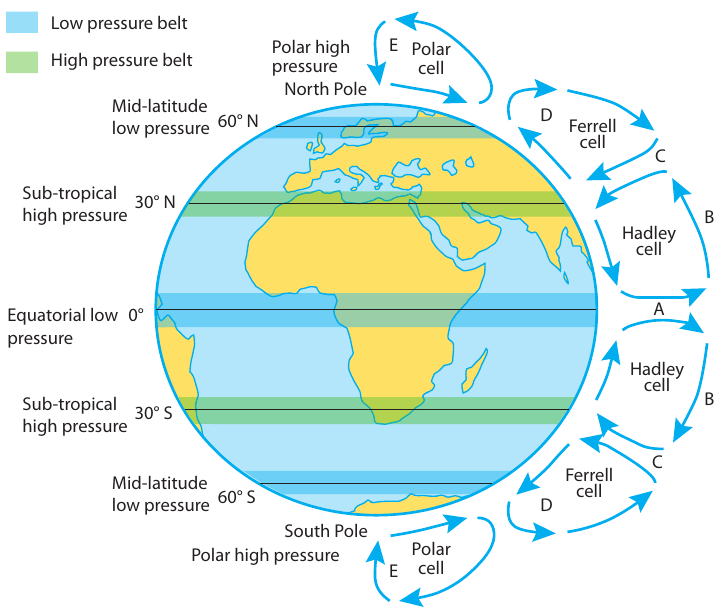
The main pressure belts from north to south are:
Polar high pressure (around 90°N and 90°S)
- Very cold temperatures make air dense and heavy
- Air sinks, creating high pressure
- Associated with Polar cells
Mid-latitude low pressure (around 60°N and 60°S)
- Air rises where warm and cold air masses meet
- Creates low pressure zones
- Part of the Ferrell cell circulation
Subtropical high pressure (around 30°N and 30°S)
- Air sinks in these regions
- Creates high pressure belts
- These are sometimes called the "horse latitudes"
- Associated with Hadley cells
Equatorial low pressure (around 0°)
- Intense heating makes air rise strongly
- Creates a belt of low pressure
- Part of the Hadley cell circulation
Important features of pressure belts
Note
Consistency: These pressure belts exist in both the Northern and Southern Hemispheres, showing the same pattern.
Connection to circulation: Each pressure belt is associated with major atmospheric circulation cells (Hadley, Ferrell, and Polar cells) that move air around the globe.
Seasonal shifts: While the basic pattern stays the same, these belts can shift slightly north and south with the seasons as the Sun's direct rays move.
Weather influence: These pressure belts strongly influence global weather patterns, wind systems, and climate zones.
Summary
Key Points to Remember:
- Atmospheric pressure is created by the weight of air pressing down on Earth's surface
- Higher altitudes have lower pressure because there's less air above them
- Temperature differences cause pressure variations - warm air creates low pressure, cold air creates high pressure
- Vertical air movement affects surface pressure - rising air creates low pressure, sinking air creates high pressure
- Global pressure belts form organised east-west patterns linked to major circulation cells and temperature zones