Case Study 2: The Middle East (Grade 11 NSC Matric History): Revision Notes
📚Revision Notes
The Arab-Israeli Conflict
Introduction
When Israel became an independent state in 1948, it triggered a long-running conflict with Arab nations that continues today. This ongoing Arab-Israeli conflict has caused enormous suffering and damage throughout the Middle East. The conflict has the potential to spark a major international war that could affect the entire world.
Note
The Arab-Israeli conflict is one of the longest-running international conflicts of the modern era, spanning over 75 years and involving multiple wars, peace processes, and ongoing tensions that continue to shape Middle Eastern politics today.
The Nakba
The Nakba (“catastrophe” in Arabic) refers to the mass displacement of Palestinians during the 1948 Arab–Israeli War. As the State of Israel was established, more than a million Palestinians were expelled or fled from their homes due to fighting, deliberate expulsions, and fear of massacres such as Deir Yassin.
Over 400 villages were depopulated or destroyed, and most refugees were not allowed to return afterward. The Nakba marks a foundational moment in the Israeli–Palestinian conflict, shaping Palestinian identity, memory, and claims for the right of return.

Living conditions in refugee camps
Conditions in Palestinian refugee camps were absolutely terrible. Most people believed they would only stay there temporarily and would soon be allowed to return to their homes. However, as Israel became more established as a nation, it became clear that the Palestinians would not be returning home anytime soon.
Important
The refugee crisis had lasting consequences that continue to fuel conflict today. The desperate living conditions and lack of hope for return created the perfect conditions for militant groups to emerge and recruit supporters.
Key consequences of the refugee crisis:
- Host countries lacked the resources to properly support the refugees, leading to widespread poverty and suffering
- Some Palestinian families eventually migrated to other countries, but thousands remained trapped in the camps
- The desperate conditions led to the formation of militant armed groups who began launching guerrilla attacks against Israeli targets
Formation of Palestinian resistance groups
The most important resistance group that emerged was Al Fatah, founded in 1958 by Yasser Arafat. Al Fatah's main goal was to establish an independent Palestinian state.
Unfortunately, clashes between different Palestinian groups sometimes threatened the security of the host nations. For example, in 1970, the Jordanian army attacked PLO (Palestine Liberation Organisation) camps in Jordan, killing 30,000 refugees. Many Palestinians then fled to Lebanon, which became the centre of Palestinian resistance.
The war of 1967
After the Suez Crisis, both Israel and the Arab nations began building up their military forces. Israel received support from the USA, whilst Arab countries were backed by the Soviet Union.
Build-up to war
Tensions reached a breaking point when:
- President Nasser of Egypt spoke about going to war with Israel to destroy the "Zionist state"
- The US 6th Naval Fleet patrolled the Eastern Mediterranean to protect conservative Arab kingdoms and Israel
- In 1967, Egypt, Jordan, Syria and Iraq signed a military alliance and began building up forces along Israel's borders
- Al Fatah attacks increased significantly
The Israelis became convinced that this military build-up was a sign that the Arab nations were planning to invade. Therefore, they decided to attack first.
The Six-Day War
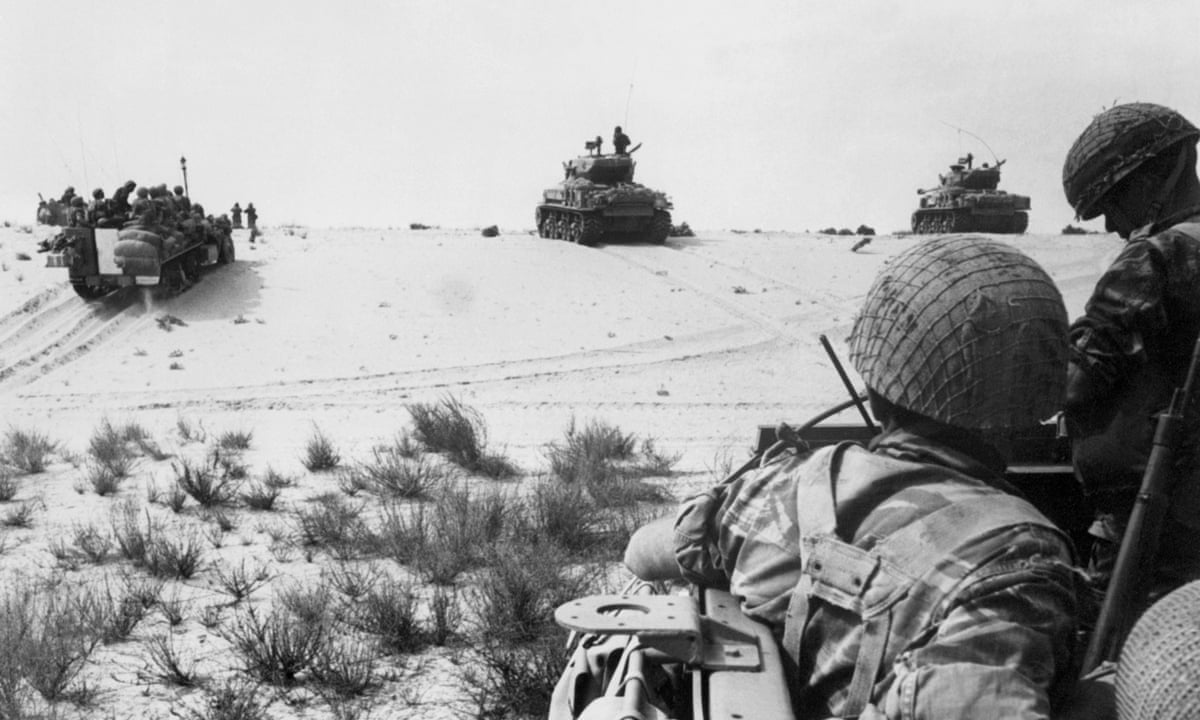
On 5 June 1967, Israel launched a surprise air attack against Egypt, Jordan and Syria. This devastating attack destroyed the air forces of all three countries - Egypt alone lost 286 of its 340 warplanes. Without air support, the Arab armies were extremely vulnerable.
Outcome of the war of 1967
In just six days, the Israeli army had completely defeated the Arab armed forces and occupied significant Arab territories:
- Golan Heights (from Syria)
- West Bank of the Jordan River (from Jordan)
- Gaza Strip (from Egypt)
- Entire Sinai Peninsula (from Egypt)
This victory greatly increased the territory under Israeli control. Israeli leaders felt confident with US support, but they refused to return the occupied lands. This made Arab anger even worse, and when Israel refused to return the conquered territories, many newly independent countries supported the Arab cause.
UN Resolution 242
The United Nations passed Resolution 242, which demanded that:
- Israel should return all occupied territories
- In return, Arab states should recognise Israel's right to exist
Note
UN Resolution 242 became the foundation for many future peace negotiations, as it established the principle of "land for peace" - the idea that Israel should withdraw from occupied territories in exchange for recognition and peace from Arab states.
Israel supported this resolution, but only if the Arabs recognised Israel first. However, the Arab countries and many UN member states insisted on an unconditional Israeli withdrawal.
Impact on Palestinian refugees
The 1967 war made the refugee situation even worse. Palestinian refugee camps in Jordan were flooded with 400,000 more refugees, making conditions even more desperate.
As a result, the PLO and al-Fatah turned to more extreme terrorist methods, including:
- Hijacking aircraft
- Attacking ordinary Jewish civilians
- Assassinating Israeli athletes at the Olympic Games
An uneasy truce followed the end of the 1967 war, but the conflict was far from over.
Yom Kippur war of 1973

After the 1967 defeat, Egypt and Syria worked to acquire more advanced weapons and rebuilt their air forces.
The surprise attack
On 6 October 1973, during the Jewish religious holiday of Yom Kippur, Egypt and Syria launched a coordinated surprise attack:
- Egyptian troops re-occupied the Sinai Peninsula
- Syrian troops re-occupied the Golan Heights
Outcome of Yom Kippur war of 1973
After three weeks of intense fighting using high-tech missiles, and with help from the US army and air force, the Israelis managed to push back the invading forces.
Important
The Yom Kippur War marked a turning point in the conflict. Despite Israel's eventual military success, the war showed that Arab forces had become much more capable and that Israel was not invincible. The high costs of modern warfare made both sides more willing to consider negotiated solutions.
Consequences of the war:
- Israel suffered heavy losses
- Arab oil-producing countries threatened to cut off oil supplies to countries that supported Israel
- The USA and UN quickly organised a ceasefire
This was the last full-scale war between Israel and its Arab neighbours. The cost of another war on this scale was now too high for both sides to bear.
Intifada
The years 1967-1987 were extremely tense and difficult. Israel had occupied the remaining parts of Palestine, including large Arab populations living in the occupied territories of the West Bank, Gaza and the Golan Heights.
Israeli policies in occupied territories
Initially, Israeli rule in the occupied areas brought some benefits, such as:
- Access to jobs for Palestinians
- A university was built
However, this policy ended after the Yom Kippur war, and Israeli rule became deeply resented by Palestinians because:
- The Israeli government started confiscating Palestinian land and building Jewish settlements to ensure they would never have to return the land
- Water supplies were diverted to the new Israeli settlements
- Palestinian Arabs were restricted to their own communities, surrounded by fences and military checkpoints where they were humiliated every time they moved
- There was little development in Palestinian areas
- Unemployment and suffering in Palestinian towns and villages increased dramatically
The first Intifada begins
In December 1987, the frustration of Palestinians in the occupied areas exploded into an uprising known as the first Intifada.

Note
The word "Intifada" comes from Arabic and means "shaking off" or "uprising." It represented a fundamental shift in Palestinian resistance from external military attacks by armed groups to popular, grassroots resistance by ordinary Palestinians living under occupation.
How it started: An Israeli soldier drove his vehicle into a Palestinian car, killing the occupants. This incident sparked the first Intifada.
Characteristics of the uprising:
- Within weeks, popular protests broke out in all occupied areas
- Youth, women and children fought with stones and bottles against Israeli guns
- Images of this violence embarrassed Israel, so soldiers were issued with batons instead
- Brutal beatings took place, resulting in thousands suffering broken bones and even death
Evolution of the Intifada
Soon the Intifada developed into a more organised and revolutionary movement:
- Hundreds of "popular committees" were set up as an alternative government in occupied areas
- Palestinians boycotted Israeli taxes and shops
- They stopped working in Israeli businesses
- Some made contact with al-Fatah and other revolutionary groups for military training and weapons
- New armed groups emerged, such as Hamas (the armed wing of the Muslim Brotherhood in Palestine)
- Armed attacks took place against Israeli soldiers and settlers
- Israel responded with harsh suppression
Results of the first Intifada
By 1993, the first Intifada had come to an end. The conflict had been extremely costly:
- Israeli forces killed an estimated 1,100 Palestinians
- Palestinians killed 164 Israelis
- Palestinians also killed an estimated 1,000 other Palestinians as alleged collaborators
Impact of the Intifada:
- Palestinian confidence and pride in their own efforts increased significantly
- They were no longer dependent on neighbouring Arab states for support
- International condemnation of Israeli brutality put new pressure on Israel to reach a peace settlement
- There was a new opportunity and urgency on both sides to explore dialogue
Peace processes to 2000
In 1979, Israel and Egypt signed a peace treaty known as the Camp David Accords. This important treaty contained two key agreements:
- Egypt agreed to recognise the state of Israel, and the Sinai Peninsula was returned to Egypt
- A political settlement of the Palestinian issue based on an autonomous Palestinian State alongside Israel in Palestine
However, the PLO and its allies rejected this agreement completely. But divisions began to emerge in both Israel and the PLO between:
- Those who wanted to continue with violence
- Those who were prepared to make sacrifices to try to bring about peace
The Intifada disrupted the peace process initially, but after it ended, leaders on both sides saw the possibility for negotiation:
- 1988: The PLO recognised Israel's right to exist
- 1993: After years of delicate negotiation, PLO and Israeli leaders met in Oslo, Sweden to sign the Oslo Accords
The Oslo Accords
The Oslo Accords created a framework for future relations between Israelis and Palestinians:
Note
The Oslo Accords were groundbreaking because they represented the first time that Israeli and Palestinian leaders officially recognised each other and committed to peaceful coexistence. The famous handshake between Israeli Prime Minister Yitzhak Rabin and PLO Chairman Yasser Arafat on the White House lawn symbolised hope for a new era of peace.
Key provisions:
- Agreement on the creation of a Palestinian National Authority (PNA) to govern parts of the West Bank and Gaza Strip
- The Israeli army would withdraw from these areas
- The PNA would be responsible for administering these areas
- The accords anticipated this would be a temporary arrangement lasting about five years, during which the really difficult issues could be resolved
After the Oslo Accords
Unfortunately, all negotiations since the Oslo Accords have failed to achieve lasting peace.
Important
The failure of the peace process after Oslo shows how difficult it is to resolve deep-rooted conflicts. Both sides have become more hardline over time, making compromise increasingly difficult. Understanding why peace efforts fail is as important as understanding the conflicts themselves.
Reasons for failure:
- In Israel, a frightened and polarised population has continued to elect right-wing, nationalist governments, many of which reject major concessions to the Palestinians.
- These governments have demanded terms—particularly on borders, settlements, refugees and security—that Palestinian leaders could not accept without losing legitimacy.
- Palestinian nationalism has also hardened, influenced by continued settlement expansion, restrictions on movement, and repeated military escalations.
- Since 2000, the Second Intifada marked a decisive collapse in trust, followed by repeated cycles of violence in Gaza and the West Bank.
- The growth of Israeli settlements, which now number over 700 000 settlers across East Jerusalem and the West Bank, has further undermined the viability of a two-state solution.
- Palestinian political divisions—especially between Fatah in the West Bank and Hamas in Gaza—have weakened unified negotiation positions.
- Episodes of major conflict (2008–09, 2012, 2014, 2021) have caused severe destruction in Gaza and reinforced distrust on both sides.
Current situation:
Since October 2023, the region has witnessed one of the deadliest phases of the conflict. Israel’s military assault on Gaza—launched after the Hamas attacks of 7 October—has resulted in tens of thousands of Palestinian deaths, massive displacement, and the destruction of large parts of the territory.
Many international organisations, human-rights groups, UN officials, and several states have described Israel’s actions as a genocide or have raised concerns about genocidal intent. Israel strongly rejects these accusations, stating that its actions target Hamas, not civilians.
Meanwhile, violence and displacement have also escalated in the West Bank, and regional tensions involving Lebanon, Yemen, Syria and Iran have intensified.
Amid these developments, there is no peaceful solution in sight. Negotiations are frozen, mutual distrust is at its highest point in decades, and the humanitarian crisis continues to deepen.
Summary
Key Points to Remember:
- The 1948 Arab-Israeli War and the Nakba created over one million Palestinian refugees living in terrible conditions, leading to the formation of militant groups like Al Fatah
- The 1967 Six-Day War saw Israel occupy the West Bank, Gaza Strip, Golan Heights and Sinai Peninsula, dramatically expanding Israeli territory
- The 1973 Yom Kippur War was the last full-scale conflict between Israel and Arab states, ending with a ceasefire
- The First Intifada (1987-1993) was a Palestinian uprising characterised by stone-throwing youth against Israeli forces, leading to international pressure for peace talks
- The Oslo Accords (1993) created hope for peace by establishing the Palestinian National Authority, but subsequent negotiations have failed and conflict continues today