Reproduction (Grade 11 NSC Matric Life Sciences): Revision Notes
📚Revision Notes
Reproduction
Evolution of plant reproduction strategies
As plants evolved over millions of years, they developed increasingly sophisticated ways to reproduce that required less dependence on water. This evolutionary progression shows how different plant groups adapted to life on land with varying degrees of success.
Note
The four main plant groups show a clear evolutionary progression in their reproductive strategies: bryophytes → pteridophytes → gymnosperms → angiosperms, with each group becoming more independent of water for reproduction.
Bryophytes - the most water-dependent plants
Bryophytes (such as mosses and liverworts) are the least adapted to surviving in dry conditions. They remain heavily dependent on water for reproduction because of several key limitations:
Important
Bryophytes are the most primitive land plants and still require water for reproduction because their sperm cells must swim to reach the egg cells, just like their aquatic ancestors.
- No protective structures: They lack a cuticle (waxy coating), supporting tissues, and vascular tissues to help them retain water
- Simple body structure: Their plant body forms a thallus, which means they don't have true roots, stems, or leaves like more advanced plants
- Dominant gametophyte generation: The main plant you see is actually the gametophyte (the sexual generation), making reproduction the primary focus
- Dependent sporophyte: The sporophyte generation relies completely on the gametophyte for both food and water
- Swimming sperm: The male gametes are motile and must swim through water to reach the female gamete for fertilisation to occur
Pteridophytes - more advanced but still water-dependent
Pteridophytes (ferns and their relatives) show evolutionary improvements over bryophytes but still need water for fertilisation. Their adaptations allow them to grow larger and survive better on land:
Note
Pteridophytes represent an important evolutionary step forwards with their vascular tissues and protective cuticles, but they haven't completely broken free from water dependence during reproduction.
- Protective cuticle: Their leaves have a waxy cuticle that prevents excessive water loss through desiccation
- Transport system: They possess vascular tissue that efficiently transports food and water throughout the plant
- Independent sporophyte: The sporophyte generation becomes dominant and doesn't depend on the gametophyte for water and nutrients once it matures
Gymnosperms and angiosperms - fully terrestrial plants
Both gymnosperms (cone-bearing plants) and angiosperms (flowering plants) have evolved excellent adaptations for life on land:
- Advanced leaf structure: Leaves with cuticles provide excellent protection against water loss
- Complete vascular system: True roots, stems, and leaves work together as an integrated transport system
- Protected embryos: Embryos are enclosed in seeds that prevent them from drying out
- Pollen grains: These structures protect and transport sperm cells, eliminating the need for water during fertilisation
Types of reproduction in plants
Plants can reproduce through two main strategies, each with distinct advantages and disadvantages.
Asexual reproduction
In asexual reproduction, only one parent plant is needed to create offspring. The process involves mitosis, where a haploid sperm cell fuses with a haploid egg cell to produce a diploid zygote. This zygote then divides through mitosis to form an embryo and eventually a new organism.
Advantages of asexual reproduction:
- Single parent requirement: No need to find a mate, making the process more straightforward
- Speed: Reproduction happens faster since there's no need to locate and coordinate with another plant
- Genetic uniformity: All offspring are genetically identical, so if conditions are favourable, they can outcompete other organisms
- Independence: The process doesn't rely on external factors like pollinators or seed dispersal agents
Disadvantages of asexual reproduction:
Important
The main risk of asexual reproduction is the lack of genetic diversity. If environmental conditions change unfavourably, the entire genetically identical population could be wiped out.
- Lack of genetic variation: Since all offspring are genetically identical, if environmental conditions become unfavourable, the entire population may die
- Inherited weaknesses: Poor characteristics from the parent plant will be passed on to all offspring
- Overcrowding risk: Rapid multiplication through asexual reproduction can lead to competition for resources in the same area
Sexual reproduction
Sexual reproduction involves two parent plants contributing genetic material to create genetically diverse offspring.
Advantages of sexual reproduction:
- Genetic diversity: Offspring are genetically different from their parents and can withstand various environmental conditions
- Selective breeding: Farmers and plant breeders can select organisms with desirable traits and cross-breed them to produce improved varieties
Disadvantages of sexual reproduction:
- Two parents needed: The process requires finding and coordinating between two compatible plants
- External dependencies: Plants that reproduce sexually often rely on pollinating agents (like bees or wind) and dispersal agents to spread their seeds
Flower structure and function
Flowers serve as the reproductive structures in angiosperms, with two primary functions: containing and protecting reproductive organs, and attracting pollinators for successful reproduction.
Note
Flowers are incredibly sophisticated structures that evolved specifically to maximise reproductive success through efficient pollination and seed production.
Understanding flower anatomy
All flower parts are actually modified leaves arranged in circular patterns called whorls around a central point. Each whorl has a specialised function, and there are typically four main whorls:
- Calyx (outermost whorl)
- Corolla (second whorl)
- Androecium (third whorl - male parts)
- Gynoecium (innermost whorl - female parts)
Key flower terminology
| Term | Definition |
|---|---|
| Calyx | The collection of green sepals that protect the flower and its reproductive organs |
| Corolla | All the petals of a flower working together to attract pollinators |
| Receptacle | The thickened part of the stem where all flower organs attach and grow |
| Perianth | The non-reproductive parts (calyx and corolla) that form a protective envelope around the sexual organs |
| Stamen | The male reproductive part consisting of a filament and pollen-producing anthers |
| Pistil | The female reproductive part consisting of stigma, style, and ovary where ovules develop |
| Fruit | The fleshy, often sweet structure that forms around seeds after fertilisation in angiosperms |
Detailed flower structure
In a typical flowering plant, the outermost whorl forms the calyx, made up of green sepals that provide protection. All floral parts attach to a thickened structure called the receptacle. The corolla consists of colourful petals designed to attract pollinators. Together, the calyx and corolla make up the perianth.
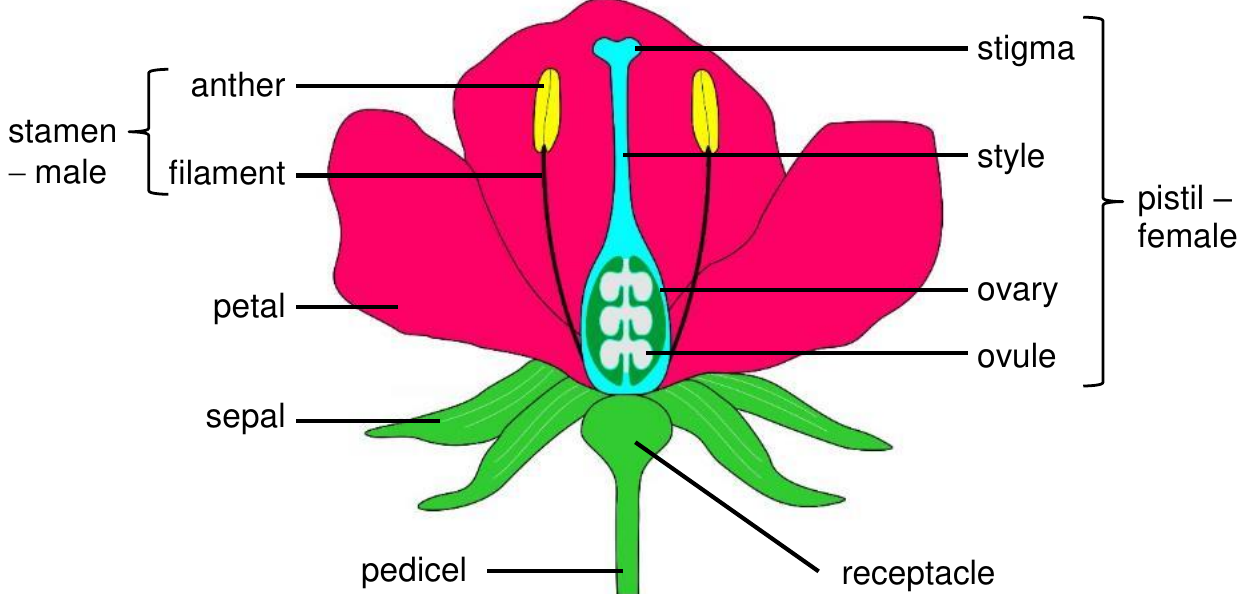
The stamens represent the male reproductive parts of the flower. Each stamen contains a filament (supporting stalk) and a bi-lobed anther containing four pollen sacs or microsporangia. These structures produce pollen grains (microspores) through meiosis, and these pollen grains are haploid.
The female reproductive parts consist of carpels that fuse together to form one or more pistils. Each pistil includes a stigma (receptive surface), style (connecting tube), and ovary (chamber containing ovules). Ovules form inside the ovary through meiosis.
Example
Fertilisation Process in Flowers
Step 1: Pollen grain lands on the stigma
Step 2: Pollen germinates and grows a tube down through the style
Step 3: Male gametes travel through the pollen tube to reach the ovule
Step 4: Fertilisation occurs when male and female gametes fuse
Step 5: Ovule develops into a seed, ovary wall becomes fruit
During reproduction, when a pollen grain lands on the stigma, it germinates and grows down through the style towards the ovule, carrying male gametes to fertilise the ovule. After fertilisation, the ovule develops into a seed while the ovary wall thickens to become fruit. Importantly, fruit generally do not develop without fertilisation occurring first.
Summary
Key Points to Remember:
-
Plant evolution shows decreasing water dependence: From bryophytes (most dependent) → pteridophytes (still dependent) → gymnosperms and angiosperms (fully terrestrial)
-
Asexual reproduction is fast but risky: Only one parent needed and quick reproduction, but all offspring are genetically identical and vulnerable to environmental changes
-
Sexual reproduction creates diversity but requires more resources: Two parents needed and relies on external agents, but produces genetically varied offspring better suited for survival
-
Flowers are complex reproductive structures: Made of four whorls (calyx, corolla, androecium, gynoecium) with specialised male parts (stamens) and female parts (pistils)