Working With Weight (Grade 11 NSC Matric Mathematical Literacy): Revision Notes
📚Revision Notes
Working With Weight
What is Body Mass Index (BMI)?
Body Mass Index (BMI) is a calculated measurement that helps determine whether an adult has a healthy weight for their height. This important health indicator compares a person's weight to their body surface area.
BMI is a crucial tool used by healthcare professionals worldwide to assess health risks associated with weight. It provides a standardized way to evaluate whether someone's weight falls within ranges that are associated with optimal health outcomes.
Note
BMI is measured in units of kg/m², which means "kilograms per square metres". This tells us how much weight is distributed over each square metre of body surface area.
The BMI formula
The mathematical formula for calculating BMI is:
Understanding this formula is essential for accurate BMI calculations. Each component must be in the correct units to ensure reliable results.
Key points about the formula:
- Weight must be measured in kilograms (kg)
- Height must be measured in metres (m)
- Height is squared (multiplied by itself)
- The result is expressed in kg/m²
BMI weight status categories
Once you calculate a BMI value, you can determine the weight status using these standard medical categories established by health organizations:
| BMI range (kg/m²) | Weight status |
|---|---|
| Less than 18.5 | Underweight |
| 18.5 to 24.9 | Normal weight |
| 25 to 30 | Overweight |
| More than 30 | Obese |
Important
Memorize the key boundary values: 18.5, 25, and 30 kg/m². These are the critical thresholds that separate the different weight status categories and are frequently tested in exams.
Worked example: Calculating BMI
Example
Worked Example: Calculating BMI and Determining Weight Status
Problem: An adult has a height of 1.75 m and weighs 82 kg. Calculate their BMI and determine their weight status.
Step 1: Write down the given information
- Height = 1.75 m
- Weight = 82 kg
Step 2: Apply the BMI formula
Step 3: Calculate the height squared
Step 4: Complete the division
(rounded to one decimal place)
Step 5: Determine weight status
Looking at the BMI categories table, 26.8 kg/m² falls in the range "25 to 30", so this adult is classified as overweight.
Using BMI charts as an alternative
Instead of calculating BMI manually, you can use BMI charts to quickly determine weight status. These visual tools eliminate the need for mathematical calculations and are particularly useful in clinical settings.
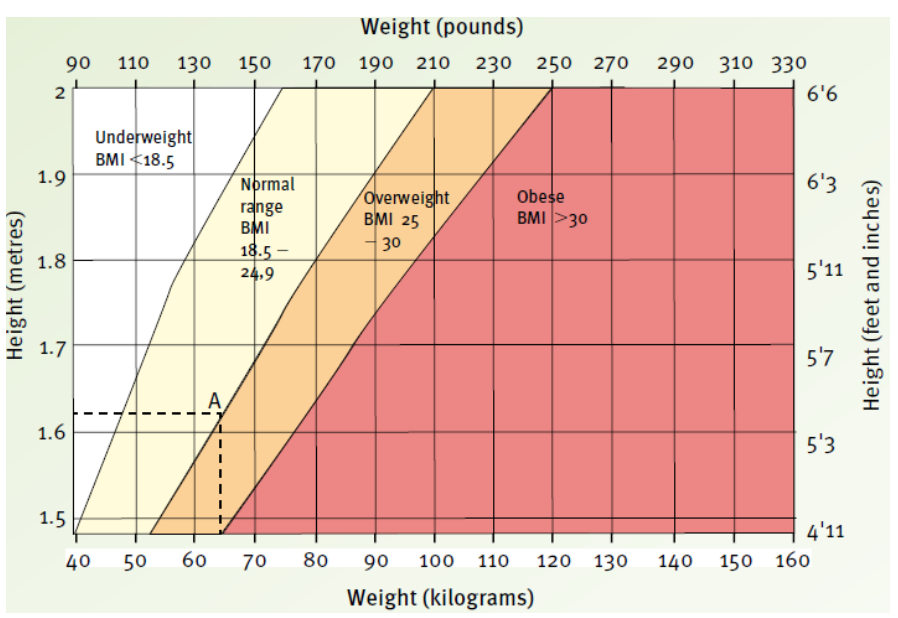
BMI charts are designed to be user-friendly and provide instant visual feedback about weight status. They're especially valuable when you need to assess multiple individuals quickly or when mathematical calculations might be prone to error.
How to use a BMI chart:
- Find your height on the vertical axis (y-axis)
- Find your weight on the horizontal axis (x-axis)
- Locate where these two values intersect
- Check which colour zone the intersection point falls in
- Read the weight status category for that zone
Note
Advantages of BMI charts:
- Quick visual assessment - no calculations needed
- Easy to read - colour-coded zones make interpretation simple
- Practical for healthcare settings - professionals can quickly assess multiple patients
- Reduces calculation errors - eliminates the possibility of mathematical mistakes
Exam preparation strategies
Understanding BMI calculations and interpretations is fundamental for health-related examinations. Success requires both theoretical knowledge and practical application skills.
Important
Essential Exam Tips:
- Always check your units - weight in kg, height in metres
- Remember to square the height - this is a common mistake that can significantly affect your answer
- Round appropriately - BMI is usually given to one decimal place
- Learn the category ranges - especially the boundaries at 18.5, 25, and 30
- Practice reading charts - you may be asked to interpret BMI charts in exams
- Show all working steps - even if using a calculator, demonstrate your method clearly
Summary
Key Points to Remember:
- BMI measures weight relative to height and determines weight status categories
- The formula is: BMI = weight (kg) ÷ [height (m)]²
- Four categories: underweight (<18.5), normal (18.5-24.9), overweight (25-30), obese (>30)
- Units matter - always use kg for weight and metres for height
- BMI charts provide a quick visual alternative to calculations
- Boundary values 18.5, 25, and 30 are critical for determining weight status categories