Quadratic Formula (Grade 11 NSC Matric Mathematics): Revision Notes
📚Revision Notes
Quadratic Formula
What is the quadratic formula?
The quadratic formula is a powerful mathematical tool used to solve any quadratic equation when other methods like factorisation don't work or are too time-consuming. While factorisation and completing the square are useful techniques, they aren't always practical for every quadratic equation. The quadratic formula provides a reliable method that works for all quadratic equations.
Note
The quadratic formula was derived by completing the square on the general quadratic equation. While you don't need to memorize the derivation, understanding that it comes from completing the square helps explain why it always works.
When to use the quadratic formula
You should use the quadratic formula when:
- The quadratic equation cannot be factorised easily
- Completing the square becomes too complex
- You need a quick and reliable method to find exact solutions
- The quadratic equation has non-integer coefficients
Important
Always check if a quadratic can be factorised first, as factorisation is often quicker when possible. However, the quadratic formula is your reliable backup method that works in every situation.
The quadratic formula
For any quadratic equation in standard form where , the solutions are given by:
Where:
- is the coefficient of
- is the coefficient of
- is the constant term
- The symbol means plus or minus, giving us two possible solutions
The discriminant
The expression under the square root, , is called the discriminant. The discriminant tells us about the nature of the roots:
- If : Two distinct real roots exist
- If : One repeated real root exists
- If : No real roots exist (the roots are imaginary)
Important
This is crucial information because it tells us whether our quadratic equation has real solutions before we even calculate them. Always check the discriminant first - it can save you time!
Step-by-step method
Step 1: Check if the equation can be factorised easily
If factorisation is straightforward, use that method first as it's often quicker.
Step 2: Write the equation in standard form
Rearrange the equation so it equals zero:
Step 3: Identify the coefficients
Carefully identify the values of , , and from your equation.
Step 4: Apply the quadratic formula
Substitute the values into
Step 5: Simplify and write the final answer
Calculate the discriminant first, then complete the calculation to find both roots.
Worked example 1: Real roots
Example
Worked Example: Solving with Real Roots
Question: Solve using the quadratic formula.
Solution:
Step 1: Check for factorisation
This equation cannot be factorised easily, so we use the quadratic formula.
Step 2: Write in standard form
Step 3: Identify coefficients
, ,
Step 4: Apply the formula
Step 5: Final answer
The two roots are: or
Worked example 2: No real roots
Example
Worked Example: When No Real Roots Exist
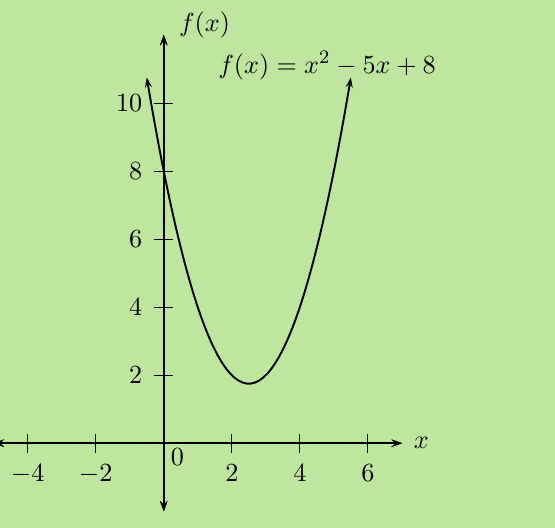
Question: Find the roots of .
Solution:
Step 1: Set the function equal to zero
Step 2: Check for factorisation
This cannot be factorised, so we use the quadratic formula.
Step 3: Identify coefficients
, ,
Step 4: Apply the formula
Step 5: Final answer
Since the discriminant is negative (), there are no real roots. The graph of this quadratic function lies entirely above the x-axis.
Worked example 3: Perfect square
Example
Worked Example: Repeated Root (Perfect Square)
Question: Solve using the quadratic formula.
Solution:
Step 1: Check the equation
Step 2: Identify coefficients
, ,
Step 3: Apply the formula
Step 4: Final answer
There is one repeated root: . This occurs when the discriminant equals zero.
Common exam tips
Note
Exam Success Tips
- Always write the formula down first before substituting values
- Be careful with negative signs, especially when or are negative
- Check your discriminant first - it saves time if there are no real roots
- Simplify your final answers completely, leaving surds in exact form
- Remember that you should get two solutions (or one repeated solution)
- If asked for decimal approximations, use your calculator only at the final step
Summary
Key Points to Remember:
- The quadratic formula works for any quadratic equation:
- The discriminant () determines the nature of roots: positive gives real roots, zero gives one repeated root, negative gives no real roots
- Always rearrange to standard form first:
- Identify coefficients carefully: watch out for negative signs and missing terms
- The formula gives two solutions: use both the plus and minus versions of