Revision (Grade 11 NSC Matric Mathematics): Revision Notes
📚Revision Notes
Revision
Understanding key terminology
When working with equations and inequalities, it's essential to understand the fundamental terms we use.
Note
Essential Definitions for Algebraic Problem Solving
An expression consists of numbers, variables, and mathematical operations like addition, subtraction, multiplication, division, and powers. Examples include or .
An equation makes a mathematical statement that two expressions are equal to each other. We use the equals sign (=) to show this relationship.
An inequality compares two expressions using symbols like >, <, ≥, or ≤ to show which is larger or smaller.
A solution represents the value or set of values that make the original equation or inequality true when substituted.
A root of an equation is specifically the value of where . This means the graph of the function crosses or touches the x-axis at that point.
What are quadratic equations?
A quadratic equation is a second-degree equation where the highest power of the variable is 2. These equations follow the standard form , where , , and are constants and .
Note
Examples of quadratic equations:
Understanding roots through graphs
Quadratic equations can have different numbers of real solutions, which we can see clearly through their graphs. Since quadratic functions create parabola shapes, the number of roots depends on how many times the parabola intersects the x-axis.
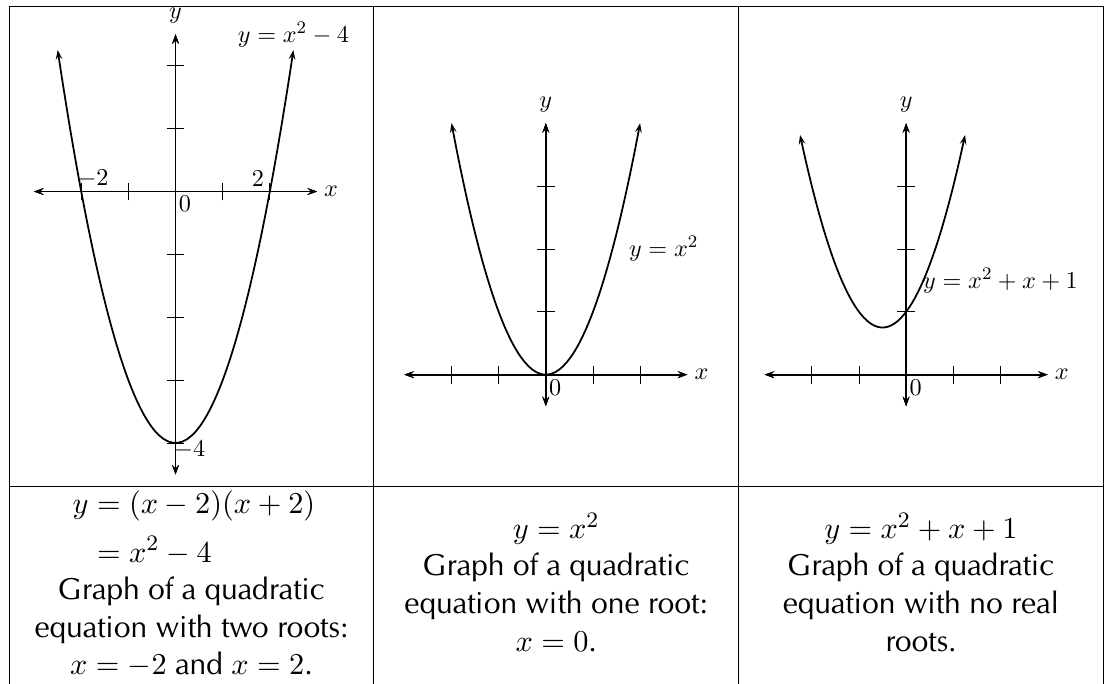
Two real roots: When the parabola crosses the x-axis at two different points, the quadratic equation has two distinct real roots. For example, has roots at and .
One real root: When the parabola just touches the x-axis at exactly one point (the vertex), there is one repeated root. The equation has a single root at .
No real roots: When the parabola lies entirely above or below the x-axis without touching it, there are no real roots. The equation has no real solutions.
The zero product law
The zero product law forms the foundation for solving quadratic equations through factorisation.
Important
Zero Product Law: If two factors multiply to give zero, then at least one of the factors must equal zero.
In mathematical terms: If , then either or (or both).
This principle allows us to solve equations like by setting each factor equal to zero: or , giving us or .
Method for solving quadratic equations by factorisation
Note
Systematic Steps for Factorisation Method:
Step 1: Write the equation in standard form
Step 2: Remove any common factors from all terms to simplify the equation
Step 3: Factorise the expression into the form
Step 4: Apply the zero product law by setting each factor equal to zero:
- , so
- , so
Step 5: Always verify your solutions by substituting both answers back into the original equation
Worked examples
Example
Worked Example 1: Basic factorisation
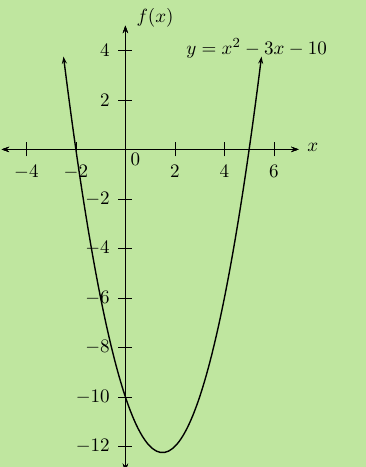
Question: Solve
Solution:
First, expand and rearrange into standard form:
Next, factorise the quadratic expression. We need two numbers that multiply to give -10 and add to give -3. These numbers are -5 and +2.
Apply the zero product law:
- or
- or
Therefore or .
Example
Worked Example 2: Standard form factorisation
Question: Solve
Solution:
The equation is already in standard form with no common factors.
To factorise, we need factors of that add to give -5. These are -8 and +3.
We can write:
Grouping:
Factoring:
Applying the zero product law:
or
or
Therefore or .
Example
Worked Example 3: Difference of squares
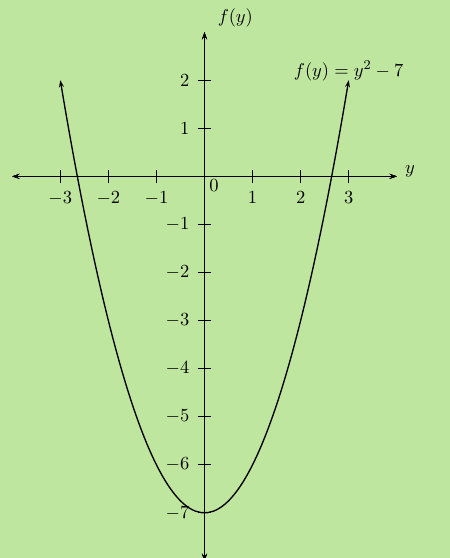
Question: Solve
Solution:
Recognise this as a difference of squares pattern where .
Rewrite as:
Factorise using the difference of squares formula:
Apply the zero product law:
or
or
Therefore .
Example
Worked Example 4: Rational equations
Question: Solve
Solution:
First, identify restrictions. The denominators cannot equal zero, so and .
Find the lowest common denominator:
Multiply each term by the LCD and simplify:
This gives us:
Expanding:
Simplifying:
Rearranging:
Dividing by 2:
Factorising:
Solving: or
or
Both solutions satisfy our restrictions, so or .
Example
Worked Example 5: Equations involving surds
Question: Solve
Solution:
When dealing with equations containing square roots, we must isolate the radical on one side, then square both sides carefully.
Square both sides:
Expanding:
Rearranging:
Factorising:
So or
Important: When squaring both sides, we may introduce invalid solutions, so we must check both answers.
For :
LHS =
RHS = ✓
For :
LHS =
RHS = ✗
Therefore is the only valid solution.
Summary
Key Points to Remember:
- Standard form for quadratic equations is - always rearrange to this format first
- Zero product law states that if two factors multiply to zero, at least one factor must be zero
- Factorisation requires finding two numbers that multiply to give and add to give
- Always check solutionsby substituting back into the original equation, especially when squaring both sides
- Graph understanding helps visualise the number of real roots: two intersections = two roots, one touch = one root, no intersections = no real roots