The Cosine Function (Grade 11 NSC Matric Mathematics): Revision Notes
📚Revision Notes
The Cosine Function
Introduction to the cosine function
The cosine function is one of the fundamental trigonometric functions that creates a smooth, repeating wave pattern. Understanding how to work with cosine functions and their transformations is essential for success in NSC Mathematics.
Note
The basic cosine function shows a characteristic wave shape that starts at its maximum value, decreases to its minimum, then returns to maximum, creating one complete cycle. This distinguishes it from the sine function, which starts at zero.
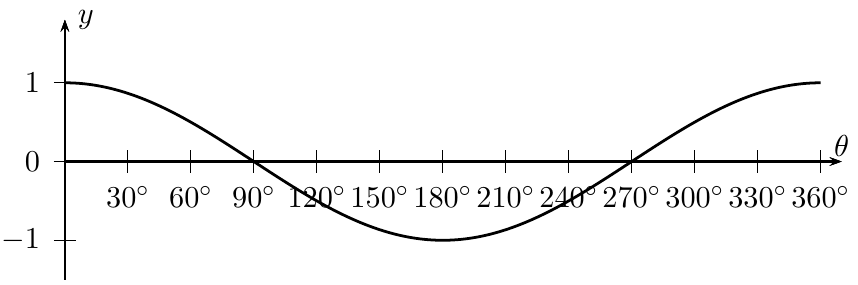
Basic cosine function: y = cos θ
Key properties of y = cos θ
The standard cosine function for the domain has several important characteristics that you must memorise:
Important
Essential Properties of :
- Period: (one complete wave cycle)
- Amplitude: (maximum distance from the centre line)
- Domain: All real numbers (), but often restricted to in problems
- Range: (the function output values are between and )
Important points on the basic cosine graph
Understanding the key points on the cosine graph helps you sketch it accurately and solve problems efficiently:
- y-intercept: - the cosine function starts at its maximum value
- x-intercepts: and - where the curve crosses the horizontal axis
- Maximum turning points: and - the highest points on the curve
- Minimum turning point: - the lowest point on the curve
Vertical transformations: y = a cos θ + q
The general form involves two parameters that transform the basic cosine function vertically.
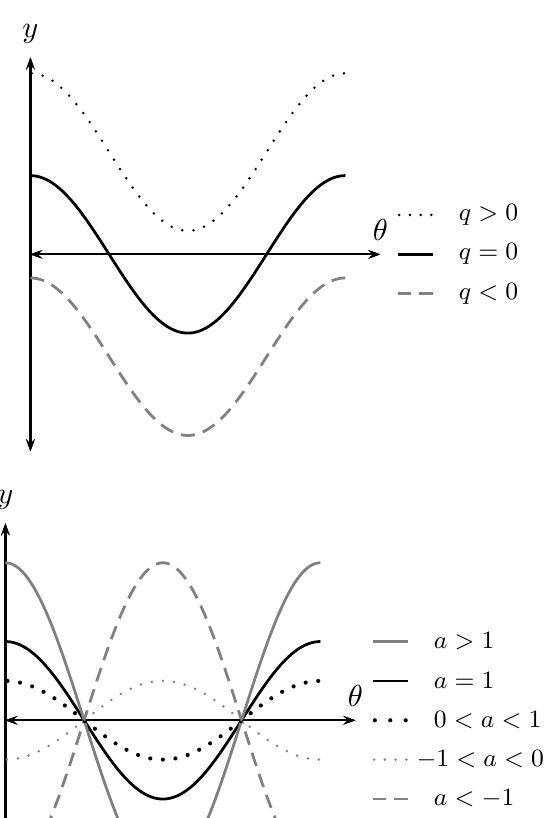
Effect of parameter q (vertical shift)
The parameter q moves the entire graph up or down:
Note
Vertical Shift Effects:
- When : the graph shifts upward by units
- When : the graph shifts downward by units
- The range becomes
Effect of parameter a (amplitude and reflection)
The parameter a affects both the height and orientation of the wave:
For : The amplitude increases, making the wave taller
For : The amplitude decreases, making the wave shorter
For : The graph reflects about the x-axis (flips upside down)
- For : Reflection occurs with decreased amplitude
- For : Reflection occurs with increased amplitude
Important
The amplitude of the transformed function is , and the range becomes .
Period transformations: y = cos(kθ)
When we write the cosine function as , the parameter k affects how often the wave pattern repeats.
Effects of parameter k on the period
For :
- When : the period decreases (wave cycles more frequently)
- When : the period increases (wave cycles less frequently)
For :
- The period still changes according to
- However, , so negative angles don't create reflections
Period formula
Important
Essential Formula:
The period of is calculated using:
This formula is essential for exam questions and must be memorised.

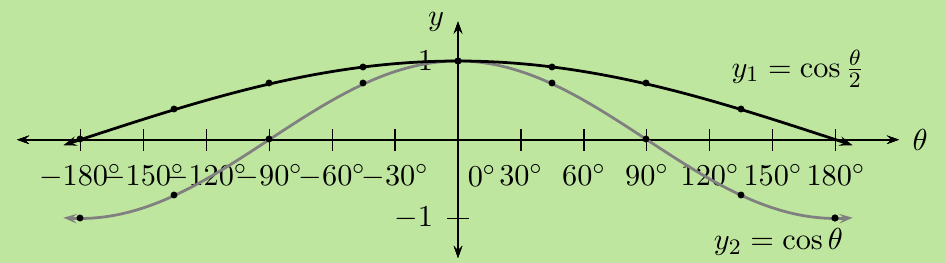
Worked example: comparing y₁ = cos θ and y₂ = cos(θ/2)
Example
Worked Example: Comparing Cosine Functions
Let's compare and systematically:
Step 1: Identify the parameter values
- For :
- For :
Step 2: Calculate the periods
- Period of
- Period of
Step 3: Compare the characteristics
| Property | ||
|---|---|---|
| Period | ||
| Amplitude | ||
| Domain | ||
| Range | ||
| Maximum turning points | ||
| Minimum turning points | none in given domain |
Phase shift transformations: y = cos(θ + p)
The form creates a horizontal shift (also called a phase shift) of the entire cosine graph.
Effect of parameter p
Note
Phase Shift Rules:
- For : The graph shifts to the left by degrees
- For : The graph shifts to the right by degrees
This horizontal movement affects the positions of all key points (intercepts, turning points) but doesn't change the period, amplitude, domain, or range.

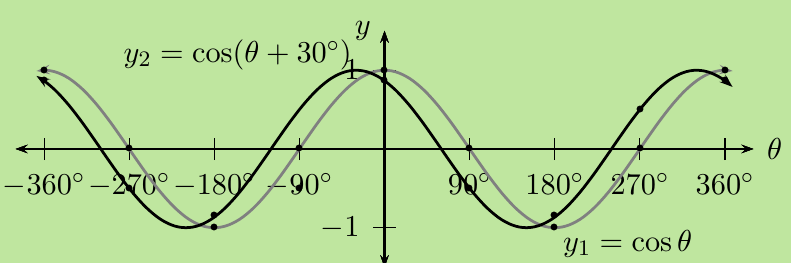
Worked example: comparing y₁ = cos θ and y₂ = cos(θ + 30°)
Example
Worked Example: Phase Shift Comparison
Step 1: Identify the transformation
- has no phase shift ()
- has , so shifts left by
Step 2: Create a table of values
| θ | |||||||||
|---|---|---|---|---|---|---|---|---|---|
Step 3: Compare the graphs
The phase-shifted function maintains the same wave shape but with all points moved to the left.
Worked example: sketching a complex cosine function
Example
Worked Example: Sketching Complex Transformations
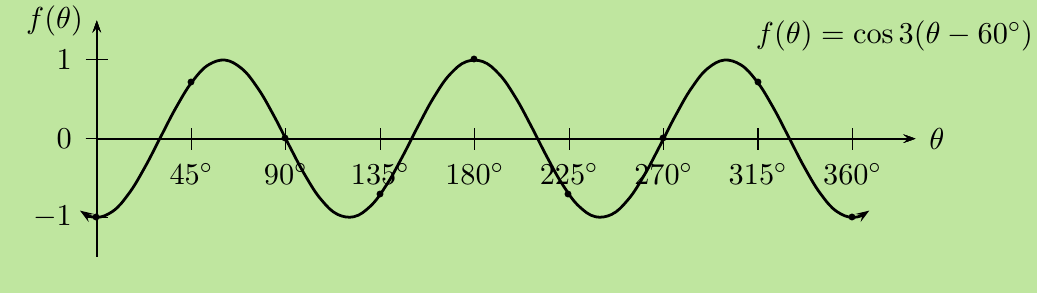
Let's work through sketching step by step.
Question: Sketch the graph of for .
Step 1: Rewrite in standard form
This shows us:
- (affects period)
- The function is shifted right by
Step 2: Calculate key properties
- Period:
- Amplitude:
- Domain:
- Range:
Step 3: Create a table of values
| θ | |||||||||
|---|---|---|---|---|---|---|---|---|---|
Step 4: Plot and sketch
The graph shows three complete cycles within due to the factor of , with the characteristic phase shift.
Finding equations from cosine graphs
Sometimes you'll need to work backwards from a graph to find the equation. Here's a systematic approach that will help you solve these problems efficiently:
Worked example: determining equation parameters
Example
Worked Example: Graph to Equation
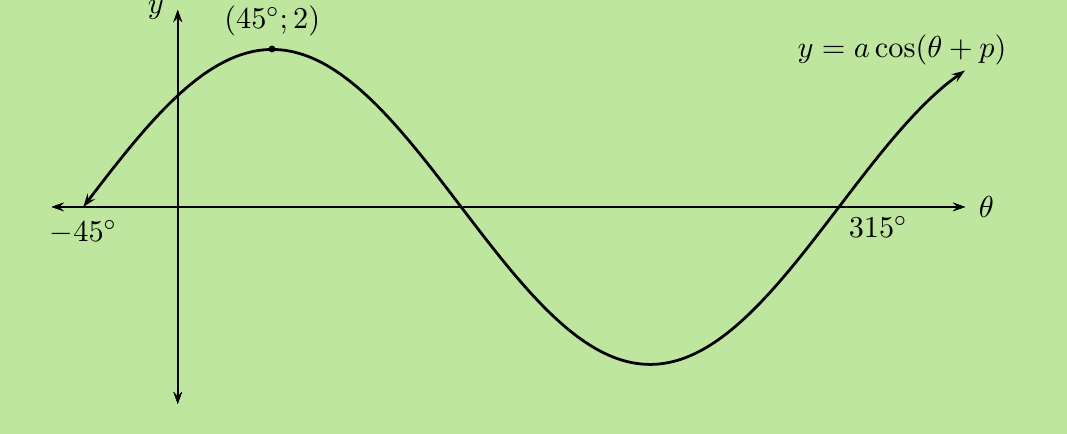
Given a cosine graph, determine the values of , , and for .
Step 1: Find the period to determine Count the horizontal distance for one complete cycle. If the period is , then .
Step 2: Find the amplitude to determine
Measure the vertical distance from the centre line to the maximum. If this distance is , then .
Step 3: Find the phase shift to determine Compare with the standard cosine function. If the maximum occurs at instead of , the graph has shifted right by , so .
Step 4: Write the final equation Combining all parameters:
Key formulas and exam tips
Essential formulas to memorise
Important
Critical Formulas for Exams:
- Period formula: Period
- Basic cosine: has period , amplitude
- General form:
- Even function property:
Exam strategies
When working with cosine functions in exams, follow these systematic approaches:
When sketching graphs:
- Always start by identifying the period using
- Mark the amplitude as units from the centre line
- Apply phase shifts by moving key points horizontally
- Apply vertical shifts by moving the entire graph up or down
When finding equations:
- Determine period first, then calculate
- Find amplitude from the graph's height
- Identify shifts by comparing with standard positions
- Check your answer by substituting key points
Important
Common Exam Traps to Avoid:
- Forgetting absolute value bars in for period calculations
- Confusing left/right shifts with positive/negative values
- Not adjusting the range when amplitude or vertical shifts change
- Mixing up cosine (starts at maximum) with sine (starts at zero)
Remember!
Summary
Key Points to Remember:
-
The basic cosine function has period , amplitude , and starts at its maximum value.
-
The period of is always , where means the absolute value of .
-
Parameter transformations: '' changes amplitude, '' shifts vertically, '' changes period, and '' creates phase shifts.
-
Cosine is an even function, meaning , so the graph is symmetric about the y-axis.
-
Always check your domain and range carefully when transformations are applied, as they often change these fundamental properties.