Chemical Bonds (Grade 11 NSC Matric Physical Sciences): Revision Notes
📚Revision Notes
Chemical Bonds
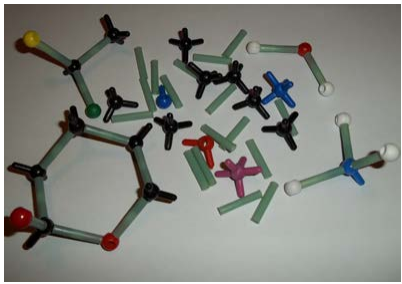
Chemical bonds are the forces that hold atoms together in compounds. Understanding how and why atoms bond is essential for explaining the properties of substances around us. Every material - from the chair you sit on to the air you breathe - exists because atoms can form bonds with each other.
Why do atoms bond?
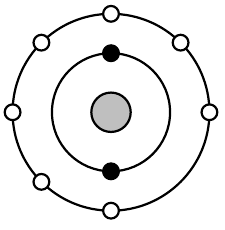
Atoms form bonds because they are trying to achieve the same stable electron arrangement as noble gases. This stability comes from having a full valence electron shell. The model we use to understand bonding is based on the arrangement of electrons in energy levels around the nucleus.
Note
Key principles of bonding:
- Electrons always occupy the lowest possible energy level
- Noble gases have full valence electron shells and are very stable
- Atoms bond to achieve the same electron configuration as noble gases
- Atoms with full valence electron shells are less reactive
The valence electrons are the electrons in the outermost energy level of an atom. These are the electrons involved in chemical bonding.
Energy and bonding
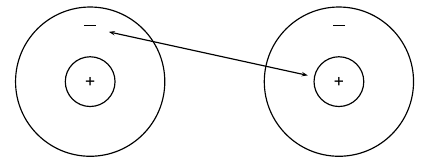
When two atoms approach each other, three important forces operate simultaneously. The balance between these forces determines whether bonding occurs or atoms remain separate.
Important
The three forces are:
- Repulsive force between the electrons of both atoms (like charges repel)
- Attractive force between the nucleus of one atom and electrons of another
- Repulsive force between the two positively-charged nuclei
The outcome of bonding depends on which forces dominate at different distances between atoms.
Case 1: A bond forms
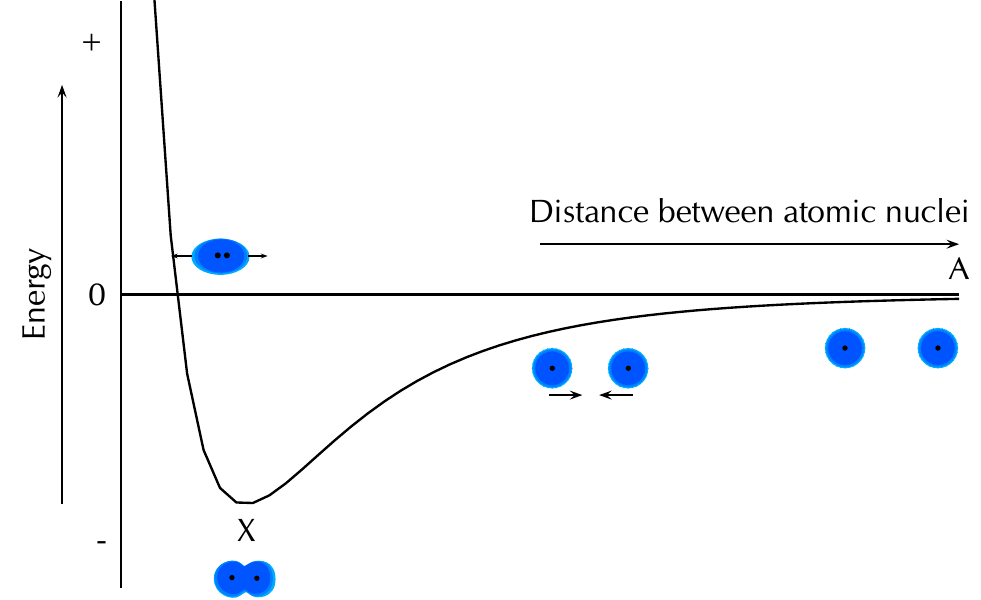
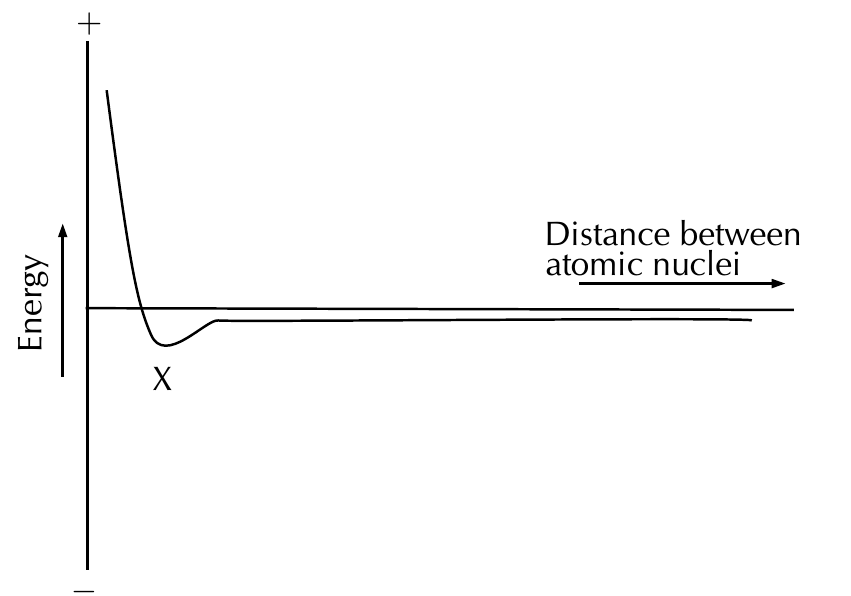
Let's examine what happens when two hydrogen atoms approach each other. The interplay of attractive and repulsive forces determines whether bonding occurs.
Example
Worked Example: Hydrogen Bond Formation
As the atoms move closer together:
- From point A to point X: Attractive forces dominate, energy decreases
- At point X: Forces are balanced, energy is at minimum - this is the bond length
- Left of point X: Repulsive forces dominate, energy increases sharply
Result: Bond formation occurs when the energy minimum (point X) is low enough to keep the atoms together. For hydrogen, this energy minimum allows the formation of molecules where each hydrogen atom achieves a full outer shell through electron sharing.
Case 2: A bond does not form
Helium atoms provide an example where bonding does not occur. Each helium atom already has a filled outer energy level.
Example
Worked Example: Helium - No Bond Formation
For helium atoms:
- The energy minimum is very close to zero
- The atoms can approach and separate easily
- No stable bond forms because helium already has a complete outer shell
- This is why helium exists as single atoms (), not molecules
Valence electrons and Lewis diagrams
Lewis diagrams use dots or crosses to represent valence electrons around element symbols. These diagrams help us predict how atoms will bond.
| Element | Group number | Valence electrons | Lewis diagram |
|---|---|---|---|
| Lithium | 1 | 1 | Li• |
| Beryllium | 2 | 2 | Be•• |
| Boron | 13 | 3 | •B• |
| Carbon | 14 | 4 | •C•• |
| Nitrogen | 15 | 5 | •N•• |
| Oxygen | 16 | 6 | •O•• |
| Fluorine | 17 | 7 | •F••• |
| Neon | 18 | 8 | ••Ne•• |
Note
Tips for drawing Lewis diagrams:
- Use the element symbol as the centre
- Place dots around the symbol to represent valence electrons
- The position of dots doesn't matter (top, bottom, left, right)
- Count valence electrons from the group number
Covalent bonds and bond formation
Important
Covalent bond: A chemical bond formed when pairs of electrons are shared between atoms.
Covalent bonding occurs when atoms share electrons to fill their outer energy shells. The shared electrons create an attractive force that holds the atoms together.
Simple molecules with single bonds
Understanding how atoms share electrons to form single covalent bonds is fundamental to chemistry. Let's work through some key examples step by step.
Example
Worked Example: Hydrogen chloride (HCl)
Step 1: Determine valence electrons
- Hydrogen: 1 valence electron (H•)
- Chlorine: 7 valence electrons (•Cl••••)
Step 2: Arrange electrons to fill outer shells
The shared pair between hydrogen and chlorine forms a covalent bond:
H•Cl•••• → H:Cl•••
Each atom now has a full outer shell through sharing.
Example
Worked Example: Methane (CH₄)
Step 1: Determine valence electrons
- Carbon: 4 valence electrons
- Each hydrogen: 1 valence electron
Step 2: Arrange electrons
Carbon forms four single bonds with four hydrogen atoms:
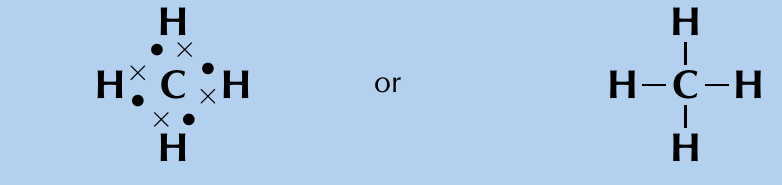
Each hydrogen shares one electron with carbon, giving carbon a complete outer shell of 8 electrons.
Molecules with lone pairs
Some atoms have electron pairs that are not involved in bonding. These are called lone pairs.
Note
Lone pair: An unshared electron pair that belongs to a specific atom.
Example
Worked Example: Water (H₂O)
Step 1: Determine valence electrons
- Oxygen: 6 valence electrons
- Each hydrogen: 1 valence electron
Step 2: Arrange electrons
H:O:H with two lone pairs on oxygen
Oxygen forms two bonds with hydrogen atoms but keeps two lone pairs that don't participate in bonding.
Multiple bonds
Atoms can share more than one pair of electrons, forming double bonds or triple bonds. This allows atoms to achieve stable electron configurations when single bonds aren't sufficient.
Example
Worked Example: Oxygen molecule (O₂)
Step 1: Each oxygen has 6 valence electrons
Step 2: To complete their outer shells, they share two pairs of electrons
O=O (double bond)
Example
Worked Example: Hydrogen cyanide (HCN)
Step 1: Valence electrons
- Hydrogen: 1
- Carbon: 4
- Nitrogen: 5
Step 2: Arrangement
H-C≡N (triple bond between carbon and nitrogen)
Note
Bond strength increases with the number of shared pairs:
- Single bond (one shared pair): weakest
- Double bond (two shared pairs): stronger
- Triple bond (three shared pairs): strongest
Dative covalent bonds
Important
Dative covalent bond: A covalent bond where both electrons in the shared pair come from the same atom.
This occurs when:
- One atom has a lone pair of electrons
- Another atom needs electrons but has none to share
Example
Worked Example: Ammonium ion (NH₄⁺)
When ammonia () bonds with a hydrogen ion ():
- The hydrogen ion has no electrons
- Nitrogen in ammonia has a lone pair
- The lone pair forms a dative bond with
In structural formulas, dative bonds are often shown without a line, or with an arrow pointing from the donor atom.
Summary
Key Points to Remember:
-
Atoms bond to achieve stable electron configurations like noble gases by sharing electrons in covalent bonds.
-
Three forces affect bonding: electron-electron repulsion, nucleus-electron attraction, and nucleus-nucleus repulsion. Bond formation occurs when attractive forces create an energy minimum.
-
Lewis diagrams use dots to show valence electrons and help predict bonding patterns. The number of valence electrons equals the group number for main group elements.
-
Covalent bonds involve electron sharing and can be single, double, or triple bonds depending on how many electron pairs are shared between atoms.
-
Lone pairs are unshared electron pairs that remain on individual atoms, while dative bonds form when one atom provides both electrons for the shared pair.