Acid–Base Reactions (Grade 11 NSC Matric Physical Sciences): Revision Notes
📚Revision Notes
Acid–Base Reactions
What are acid-base reactions?
Acid-base reactions occur when an acid reacts with a base. These reactions are also called neutralisation reactions because the acid and base neutralise each other's properties. When an acid and base react together, they typically form a salt and water.
Important
Important definition: A salt in chemistry is not just table salt! A salt is any compound formed when an acid reacts with a base. It consists of the positive ion (cation) from the base and the negative ion (anion) from the acid.
Conjugate acid-base pairs
When acids and bases react, they form conjugate acid-base pairs. These are pairs of compounds that are related by the transfer of a proton (H⁺ ion). In any acid-base reaction, you can identify these pairs by looking at which species donate and accept protons.
For example, in the reaction:
- and form one conjugate pair
- and form another conjugate pair
Types of acid-base reactions
There are three main types of acid-base reactions, depending on what type of base is used. In each case, the products formed follow predictable patterns.
Acid + metal hydroxide
When an acid reacts with a metal hydroxide, the products are always a salt and water.
Example
Worked Examples: Acid + Metal Hydroxide Reactions
-
Hydrochloric acid + sodium hydroxide → sodium chloride + water
-
Hydrogen bromide + potassium hydroxide → potassium bromide + water
-
Hydrochloric acid + ammonia → ammonium chloride
General equation:
Where is the group number of the metal and represents the metal.
Note
Key point: Notice that bases containing ions always produce water as a product. Even ammonia () acts as a base, though it doesn't contain ions directly.
Acid + metal oxide
When an acid reacts with a metal oxide, the products are also a salt and water.
Example
Worked Examples: Acid + Metal Oxide Reactions
-
Hydrochloric acid + sodium oxide → sodium chloride + water
-
Hydrogen bromide + magnesium oxide → magnesium bromide + water
General equation:
Where is the group number of the metal, and and represent the ratio in which the metal combines with oxygen based on the metal's valency.
Acid + metal carbonate
When an acid reacts with a metal carbonate, the products are a salt, carbon dioxide gas, and water.
Example
Worked Examples: Acid + Metal Carbonate Reactions
-
Nitric acid + sodium carbonate → sodium nitrate + carbon dioxide + water
-
Sulfuric acid + calcium carbonate → calcium sulfate + carbon dioxide + water
-
Hydrochloric acid + calcium carbonate → calcium chloride + carbon dioxide + water
Note
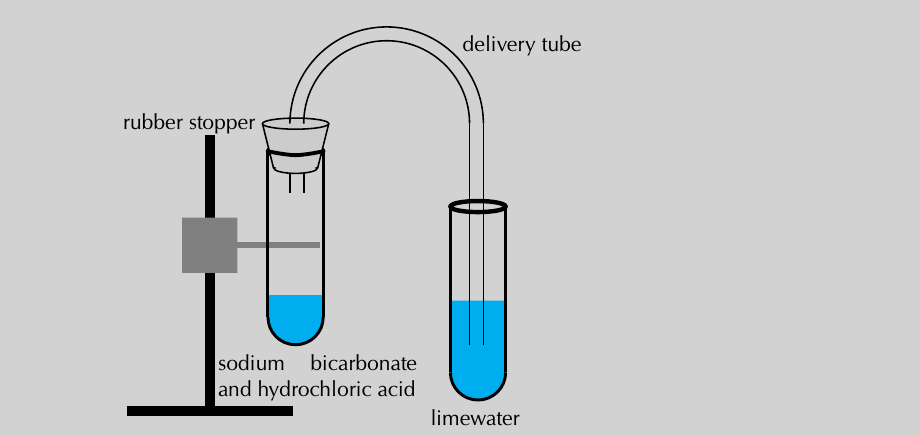
Key observation: The carbon dioxide gas produced causes the limewater to turn milky, which is a reliable test for CO₂.
Practical applications of acid-base reactions
Acid-base reactions have numerous practical applications in our daily lives, from agriculture to medicine to environmental protection.
Domestic uses
- Soil treatment: Calcium oxide (lime) is spread on acidic soil to neutralise excess acidity, making soil more suitable for plant growth
- Limestone in agriculture: Used in pit latrines and farming to neutralise acidic waste and improve soil quality
Biological uses
- Stomach problems: When there's too much hydrochloric acid in the stomach, antacids (which are bases) are taken to neutralise the excess acid
- Common antacids: Aluminium hydroxide, magnesium hydroxide ("milk of magnesia"), and sodium bicarbonate ("bicarbonate of soda")
- Bee stings: These are acidic and can be soothed using basic substances like bicarbonate of soda
Industrial uses
- Pollution control: Calcium hydroxide (limewater) is used to absorb harmful acidic gas released from power stations and fossil fuel burning
Laboratory investigations
General experiment: acid-base reactions
Example
Worked Example: Investigating Acid-Base Reactions
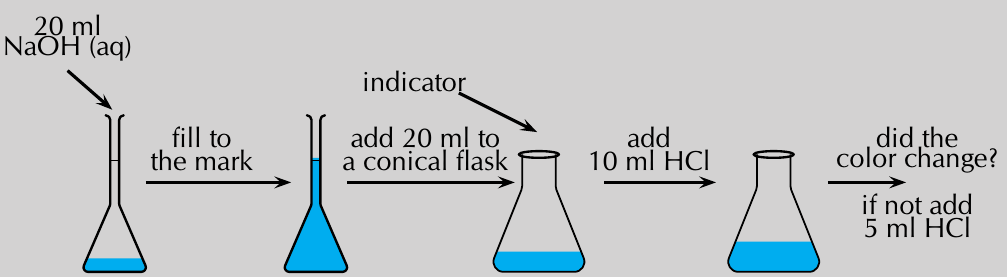
Aim: To investigate acid-base reactions using indicators
Method:
- Add 20 ml of sodium hydroxide solution to a volumetric flask and fill to the mark with water
- Transfer 20 ml of this solution to a conical flask and add a few drops of indicator
- Slowly add 10 ml of hydrochloric acid
- If no colour change occurs, continue adding 5 ml portions of acid until the colour changes
Observation: The solution changes colour when the acid has neutralised the base, showing that neutralisation has occurred.
Using natural indicators
Many household substances can act as indicators - chemicals that change colour depending on whether they're in acidic or basic conditions.
Natural indicators include:
- Red cabbage
- Beetroot
- Berries
- Curry powder
- Tea
- Red grapes
- Onions (by smell)
- Vanilla essence (by smell)
- Baking powder
Note
Key observation: Some substances change colour in acids or bases, while others (like onions and vanilla essence) lose their characteristic smell when mixed with acids or bases. These are called olfactory indicators.
Testing for carbon dioxide
When acids react with carbonates, carbon dioxide gas is produced. This can be tested using limewater:
Method:
- Set up apparatus with delivery tube connecting the reaction vessel to limewater
- Add acid to metal carbonate
- Observe the limewater - it turns milky when is present
Important
Safety note: Always wear safety glasses and work in a well-ventilated room when working with acids.
Exam tips and common mistakes
Important
- Remember: Not all neutralisation reactions produce water - when acids react with carbonates, is also produced
- Balancing equations: Pay careful attention to the charges on ions when writing chemical equations
- Salt identification: The salt formed always contains the metal from the base and the non-metal from the acid
- Indicator colour changes: Learn which direction indicators change colour (acid to base or base to acid)
Summary
Key Points to Remember:
- Neutralisation reactions occur when acids react with bases, typically producing salts and water
- Three main types: acid + metal hydroxide, acid + metal oxide, acid + metal carbonate
- Metal carbonate reactions are special because they produce carbon dioxide gas in addition to salt and water
- Indicators help us detect when neutralisation is complete by changing colour
- Real-world applications include treating stomach acidity, improving soil quality, and reducing industrial pollution