Electric Field (Grade 11 NSC Matric Physical Sciences): Revision Notes
📚Revision Notes
Electric Field
What is an electric field?
When we think about how electric charges interact with each other, we might wonder how a charge can exert a force on another charge even when they're not touching. The answer lies in understanding electric fields.
An electric field is a region of space around a charge where other electric charges will experience a force. Think of it as an invisible influence that extends outward from every charged object. If you place a charged particle anywhere in this region, it will feel a push or pull, even though nothing appears to be directly touching it.
The direction of an electric field at any point tells us which way a positive test charge would move if we placed it there. This is important because we always use a positive test charge as our reference point when defining field direction.
Important
DEFINITION: Electric field
A region of space in which an electric charge will experience a force. The direction of the field at a point in space is the direction in which a positive test charge would move if placed at that point.
Representing electric fields with field lines
Just like we use magnetic field lines to show magnetic fields, we can represent electric fields using electric field lines. These lines help us visualise both the direction and strength of electric fields around charged objects.
Electric field around a positive charge
When we have a positive charge, the electric field lines point radially outward in all directions. This makes sense because a positive test charge placed anywhere around a positive source charge would be repelled (pushed away).
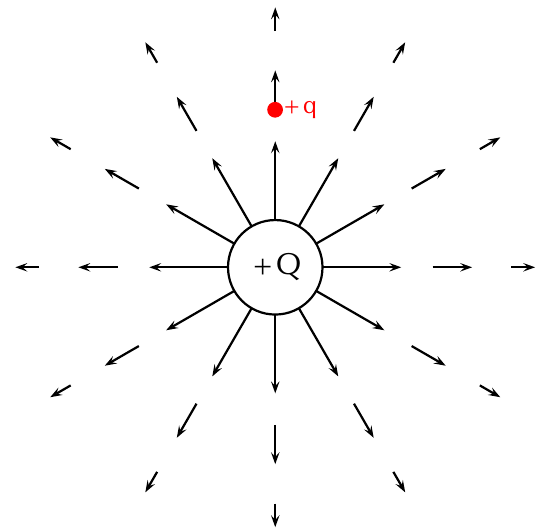
At every point around the positive charge, a positive test charge experiences a repulsive force pushing it away. The arrows represent the direction of force that the test charge would experience at each location. Notice how Coulomb's law applies here - the force gets weaker as the distance increases, which is why the arrows get shorter further away from the charge.
Electric field around a negative charge
For a negative charge, the situation is different. The electric field lines point radially inward toward the charge. This is because a positive test charge would be attracted to (pulled toward) the negative source charge.
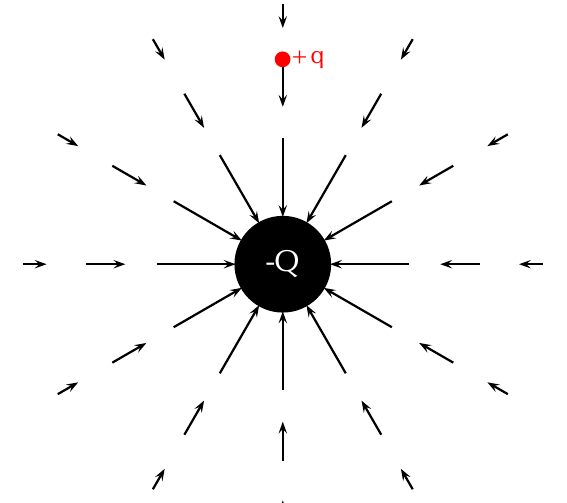
The pattern looks almost identical to the positive charge case, but with one crucial difference - all the arrows point in the opposite direction. The field lines converge on the negative charge instead of diverging from it.
Summary of field patterns for isolated charges
Let's compare these two fundamental patterns side by side:
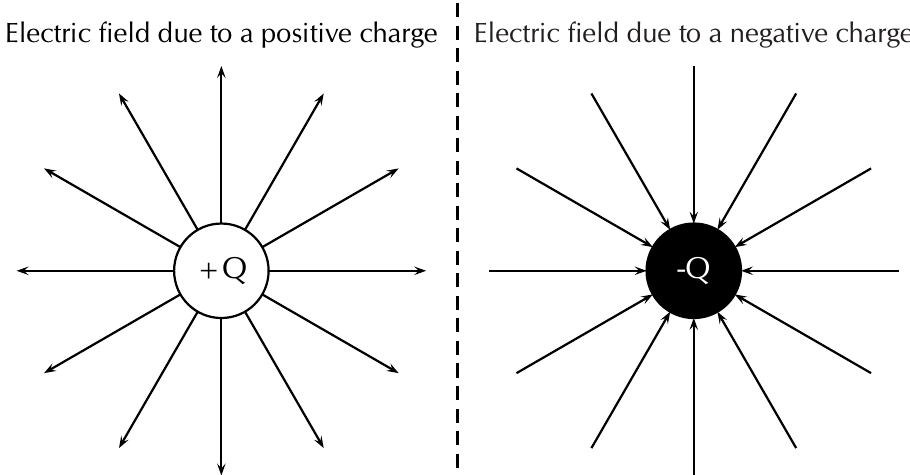
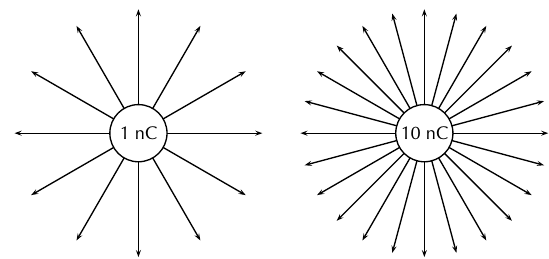
The strength of the electric field depends on the magnitude of the source charge. A larger charge creates a stronger field, which we represent by drawing more field lines around it.
Note
Important conventions for drawing electric field lines
When drawing electric field lines, we follow specific rules that help us create accurate and meaningful diagrams:
- Direction: Arrows on field lines show the direction a positive test charge would move
- Source and sink: Field lines point away from positive charges and toward negative charges
- Strength: Field lines are drawn closer together where the field is stronger
- No crossing: Field lines never touch or cross each other
- Perpendicular: Field lines are always perpendicular to the surface of a charge
- Proportional: More field lines are drawn around charges with greater magnitude
Key points to remember about electric fields
There is an electric field at every point in space surrounding a charge. Field lines are just a representation - they're not real physical objects. Field lines exist in three dimensions, not just the two-dimensional drawings we see. The number of field lines through a surface is proportional to the charge contained inside.
Electric fields around multiple charges
Real situations often involve multiple charges interacting with each other. When this happens, we need to consider how the individual electric fields combine to create a net field.
Electric field around two unlike charges
When we place a positive and negative charge near each other, something interesting happens. The field lines that would normally spread out from the positive charge get "pulled" toward the negative charge.
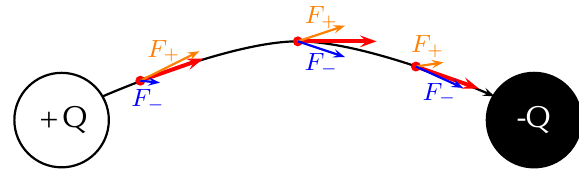
The resulting field pattern shows curved lines that start at the positive charge and end at the negative charge. Between the charges, the field lines are relatively straight, showing the strong attractive force in this region.
To understand how this works, we can think about the forces on a positive test charge at different points. The positive source charge pushes the test charge away, while the negative source charge pulls it in. The net force (and thus the field direction) depends on which influence is stronger at each point.
Electric field around two like charges (positive)
When we have two positive charges near each other, both charges repel a positive test charge. This creates a more complex field pattern.
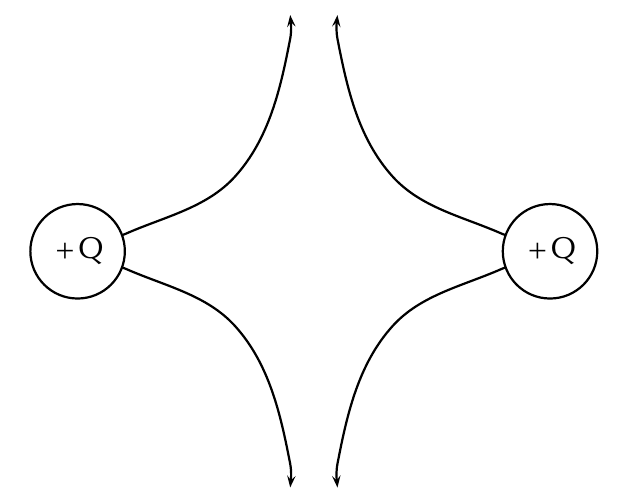
The key feature here is that there's a region between the two charges where the field lines curve away from each other. This happens because both charges are pushing test charges away, and the combined effect creates these characteristic curved patterns.
Note
Between two identical positive charges, there's a point exactly in the middle where the forces from both charges cancel out. At this point, a test charge would experience no net force.
Electric field around two like charges (negative)
For two negative charges, we can apply the same principles but remember that field lines point toward negative charges. The field pattern looks similar to two positive charges, but with all arrows pointing in the opposite direction - toward the charges instead of away from them.
Charges with different magnitudes
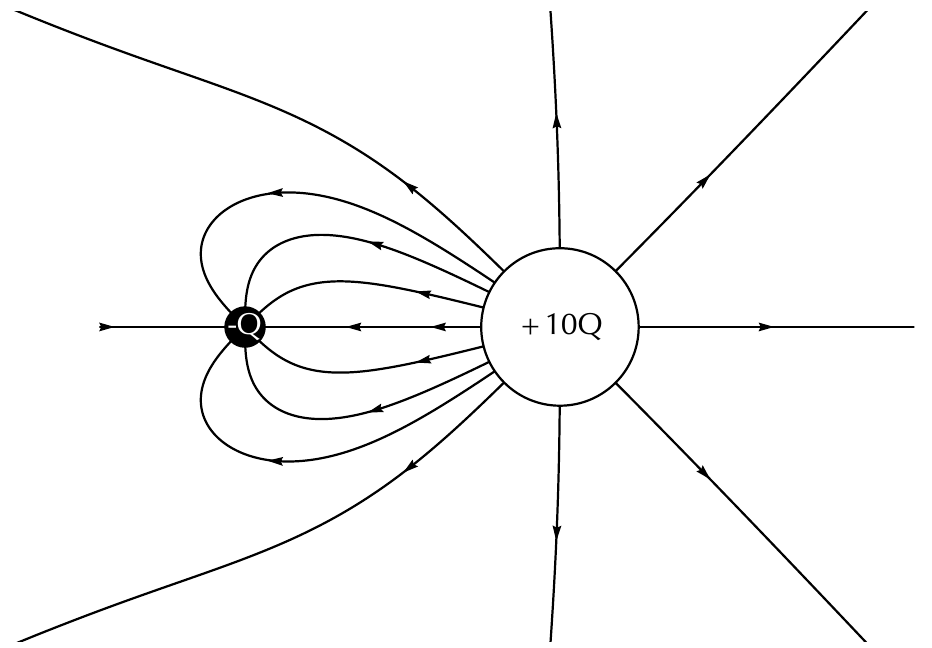
When charges have different magnitudes, the larger charge has a greater influence on the field pattern. The field lines will be more densely packed around the larger charge, and the overall pattern will be "skewed" toward the stronger charge.
Electric field strength
So far we've looked at electric fields qualitatively - showing their direction and relative strength. But we can also measure electric field strength quantitatively by putting a number on how strong the field is at any point.
Electric field strength is defined as the force per unit charge that a test charge would experience at that point. This gives us a way to compare field strengths at different locations.
Important
DEFINITION: Electric field strength
The magnitude of the electric field, , at a point can be quantified as the force per unit charge:
where is the Coulomb force exerted by a charge on a test charge .
The units of electric field are newtons per coulomb: .
Since force is a vector and charge is a scalar, the electric field is also a vector - it has both magnitude and direction at every point.
Calculating electric field strength
We can combine the definition of electric field with Coulomb's law to get a formula for calculating field strength around a point charge:
Starting with:
And substituting Coulomb's law:
We get:
This shows that electric field strength only depends on the source charge Q and distance r - it doesn't depend on the test charge .
If we know the electric field at a point, we can find the force on any charge placed there using:
Worked examples
Let's work through some practical problems to see how these concepts apply in calculations.
Example
Worked Example 1: Electric field from a single charge
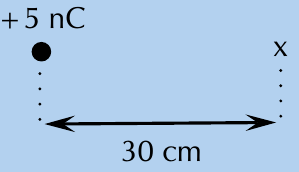
Question: Calculate the electric field strength 30 cm from a 5 nC charge.
Solution:
Step 1: Identify what we need to find We need to calculate the electric field at a specific distance from a given charge.
Step 2: Identify given information
- Charge:
- Distance:
Step 3: Choose the appropriate formula
- We'll use:
Step 4: Calculate the result
Example
Worked Example 2: Electric field from multiple charges
Question: Two charges and are separated by 40 cm. What is the electric field strength at a point 10 cm from and 30 cm from ?

Solution:
Step 1: Understand the problem
- We need to find the net electric field at point x, which requires calculating the field from each charge separately, then adding them as vectors.
Step 2: Calculate the field from
Step 3: Calculate the field from
Step 4: Add the fields
- Since both fields point in the same direction (away from and toward ), we add them:
Example
Worked Example 3: Two-dimensional electric fields
Question: Two point charges form a right-angled triangle with point A at the origin. is 0.05 m to the right of A, and is 0.03 m above A. What is the net electric field at point A?
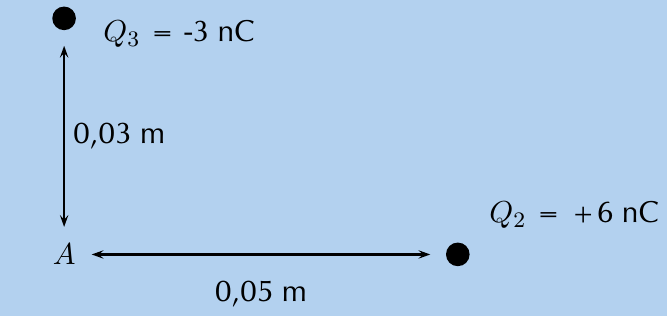
Solution:
This problem requires vector addition since the fields are perpendicular to each other.
Step 1: Calculate field magnitudes
- From :
- From :
Step 2: Determine directions
- points left (toward A from , which is positive)
- points up (toward , which is negative)
Step 3: Use Pythagoras' theorem for resultant
Step 4: Find the angle
The final resultant electric field at point A is 36,930 N⋅C⁻¹ at an angle of 54.2° to the horizontal.
Summary
Key Points to Remember:
- Electric fields exist around all charges - they represent the region where other charges would experience forces
- Field lines show direction and strength - closer lines mean stronger fields, and arrows show the direction a positive charge would move
- Like charges repel, unlike charges attract - this determines whether field lines point toward or away from charges
- Electric field strength is force per unit charge - calculated using
- Multiple charges require vector addition - calculate each field separately, then combine them using vector rules