Newton's Third Law (Grade 11 NSC Matric Physical Sciences): Revision Notes
📚Revision Notes
Newton's Third Law
Newton's third law deals with the interaction between pairs of objects. When objects interact with each other, they exert forces on one another. These forces always occur in pairs and have special properties that make them fundamental to understanding motion.
Consider this everyday example: when you hold a book against a wall, you push on the book to keep it in place, and the book pushes back on your hand. If the book didn't push back, your hand would move straight through it! Similarly, the book pushes against the wall, and the wall pushes back on the book.
Definition of Newton's third law
Important
Newton's third law of motion states: If body A exerts a force on body B, then body B exerts a force of equal magnitude on body A, but in the opposite direction.
This law is often summarised as "for every action, there is an equal and opposite reaction." However, it's more accurate to think of these as action-reaction pairs of forces.
Properties of action-reaction pairs
Action-reaction pairs have three important characteristics that you must remember:
Note
Key Properties of Action-Reaction Pairs:
-
The same type of force acts on both objects - if one force is gravitational, the other is also gravitational; if one is a normal force, the other is also a normal force
-
The forces have the same magnitude but act in opposite directions - they are equal in size but point in completely opposite ways
-
The forces act on different objects - this is crucial! The action and reaction forces never act on the same object
These properties help us identify true action-reaction pairs and distinguish them from other forces that might seem similar.
Worked example: Forces in a seat belt scenario
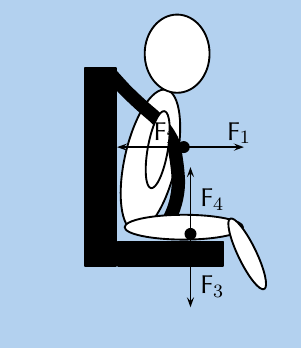
Let's examine a practical situation where Newton's third law applies. When Dineo is seated in a car with his seat belt on and the car suddenly stops, several force pairs are present.
Example
Worked Example: Seat Belt Force Analysis
Step 1: Analyse the situation
Dineo continues moving forward due to Newton's first law (inertia) until the seat belt stops him. During this interaction, we can identify two main action-reaction pairs.
Step 2: Identify the force pairs
Force Pair 1:
- Action: Force of Dineo on the seat belt
- Reaction: Force of the seat belt on Dineo
Force Pair 2:
- Action: Force of Dineo on the seat (his weight pressing down)
- Reaction: Force of the seat on Dineo (supporting him upward)
Each pair demonstrates Newton's third law because the forces are equal in magnitude, opposite in direction, and act on different objects.
Worked example: Forces in a lift
This example shows how Newton's third law applies when a person stands in a lift moving at constant velocity.
Example
Worked Example: Lift Force Analysis
Step 1: Analyse the situation
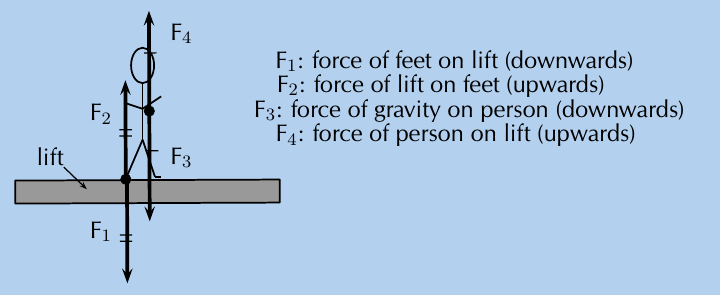
When Tammy travels in a lift moving at constant velocity, we need to focus on the action-reaction pairs of forces rather than the motion of the lift itself.
Step 2: Identify the forces
The diagram shows four forces:
- : Force of feet on lift (downward)
- : Force of lift on feet (upward)
- : Force of gravity on person (downward)
- : Force of person on lift (upward)
Step 3: Determine the correct relationship
The question asks about the force of the floor on Tammy's feet (). According to Newton's third law, this force is equal in magnitude to the force that Tammy's feet exert on the floor (), but acts in the opposite direction.
Worked example: Book pushed against a wall
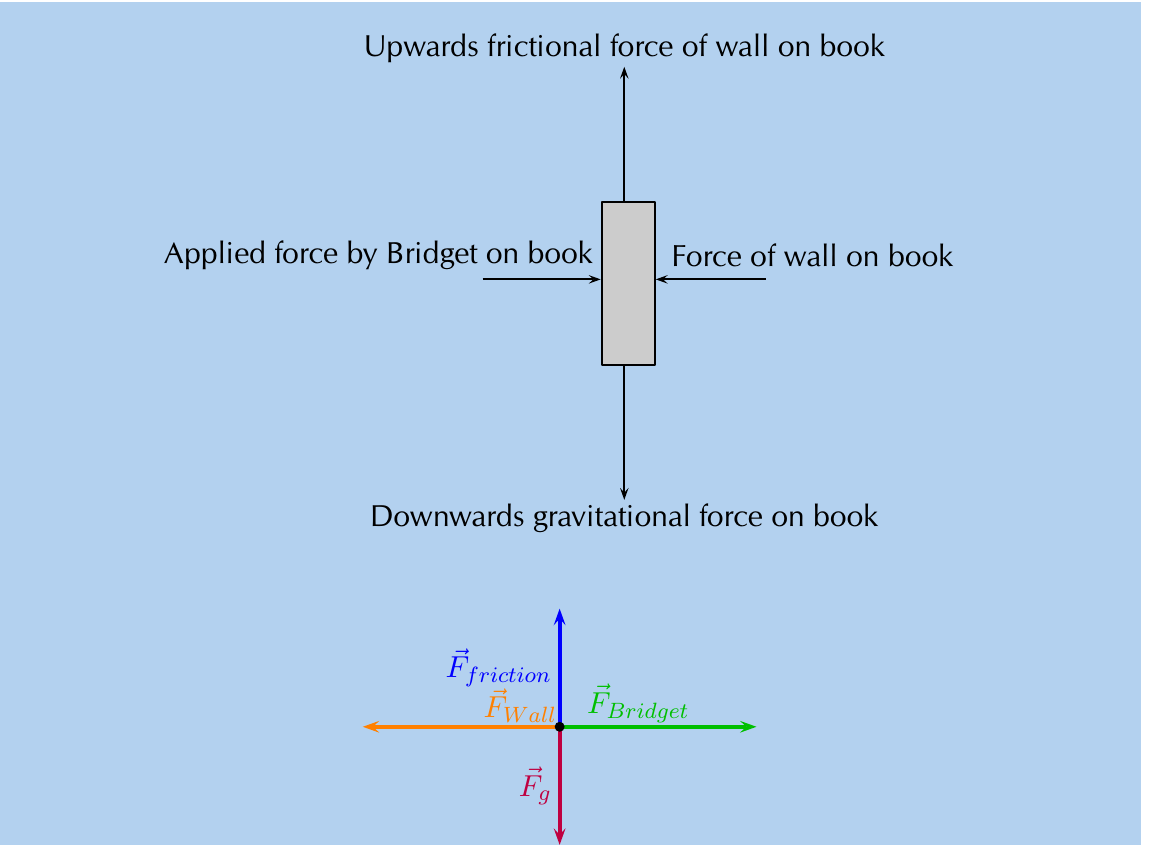
This classic example demonstrates Newton's third law when Bridget presses a book against a wall.
Example
Worked Example: Book Against Wall Force Analysis
Step 1: Draw a force diagram
When drawing force diagrams, we must include all forces acting on the object of interest (the book). The four forces acting on the book are:
- Applied force by Bridget (horizontal, toward wall)
- Normal force from wall (horizontal, away from wall)
- Gravitational force (downward)
- Frictional force from wall (upward)
Step 2: State Newton's third law
If body A exerts a force on body B, then body B exerts a force equal in magnitude but opposite in direction on body A.
Step 3: Identify action-reaction pairs in the horizontal plane
Pair 1:
- Action: Applied force of Bridget on the book
- Reaction: Force of the book on Bridget's hand
Pair 2:
- Action: Force of the book on the wall
- Reaction: Force of the wall on the book
Notice how the objects are "swapped around" in the naming of each pair - this is a key feature of Newton's third law pairs.
Practical investigation: Balloon rocket
This experiment demonstrates Newton's third law using a balloon rocket system.
Example
Practical Investigation: Balloon Rocket Demonstration
Aim: To investigate Newton's third law using a balloon rocket attached to a fishing line track.
Apparatus needed:
- Balloons (one per team)
- Plastic straws (one per team)
- Tape (cellophane or masking)
- Fishing line (10 metres)
- Stopwatch (optional)
- Measuring tape (optional)
Method:
- Work in groups of at least five people
- Attach the fishing line horizontally between two fixed points using tape
- Thread the fishing line through a straw and tape the straw to an inflated balloon
- Release the balloon and observe its motion along the line
- Time the balloon's journey and measure the distance travelled
- Calculate average speed and repeat for multiple trials
| Distance (m) | Time (s) | Speed (m·s⁻¹) |
|---|---|---|
| Trial 1 | ||
| Trial 2 | ||
| Trial 3 | ||
| Average: |
Explanation: The balloon pushes air out backwards (action), and the air pushes the balloon forward (reaction). This demonstrates Newton's third law perfectly.
Note
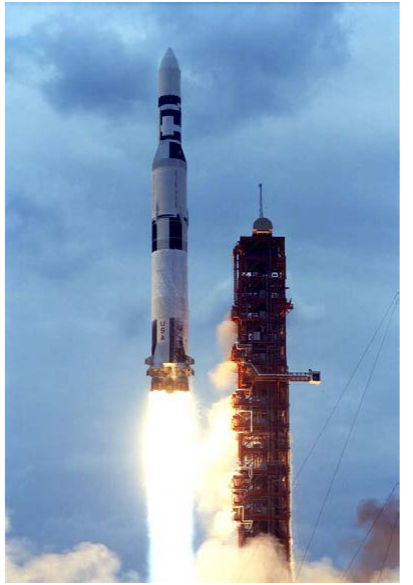
Real rockets like the Saturn V work on the same principle - they push hot gases downward and backward at high speed, and the gases push the rocket upward and forward with equal force. This is how rocket propulsion works in the vacuum of space where there's no air to "push against"!
Forces in equilibrium
Newton's third law connects closely with the concept of equilibrium. When an object is stationary or moving at constant velocity, either:
- No forces are acting on the object, or
- The forces acting on the object are exactly balanced
This means the resultant force is zero. Equilibrium occurs when an object has the sum of all forces acting on it equal to zero.
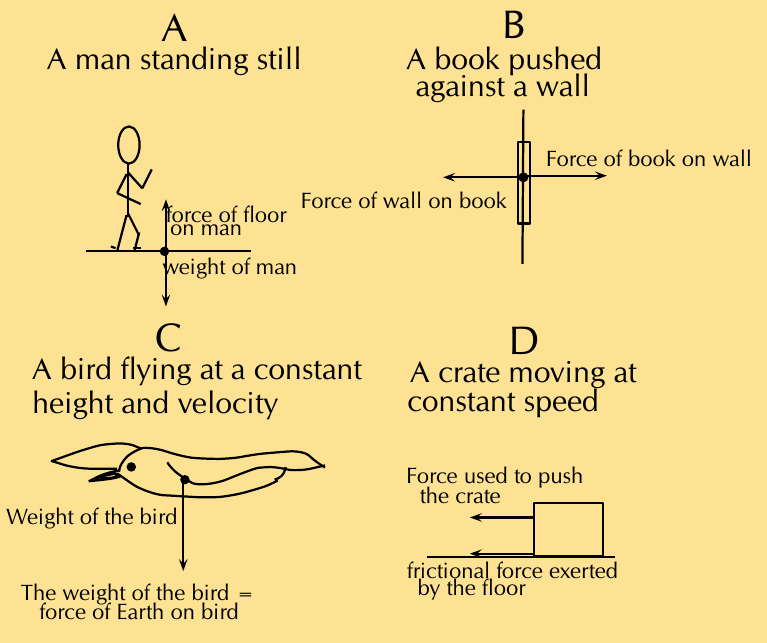
Note
The diagram shows four different scenarios where forces demonstrate Newton's laws:
- A person standing still (balanced vertical forces)
- A book pushed against a wall (action-reaction pairs)
- A bird flying at constant velocity (balanced forces)
- A crate moving at constant speed (balanced horizontal forces)
Important
Don't confuse action-reaction pairs with balanced forces - action-reaction pairs act on different objects, while balanced forces act on the same object and result in equilibrium.
Remember!
Summary
Key Points to Remember:
-
Newton's third law states that forces always occur in pairs - if object A pushes on object B, then object B pushes back on object A with equal force in the opposite direction
-
Action-reaction pairs have three key properties: same type of force, equal magnitude but opposite direction, and they act on different objects
-
These force pairs are present everywhere - walking, sitting, holding objects, and even in rocket propulsion
-
Don't confuse action-reaction pairs with balanced forces - action-reaction pairs act on different objects, while balanced forces act on the same object
-
In equilibrium situations, Newton's third law still applies - the action-reaction pairs exist alongside the balanced forces that keep objects stationary or moving at constant velocity