Converting Between Different Units of Measurement (Grade 12 NSC Matric Mathematical Literacy): Revision Notes
📚Revision Notes
Converting Between Different Units of Measurement
Understanding how to convert between different units of measurement is essential for solving real-world problems in Mathematical Literacy. The metric system forms the foundation of most measurement conversions, and mastering these skills will help you tackle various exam questions confidently.
Note
Measurement conversions are one of the most frequently tested topics in Mathematical Literacy exams. Once you master the basic principles, you'll be able to handle any conversion question with confidence.
Basic conversion principles
The fundamental rule for metric conversions is straightforward and must be memorised:
Important
The Golden Rule of Metric Conversions:
- To convert to a smaller unit, we multiply
- To convert to a larger unit, we divide
This principle applies to ALL metric measurements - length, volume, and mass. Understanding this concept will prevent common mistakes in exam situations.
Metric length conversions
Length measurements use the metric system with four main units that you need to know. The conversion factors for length show the relationship between these units:
| Unit | Conversion Factor |
|---|---|
| 10 millimetres (mm) | = 1 centimetre (cm) |
| 1 000 millimetres (mm) | = 1 metre (m) |
| 100 centimetres (cm) | = 1 metre (m) |
| 1 000 metres (m) | = 1 kilometre (km) |
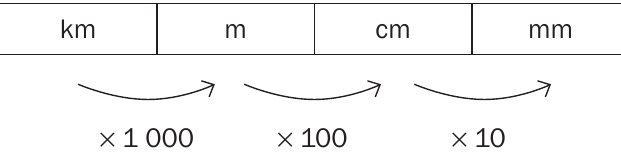
Converting to smaller units (multiply)
When converting from larger units to smaller units, you multiply by the conversion factor:
Note
Think of it this way: smaller units mean more of them, so the number gets bigger (multiply). For example, 1 metre contains 100 centimetres, so when converting metres to centimetres, your answer will be a larger number.
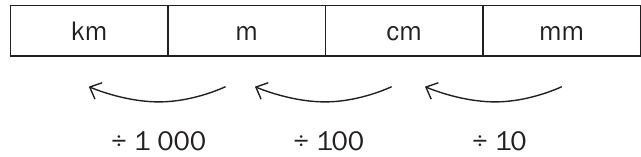
Converting to larger units (divide)
When converting from smaller units to larger units, you divide by the conversion factor:
Note
Larger units mean fewer of them, so the number gets smaller (divide). For example, 100 centimetres make up only 1 metre, so when converting centimetres to metres, your answer will be a smaller number.
Metric volume conversions
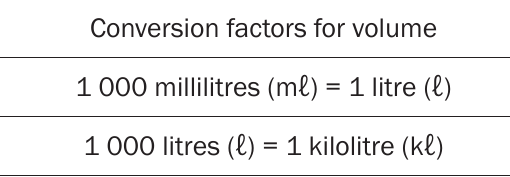
Volume measurements in the metric system use three main units. The conversion factors for volume are:
Note
Volume conversions follow the same multiply for smaller, divide for larger rule as length conversions. The key factor for volume is usually 1 000 between major units.
Metric weight conversions
Mass (or weight) measurements follow the same pattern as other metric units. The conversion factors for weight are:
| Unit | Conversion Factor |
|---|---|
| 1 000 mg | = 1 gramme (g) |
| 1 000 grammes (g) | = 1 kilogramme (kg) |
| 1 000 kilogrammes (kg) | = 1 tonne (t) |
Note
Weight conversions are particularly straightforward because they consistently use the factor of 1 000 between all major units (mg → g → kg → t).
Worked examples
Here are step-by-step solutions to common conversion problems:
Example 1: Length conversions
Example
Worked Example: Length Conversions
Problem: A leaf is 25 mm long. How long is it in cm?
Solution: Converting to a larger unit, divide by 10: 25 mm ÷ 10 = 2,5 cm
Problem: A sofa is 187 cm long. How long is it in metres?
Solution: Converting to a larger unit, divide by 100: 187 cm ÷ 100 = 1,87 m
Example 2: Volume conversions
Example
Worked Example: Volume Conversions
Problem: Harry's household uses 1 023 ℓ of water per month. How much water do they use in kℓ?
Solution: Converting to a larger unit, divide by 1 000: 1 023 ℓ ÷ 1 000 = 1,023 kℓ
Problem: A tin contains 3,5 ℓ of paint. How many millilitres of paint is in the tin?
Solution: Converting to a smaller unit, multiply by 1 000: 3,5 × 1 000 = 3 500 mℓ
Example 3: Weight conversions
Example
Worked Example: Weight Conversions
Problem: The cover of a book is 16,2 cm long. How long is the book in mm?
Solution: Converting to a smaller unit, multiply by 10: 16,2 cm × 10 = 162 mm
Problem: A medicine tablet weighs 50 mg. How much does the tablet weigh in grammes?
Solution: Converting to a larger unit, divide by 1 000: 50 mg ÷ 1 000 = 0,05 g
Cooking conversions and temperature
In recipes and cooking contexts, measurements often use cups, spoons, and other kitchen measurements. These conversions for cooking and baking are commonly used:
| Measurement | Volume Equivalent |
|---|---|
| 1 cup | = 250 mℓ |
| 1 tablespoon (tbsp) | = 15 mℓ |
| 1 teaspoon (tsp) | = 5 mℓ |
Understanding cooking measurements
Measuring cups and spoons come in standard sizes and are common in kitchens because they are quick and simple to use. While you can approximate measurements using everyday household objects (like a small tea cup being roughly the same size as a measuring cup), precise measurements require proper measuring tools.
When following recipes, accuracy is important for successful results, so these rough approximations are often not suitable for serious cooking or baking.
Note
Exam tip: These cooking conversions will be provided in your assessment, so focus on understanding how to use them rather than memorising them.
Remember!
Summary
Key Points to Remember:
- Basic rule: Multiply when converting to smaller units, divide when converting to larger units
- Metric factors: Most metric conversions use factors of 10, 100, or 1 000
- Length units: km → m → cm → mm (using factors of 1 000, 100, and 10)
- Volume units: kℓ → ℓ → mℓ (using factor of 1 000)
- Weight units: t → kg → g → mg (using factor of 1 000)
- Show your working: Always write out your calculation steps clearly in exams