Working with Irrational Numbers (Grade 12 NSC Matric Mathematics): Revision Notes
📚Revision Notes
Working with Irrational Numbers
Understanding irrational numbers and surds
Irrational numbers are real numbers that cannot be expressed as simple fractions. These numbers have decimal expansions that neither terminate nor repeat in a pattern. When we work with square roots, cube roots, and other radicals that don't simplify to whole numbers, we often encounter irrational numbers.
Surds are a special type of irrational number. They are expressions involving square roots, cube roots, or higher-order roots that cannot be simplified to rational numbers. Common examples include , , , , and .
Note
It's important to distinguish surds from rational square roots. Not all square roots are surds. For instance:
- (rational)
- (rational)
- (rational)
- (rational)
These are not surds because they simplify to whole numbers.

Locating surds on a number line
To estimate where a surd falls on a number line, you need to identify two consecutive whole numbers between which the surd lies. This technique helps you understand the approximate value of irrational numbers.
Important
Method: Find perfect squares close to your number and determine which whole numbers they correspond to.
Example
Worked Example 1: Locating √5
To locate on a number line:
- Consider that and
- Since , we know that
- is closer to 2 than to 3
Example
Worked Example 2: Locating √17
To locate on a number line:
- Consider that and
- Since , we know that
- is very close to 4
Simplifying surds through operations
Multiplication of surds
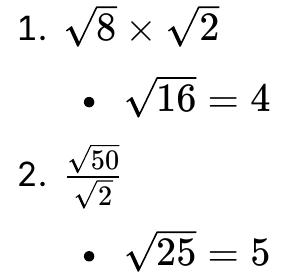
When multiplying surds, you can combine them under a single radical sign using the rule:
Example
Worked Example 3: Multiplying Surds
This rule makes calculations more efficient and helps simplify complex expressions.
Division of surds
Division of surds follows a similar pattern:
Example
Worked Example 4: Dividing Surds
Simplifying square roots by factoring
The key to simplifying surds is to identify and extract perfect square factors. Look for factors of the number under the radical that are perfect squares, then separate them out.
Important
Method:
- Factor the number under the square root
- Identify perfect square factors
- Take the square root of perfect squares and move them outside the radical
Example
Worked Example 5: Simplifying by Factoring
The 9 is a perfect square (), so its square root (3) comes out of the radical, leaving inside.
Addition and subtraction of surds
You can only add or subtract surds that have the same radical part - these are called like terms.
Important
Rule: Surds with identical radical parts can be combined by adding or subtracting their coefficients.
Example
Worked Example 6: Adding Like Terms
The radical parts () are identical, so we add the coefficients: .
Rationalising the denominator
Rationalising means removing surds from the denominator of a fraction. This makes fractions easier to work with and is often required in final answers.
Basic rationalisation
To rationalise a simple surd in the denominator, multiply both numerator and denominator by the same surd.
Example
Worked Example 7: Basic Rationalisation
To rationalise :
- Multiply top and bottom by
The denominator becomes 2 (a rational number) because .
Using the difference of two squares
For more complex denominators involving sums or differences of surds, use the conjugate method.
Example
Worked Example 8: Using Conjugates
To rationalise :
- Multiply by the conjugate
Additional worked examples
Example
Worked Example 9: Simplify √8 × √2
Example
Worked Example 10: Simplify √50/√2
Example
Worked Example 11: Rationalise 4/√5
To rationalise :
- Multiply top and bottom by
Summary
Key Points to Remember:
- Surds are irrational square roots that cannot be simplified to whole numbers
- Multiplication and division of surds can be combined under one radical sign
- Addition and subtraction only works with like terms (same radical part)
- Simplification involves factoring out perfect squares from under the radical
- Rationalisation removes surds from denominators by strategic multiplication