Equation of a Circle: Centre at Origin (Grade 12 NSC Matric Mathematics): Revision Notes
📚Revision Notes
Equation of a Circle: Centre at Origin
What is a circle?
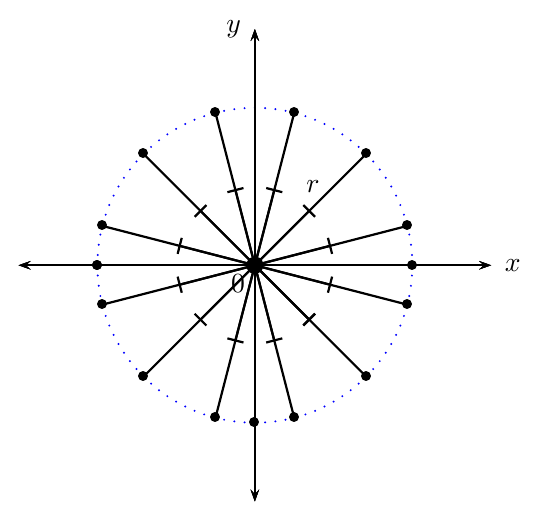
A circle is the set of all points that are an equal distance (radius) from a given point (centre). In other words, every point on the circumference of a circle is equidistant from its centre.
The radius of a circle is the distance from the centre of a circle to any point on the circumference. This distance remains constant for all points on the circle.
A diameter of a circle is any line passing through the centre of the circle which connects two points on the circle. The diameter is also the maximum distance between two points on a circle.
Note
Understanding these fundamental definitions is crucial for working with circles. Remember that the radius is the key measurement that determines the size of a circle.
Deriving the equation of a circle with centre at the origin
When a circle has its centre at the origin O(0; 0), we can derive its equation using the Pythagorean theorem.
Consider any point P(x; y) on the circumference of a circle with radius r and centre at O(0; 0).
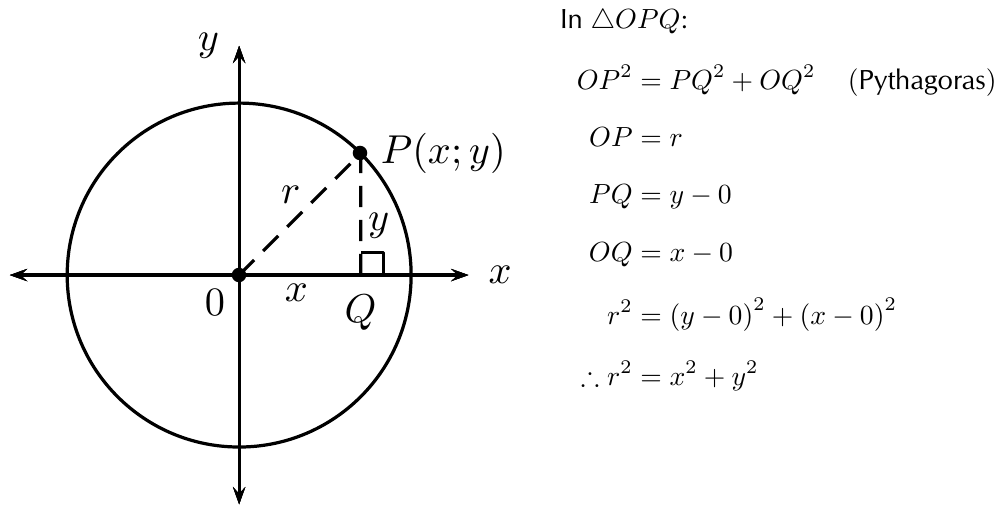
In triangle OPQ (where Q is the foot of the perpendicular from P to the x-axis):
- OP = r (radius of the circle)
- PQ = y - 0 = y (vertical distance)
- OQ = x - 0 = x (horizontal distance)
Using the Pythagorean theorem:
Substituting the values:
Rearranging:
Important
This is the standard form equation of a circle with centre at the origin.
Key formula
Important
Equation of a circle with centre at the origin:
If P(x; y) is a point on a circle with centre O(0; 0) and radius r, then the equation of the circle is:
Circle symmetry
A circle with centre at the origin has special symmetry properties:
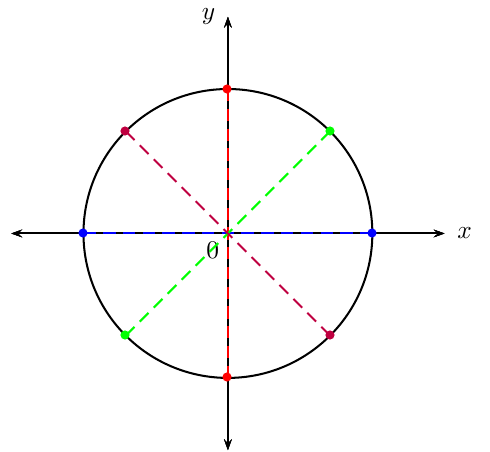
- Origin symmetry: For every point (x; y) on the circumference, the point (-x; -y) is also on the circle
- Axis symmetry: A circle centred on the origin is symmetrical about both the x-axis and y-axis
- Line symmetry: The circle is also symmetrical about the lines y = x and y = -x
Note
This means a circle has infinitely many lines of symmetry - any line passing through the centre is a line of symmetry.
Worked example 1: Basic circle equation
Example
Worked Example: Basic Circle Equation
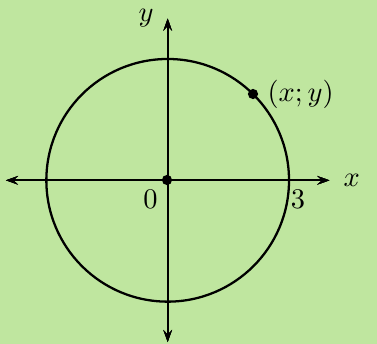
Question: Given a circle with centre O(0; 0) and radius of 3 units.
- Sketch the circle on the Cartesian plane
- Determine the equation of the circle
- Show that the point T(-√4; √5) lies on the circle
Solution:
Step 1: Draw a sketch
Step 2: Determine the equation
Using the general form:
Substitute r = 3:
Therefore:
Step 3: Show that point T lies on the circle
Substitute the coordinates of T(-√4; √5) into the equation:
LHS =
=
=
=
=
= RHS
Therefore, T(-√4; √5) lies on the circle .
Worked example 2: Circle through two points
Example
Worked Example: Circle Through Two Points
Question: A circle with centre O(0; 0) passes through the points P(-5; 5) and Q(5; -5).
- Plot the points and draw a rough sketch
- Determine the equation of the circle
- Calculate the length of PQ
- Explain why PQ is a diameter
Solution:
Step 1: Draw a sketch
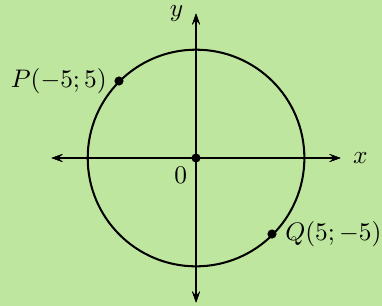
Step 2: Determine the equation
Using the general form and substituting P(-5; 5):
Therefore units
The equation is:
Step 3: Calculate the length PQ
Using the distance formula:
units
Step 4: Why PQ is a diameter
The radius
The diameter
Since , PQ is a diameter of the circle.
Alternative method: Using symmetry, P(-5; 5) lies opposite Q(5; -5) with respect to the origin, so PQ passes through the centre and is therefore a diameter.
Worked example 3: Finding points with specific conditions
Example
Worked Example: Finding Points with Specific Conditions
Question: Given a circle with centre O(0; 0) and radius √45 units. Determine the possible coordinates of the points on the circle which have an x-value that is twice the y-value.
Solution:
Step 1: Determine the equation
Step 2: Find coordinates where x = 2y
Substitute into the equation:
When :
When :
Therefore, the points are (6; 3) and (-6; -3).
Check:
For (6; 3): ✓
For (-6; -3): ✓
Exam tips
Summary
Key Exam Strategies:
- Always start with a sketch when solving circle problems - it helps visualise the situation
- Remember the standard form: for circles with centre at origin
- Use symmetry properties to check your answers or find alternative solutions
- Substitute coordinates into the equation to verify if points lie on the circle
- The radius is always positive - take the positive square root when finding r
- Diameter = 2 × radius - use this relationship in problems involving diameters
Remember!
Summary
Key Points to Remember:
- A circle is the set of all points equidistant from the centre
- The equation of a circle with centre at origin is
- Use the Pythagorean theorem to derive the circle equation
- Circles with centre at origin have multiple lines of symmetry
- Always substitute coordinates to verify if points lie on the circle