Abiotic and Biotic Changes in Australian Ecosystems (HSC SSCE Biology): Revision Notes
📚Revision Notes
Abiotic and Biotic Changes in Australian Ecosystems
Introduction
Australia's ecosystems have undergone dramatic transformations over millions of years. When the climate within a habitat shifts, the types and numbers of organisms living there also change. Organisms that are well-adapted to the new environmental conditions tend to survive, whilst those that cannot adapt may become extinct. Over time, this process can lead to the evolution of entirely new species.
The study of these changes helps us understand how Australia's unique flora and fauna developed, and how they continue to respond to environmental pressures today.
Note
Understanding the relationship between environmental changes and species evolution is crucial for predicting how modern ecosystems will respond to current climate challenges. The patterns we observe in Australia's past can inform conservation strategies today.
Key terminology
Before exploring the changes in Australian ecosystems, it's important to understand some key terms:
- Abiotic factors: Non-living physical and chemical features of the environment, such as temperature, rainfall, and soil type
- Biotic factors: Living components of an ecosystem, including all plants, animals, and microorganisms
- Gondwana: The ancient supercontinent that included Australia, Antarctica, South America, Africa, and India before they separated
- Megafauna: Large animals, typically weighing over kg, many of which are now extinct
- Distribution: The geographical area where a particular species is found
- Abundance: The number of individuals of a species present in a given area
- Extinct: A species that no longer exists anywhere on Earth
- Extant: A species that is still living today
Origins of Australian plants and animals
Understanding where Australia's current species came from helps explain the country's unique biodiversity.
Origins of Australian plants
Present-day Australian plant species have three main origins:
- Gondwanan relics: Species that were already present on the Australian landmass when it separated from the ancient supercontinent of Gondwana
- South-east Asian dispersals: Plants that spread from South-east Asia to Australia after the continents moved closer together
- Introduced species: Plants brought to Australia by humans, either deliberately or accidentally
Note
The majority of Australia's native plant species are Gondwanan relics, which explains why many Australian plants are found nowhere else on Earth. This ancient heritage makes Australia's flora particularly vulnerable to rapid environmental changes.
Origins of Australian animals
The animals found in Australia today can be traced to four main sources:
- Original residents: Species that inhabited the continent when it broke away from Gondwana, including frogs, reptiles, monotremes (like platypuses), marsupials, emus, and lyrebirds
- Asian immigrants: Animals that arrived when sea levels were lower, creating land bridges between Australia and Asia. This occurred around million years ago and again between and years ago. Examples include venomous snakes, rats, mice, and bats
- Aboriginal introductions: Species brought by Aboriginal people or traders approximately years ago, such as dingoes
- European introductions: Animals introduced by European settlers beginning about years ago
Important
Australia's geographic isolation allowed marsupials and monotremes to dominate, unlike other continents where placental mammals became the dominant group. This isolation created one of the world's most distinctive faunas.
Timeline of abiotic and biotic changes
Australia's ecosystems have changed dramatically over geological time. The following timeline summarizes major changes in climate, vegetation, and animal life:
55 million years ago - Rainforest dominance
Climate changes:
- Wet and warm conditions prevailed
- High rainfall supported extensive vegetation
Vegetation changes:
- Rainforests formed the dominant vegetation type across Australia
- These rainforests had replaced the towering conifer forests of earlier eras
- Great diversity of plant species existed
Fauna changes:
- Many early ancestors of modern Australian animals appeared
- Early forms of koalas, kangaroos, bats, crocodiles, and possums evolved
- Large variety of fauna adapted to rainforest conditions
This period occurred before Australia separated from Gondwana, when the continent was positioned much further south than its current location.
45 million years ago - Continental drift begins
Climate changes:
- As Australia separated from Antarctica and drifted northward, the climate became progressively drier
- Temperature patterns shifted
Vegetation changes:
- Rainforests contracted and became restricted mainly to coastal regions
- Inland areas developed more open forests and woodlands
- Vegetation adapted to drier conditions
Note
The separation from Antarctica was a pivotal moment in Australian ecological history. As the continents drifted apart, ocean currents changed, bringing drier conditions that would fundamentally reshape Australia's ecosystems over millions of years.
Fauna changes:
- Animal species diversified significantly
- Kangaroos evolved the ability to hop rather than walk
- Large herds of wombat-like creatures appeared
- Carnivorous predators such as thylacines (Tasmanian tigers) and marsupial lions emerged
8 million years ago - Modern flora emerges
Climate changes:
- Continued drying trend
- Climate became more variable
Vegetation changes:
- Eucalyptus (gum trees) and wattles became increasingly common
- Wildflowers flourished and diversified
- This era marked the transition between ancient and modern vegetation types
- Conifers and cycads declined in importance as flowering plants expanded
Fauna changes:
- Saltwater crocodiles evolved
- Budgerigars and other modern bird species appeared
- Fauna began to resemble present-day species more closely
Note
The emergence of eucalyptus as a dominant plant group was crucial for Australia's future ecosystems. Eucalypts are highly adapted to fire and drought, characteristics that would become increasingly important as Australia continued to dry out.
2 million years ago - Megafauna era
Climate changes:
- Climate fluctuated between wet and dry periods
- Unstable environmental conditions
Vegetation changes:
- Vegetation patterns constantly shifted
- Forests, grasslands, and deserts appeared and disappeared in different regions
- Landscape composition changed repeatedly
Fauna changes:
- Megafauna reached their peak abundance
- Huge Diprotodons (giant wombat-like marsupials) roamed the landscape
- Megalania (giant monitor lizards) were apex predators
60,000 years ago - Human arrival
Human impact:
- Indigenous Australians arrived on the continent
- They used fire as a land management tool
- Vegetation was deliberately burned to:
- Clear areas for easier movement across the landscape
- Promote growth of certain plant species
- Facilitate hunting
Ecosystem changes:
- Fire became a regular feature of many Australian ecosystems
- Some scientists suggest this contributed to the extinction of megafauna
- Vegetation patterns were influenced by human fire management
Important
The arrival of humans introduced a new and powerful force shaping Australian ecosystems. Indigenous fire management practices fundamentally altered vegetation patterns and may have influenced which species survived and which became extinct.
5,000 years ago - Increasing aridity
Climate changes:
- Australia's climate became consistently drier
- This drying trend has continued to the present day
Vegetation changes:
- Dry climate conditions allowed lightning strikes to ignite frequent fires
- This may have favoured the selection of fire-resistant plant species
- Species adapted to fire, such as eucalypts, began to flourish
- Fire-adapted vegetation became dominant in many regions
Fauna changes:
- Animals adapted to drier conditions were favoured
- Species requiring wetter habitats declined
Note
The combination of increasing aridity and frequent fires created strong selection pressures that shaped the fire-adapted ecosystems we see in Australia today. Many Australian plants have evolved remarkable adaptations, such as lignotubers that allow regeneration after fire.
Present day - Human-induced climate change
Climate changes:
- Australia's climate is warming due to human activities
- Increased greenhouse gas emissions are driving temperature rises
- Rainfall patterns are changing
- Extreme weather events are becoming more frequent
Ecosystem impacts:
- Distribution and abundance of species are shifting
- Some species face increased extinction risk
- Ecosystems are under pressure to adapt rapidly
Important
Unlike past climate changes that occurred over thousands or millions of years, current human-induced climate change is happening at an unprecedented rate. This rapid change may exceed the ability of many species to adapt, leading to significant biodiversity loss.
Australian megafauna
Australia was once home to remarkable giant animals known as megafauna. These creatures were much larger than their modern relatives and played important roles in past ecosystems.
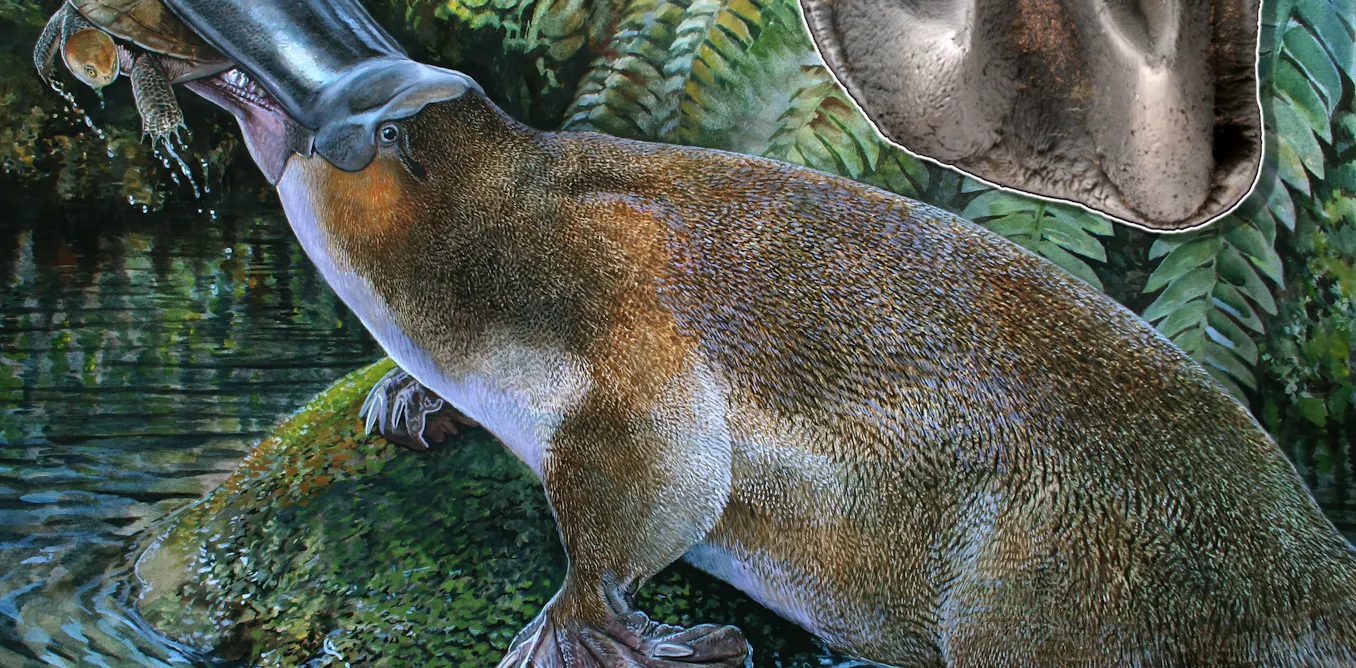
Obdurodon dicksoni - Giant platypus
This extinct species was a much larger relative of the modern platypus. Whilst today's platypus is relatively small, Obdurodon dicksoni was considerably bigger, with a more robust build. Like modern platypuses, it had a distinctive duck-like bill and webbed feet adapted for aquatic life.
Diprotodon opatum - Giant wombat
Diprotodon opatum was the largest marsupial that ever lived. This massive herbivore resembled a giant wombat and could grow to the size of a modern rhinoceros. It had a stocky body, powerful limbs, and would have been a dominant herbivore in its ecosystem.
Thylacoleo carnifex - Marsupial lion
The marsupial lion was Australia's largest mammalian carnivore. Despite its name, it wasn't closely related to true lions but was instead a carnivorous marsupial. It had powerful jaws and sharp teeth adapted for hunting large prey. Its spotted coat pattern may have provided camouflage whilst hunting.

Extinction of megafauna
Most of Australia's megafauna became extinct between and years ago. Scientists debate the causes of this extinction, with two main hypotheses:
- Climate change hypothesis: Increasing aridity and fluctuating climate conditions made survival difficult for large animals that required substantial food and water resources
- Human impact hypothesis: The arrival of Indigenous Australians and their use of fire for land management may have altered habitats and reduced food availability for megafauna
Important
Understanding Megafauna Extinction
Most likely, a combination of both factors contributed to megafauna extinction, with climate change creating stressful conditions that were exacerbated by human activities. This serves as an important lesson: even relatively small human populations can have significant impacts on vulnerable species, especially when environmental conditions are already challenging.
Connecting continental drift to ecosystem changes
Australia's journey from Gondwana has profoundly shaped its ecosystems. During the early Cretaceous period, Australia was positioned much further south as part of Gondwana. The climate was cool and wet, supporting coniferous forests, cycads, and dinosaurs. However, Australia's first mammals had already appeared during this time.
As Australia separated from Antarctica and drifted northward:
- Temperature increased: Moving toward the equator meant warmer average temperatures
- Rainfall patterns changed: Separation from Antarctica disrupted moisture-bearing weather systems
- Ocean currents shifted: New currents influenced climate patterns
- Geographic isolation increased: Species evolved in isolation, leading to unique Australian biodiversity
Note
The northward drift of Australia fundamentally transformed the continent from a cool, wet landmass dominated by rainforests into the warm, dry continent we know today. This journey took tens of millions of years, providing time for species to gradually adapt to changing conditions.
These geological changes created selection pressures that drove the evolution of Australia's distinctive flora and fauna. Species either adapted to the new conditions, migrated to suitable habitats, or became extinct.
Selection pressures shaping Australian ecosystems
Several major selection pressures have influenced the evolution and distribution of Australian species:
Increasing aridity
As the climate became drier:
- Plants evolved mechanisms to conserve water (such as small, hard leaves)
- Animals developed behaviours and physiological adaptations to survive with less water
- Fire-resistant species gained advantages
Note
Many eucalyptus species have evolved vertically-hanging leaves that minimize water loss by reducing exposure to direct sunlight. This adaptation helps them survive in Australia's increasingly dry climate.
Fire
Regular fires, both natural and human-caused, created pressure for:
- Plants to develop fire-resistant bark and seed storage mechanisms
- Animals to evolve warning behaviours and escape strategies
- Vegetation communities adapted to regenerate after fire
Note
Some Australian plants have evolved to actually require fire for reproduction. Banksia cones, for example, only release their seeds after being exposed to the intense heat of a bushfire, ensuring their seeds germinate in the nutrient-rich ash.
Geographic isolation
Australia's separation from other continents meant:
- Unique species evolved without competition from placental mammals
- Marsupials and monotremes diversified to fill ecological niches
- Some species remained relatively unchanged due to lack of competitive pressure
Climate fluctuations
Variations between wet and dry periods required:
- Flexibility in species' habitat preferences
- Ability to survive periods of resource scarcity
- Migration capabilities or dormancy strategies
Summary
Key Points to Remember:
-
Climate and ecosystems are interconnected: Changes in abiotic factors (like temperature and rainfall) directly influence biotic factors (the living organisms present). When climate changes, the distribution and abundance of species also change.
-
Australia's unique position: The continent's separation from Gondwana and drift northward created the environmental conditions that shaped its distinctive ecosystems. Geographic isolation allowed marsupials and monotremes to diversify without competition from placental mammals.
-
Multiple origins of biodiversity: Australian species come from various sources - ancient Gondwanan residents, Asian immigrants, and introduced species. Understanding these origins helps explain current biodiversity patterns.
-
Megafauna extinction illustrates ecosystem vulnerability: The loss of Australia's giant animals demonstrates how climate change and human activities can combine to drive species to extinction. This historical example remains relevant today.
-
Fire as an ecological force: Both natural and human-managed fire has been a major shaping force in Australian ecosystems for thousands of years. Many Australian plant species are specifically adapted to survive and regenerate after fire, making fire management crucial for ecosystem health.