Effect of Temperature (HSC SSCE Chemistry): Revision Notes
📚Revision Notes
Effect of Temperature
Understanding the equilibrium constant and temperature
The equilibrium constant () gives us important information about the ratio of products to reactants in a chemical reaction when it reaches equilibrium. This ratio has a specific value at a particular temperature.
When you change the concentration of one substance in an equilibrium system, Le Chatelier's principle tells us that the system will respond by shifting to counteract that change. The concentrations of all substances will adjust, but importantly, the ratio of products to reactants returns to the same value - the equilibrium constant remains unchanged.
Note
Unlike concentration changes which don't affect , temperature changes actually alter the equilibrium constant itself. This is a crucial distinction that makes temperature a unique factor in equilibrium systems.
How temperature affects equilibrium constant
Connection to Le Chatelier's principle
Let's use an example to understand this concept. Consider the formation of the iron thiocyanate complex ion, which is an exothermic reaction:
Because this reaction releases heat (negative enthalpy), we can think of heat as a product of the reaction.
What happens when temperature increases (exothermic reactions)
Example
Worked Example: Temperature Effect on an Exothermic Reaction
Consider the iron thiocyanate reaction above. When you increase the temperature of this system:
Step 1: According to Le Chatelier's principle, the system responds to minimize the change
Step 2: The reverse reaction is favoured because it absorbs (uses up) the added heat
Step 3: This means and increase (more reactants)
Step 4: Meanwhile, decreases (less product)
Step 5: This shift changes the equilibrium constant because:
Conclusion: For exothermic reactions, the equilibrium constant decreases as temperature increases.
What happens for endothermic reactions
For endothermic reactions, the opposite pattern occurs:
- Endothermic reactions absorb heat, so heat acts like a reactant
- When temperature increases, the forward reaction is favoured
- This produces more products and uses up reactants
- Therefore, increases as temperature increases
Important
Key Principles to Remember:
- Exothermic reactions: decreases when temperature increases (think: "EXO-down")
- Endothermic reactions: increases when temperature increases (think: "ENDO-up")
Why temperature must always be specified
Important
Because the equilibrium constant changes with temperature, you must always specify the temperature when stating a value. Without knowing the temperature, the equilibrium constant value has no meaning.
Examples of temperature dependence
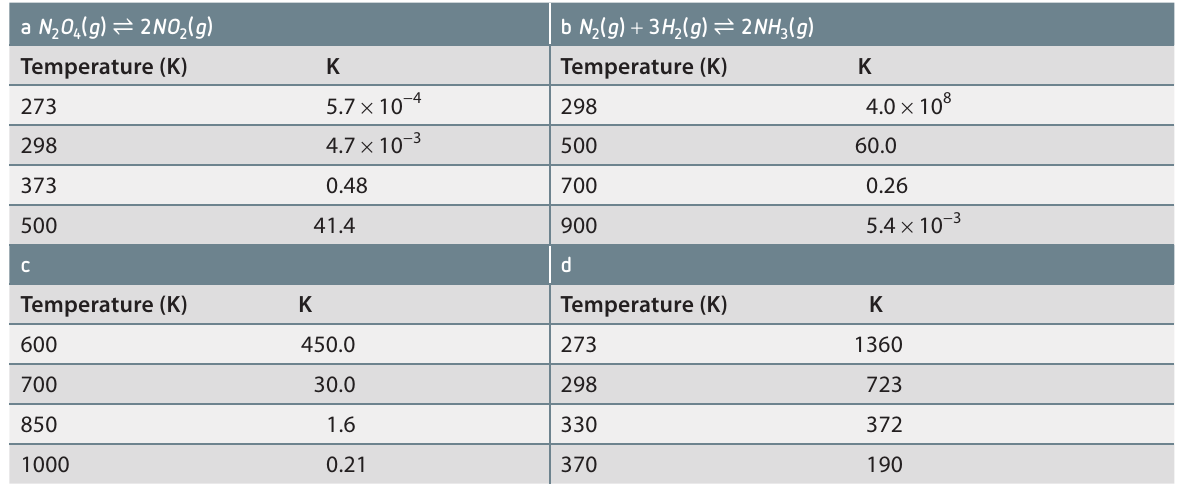
The table above shows how the equilibrium constant changes with temperature for four different reactions. Let's analyze what these patterns tell us:
Note
By observing how changes with temperature, we can determine whether a reaction is exothermic or endothermic:
- If decreases with increasing temperature → exothermic reaction
- If increases with increasing temperature → endothermic reaction
Reaction (a):
- As temperature increases from 273 K to 500 K, increases dramatically from to
- This indicates an endothermic reaction (products favoured at higher temperatures)
Reaction (b): (ammonia synthesis)
- As temperature increases from 298 K to 900 K, decreases from to
- This indicates an exothermic reaction (reactants favoured at higher temperatures)
- This has important implications for industrial ammonia production
Reaction (c):
- Shows decreasing from 450.0 to 0.21 as temperature rises from 600 K to 1000 K
- Another exothermic reaction example
Reaction (d):
- Shows decreasing from 1360 to 190 as temperature increases from 273 K to 370 K
- Also indicates an exothermic reaction
Practical implications
Note
These temperature effects on equilibrium constants are crucial for:
- Industrial chemical processes where maximising product yield is important
- Understanding reaction conditions and optimisation
- Predicting how systems will respond to temperature changes
- Designing efficient chemical reactors
Remember!
Summary
Key Takeaways:
- The equilibrium constant changes with temperature, unlike concentration changes which don't affect
- For exothermic reactions: increasing temperature causes to decrease (reverse reaction favoured)
- For endothermic reactions: increasing temperature causes to increase (forward reaction favoured)
- Temperature must always be specified when stating an equilibrium constant value
- Table data helps predict whether reactions are exothermic or endothermic by observing how changes with temperature