Equilibrium Constant (HSC SSCE Chemistry): Revision Notes
📚Revision Notes
Equilibrium Constant
Introduction to quantifying equilibrium
In earlier chapters, you learned how to describe equilibrium changes qualitatively. However, understanding equilibrium requires more than just descriptive analysis. Chemists need to quantify these changes to determine their magnitude. This quantitative approach is particularly important in industrial chemistry, where efficiency and cost-effectiveness depend on precise control of reaction conditions.
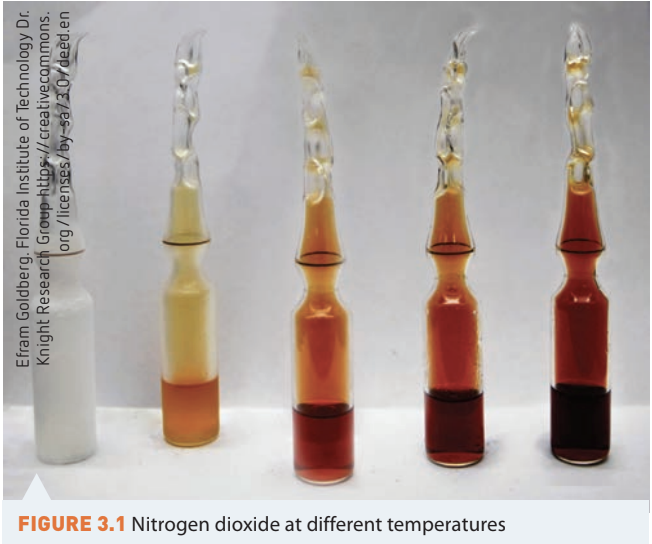
Understanding how to calculate and interpret numerical values for equilibrium systems allows chemists to predict exactly how much product will form under specific conditions. This knowledge is essential for optimising industrial processes such as ammonia and sulfuric acid production.
Note
Industrial applications of equilibrium calculations include determining optimal conditions for the Haber process (ammonia synthesis) and the Contact process (sulfuric acid production). These processes rely on precise mathematical predictions to maximize product yield while minimizing costs.
What is the equilibrium constant?
At equilibrium, a chemical system achieves a specific balance between reactants and products, much like a balanced see-saw. This balance can be expressed mathematically through a relationship called the equilibrium constant, represented by the symbols , , or sometimes just .
The equilibrium constant is a numerical value that describes the ratio of product concentrations to reactant concentrations in a specific reaction at a particular temperature when the system has reached equilibrium. This value remains constant for a given reaction at a fixed temperature, regardless of the initial concentrations.
In general terms, the equilibrium constant can be written as:
This simple expression tells us that the equilibrium constant relates the amounts of products formed to the amounts of reactants remaining when equilibrium is established.
The equilibrium expression
To be more specific about how we calculate , we need to consider the stoichiometry of the balanced chemical equation. For a general reaction:
where , , , and represent the stoichiometric coefficients, the equilibrium expression is:
Note
This expression shows several important features:
- Products appear in the numerator (top)
- Reactants appear in the denominator (bottom)
- Each concentration is raised to the power of its stoichiometric coefficient
- Multiple species are multiplied together
The square brackets indicate concentration in mol L⁻¹ (molarity). Because the equilibrium expression depends on how the equation is written, the magnitude of will vary if the equation is written differently.
Rules for writing equilibrium expressions
When writing an equilibrium expression, you must follow specific rules to determine which species to include. These rules are based on whether the concentration of a substance can vary.
What to include
Solutions and gases must always be included in equilibrium expressions because their concentrations can vary. For gaseous systems, you can use either concentration (in mol L⁻¹) or partial pressure, since partial pressure is proportional to concentration for an ideal gas.
What to exclude
Solids and pure liquids in heterogeneous systems (systems with more than one phase) are excluded from equilibrium expressions. This is because pure solids and liquids have constant concentrations that don't change during the reaction. Their "concentration" is essentially fixed by their density.
However, in homogeneous systems where all substances are in the same phase, the relative proportions of liquids matter, so they would be included.
Important
Common Mistake to Avoid: Students often incorrectly include solids and pure liquids in heterogeneous equilibrium expressions. Remember: if a substance's concentration cannot change during the reaction (pure solids and liquids), it must be excluded from the expression.
Step-by-step process
To write an equilibrium expression correctly:
- Write products in the numerator and reactants in the denominator
- Check whether any species are pure solids or liquids in a heterogeneous system - if so, exclude them
- Add square brackets around each remaining substance to indicate concentration
- Use the stoichiometric coefficient from the balanced equation as the exponent for each species
- Multiply the concentrations when there are multiple reactants or products
Worked examples
Let's apply these rules to specific reactions:
Example
Worked Example: Ammonia synthesis
For the reaction:
All species are gases, so all are included. The equilibrium expression develops as follows:
Step 1: Write basic expression
Step 2: Add concentration brackets
Step 3: Apply stoichiometric coefficients as exponents
Step 4: Include multiplication signs for clarity
Example
Worked Example: Calcium chloride dissociation
For the reaction:
The solid calcium chloride is excluded because it's a pure solid in a heterogeneous system. Only the aqueous ions are included:
Step 1: Write basic expression (with solid)
Step 2: Exclude the solid
Step 3: Add concentration brackets
Step 4: Apply the stoichiometric coefficient for chloride
Step 5: Include multiplication sign
The reaction quotient (Q)
While the equilibrium constant specifically describes a system at equilibrium, chemists often need to analyse systems that haven't yet reached equilibrium. For this purpose, we use the reaction quotient, symbol .
The reaction quotient is calculated using the same mathematical expression as the equilibrium constant, but it can be applied to any mixture of reactants and products, whether at equilibrium or not. For the general reaction:
The reaction quotient is:
This looks identical to the equilibrium expression, but it uses whatever concentrations are present at a given moment, not necessarily equilibrium concentrations.
Using Q to determine equilibrium position
The reaction quotient is an extremely useful tool because it tells us which direction a reaction will proceed to reach equilibrium. By comparing to , we can predict the system's behaviour:
Note
Comparing Q and K:
When : The system is at equilibrium. The ratio of products to reactants is exactly right, so no net reaction occurs.
When : There are fewer products (smaller numerator) and more reactants (larger denominator) than at equilibrium. To reach equilibrium, the forward reaction must be favoured, converting more reactants into products.
When : There are more products and fewer reactants than at equilibrium. To reach equilibrium, the reverse reaction must be favoured, converting some products back into reactants.
This relationship provides a powerful predictive tool: if you know the current concentrations in a system and the equilibrium constant, you can immediately determine which way the reaction will shift.
Interpreting the size of the equilibrium constant
The numerical value of provides important information about the composition of the equilibrium mixture. Since products appear in the numerator and reactants in the denominator, the magnitude of tells us the relative amounts of each at equilibrium.
Large equilibrium constants ()
A large value of indicates that the numerator (products) is much greater than the denominator (reactants). This means the reaction proceeds nearly to completion, with most reactants converting to products. We say the equilibrium lies to the right, favouring products.
Example
Example: Water formation
The reaction between hydrogen and oxygen to form water vapour has at 500 K:
This enormous value indicates that at equilibrium, virtually all the hydrogen and oxygen have reacted to form water vapour. Only trace amounts of the gaseous elements remain.
Small equilibrium constants ()
A small value of indicates that the denominator (reactants) is much larger than the numerator (products). The reaction occurs only to a small extent, with most substances remaining as reactants. We say the equilibrium lies to the left, favouring reactants.
Example
Example: Hydrogen dissociation
The dissociation of hydrogen molecules into atoms has at 500 K:
This extremely small value shows that at equilibrium, almost all hydrogen remains as molecules, with negligible amounts of hydrogen atoms present.
Intermediate equilibrium constants ()
When is close to 1, significant concentrations of both reactants and products exist at equilibrium. Neither side is strongly favoured, and the equilibrium position is somewhere in the middle.
Important
Understanding K values:
- : Equilibrium favours products (lies to the right)
- : Equilibrium favours reactants (lies to the left)
- : Significant amounts of both reactants and products present
Effect of reversing the chemical equation
The equilibrium expression must always be written to match the chemical equation exactly as it appears. This means if you write the same reaction in reverse, the equilibrium expression and constant will also change.
Consider the water formation reaction we examined earlier:
If we write this as a decomposition reaction instead:
The equilibrium expression becomes:
This is the reciprocal (inverse) of the original expression, so the equilibrium constant for the reverse reaction is:
Note
This makes intuitive sense: if the forward reaction strongly favours products (large ), the reverse reaction must strongly favour reactants (small ).
Units for equilibrium constants
Important
In Australian HSC Chemistry examinations and most general chemistry contexts, equilibrium constants are reported as dimensionless numbers without units. However, it's crucial to remember that all concentrations used in the equilibrium expression must be in mol L⁻¹. If concentrations are given in other units (such as g L⁻¹ or ppm), you must convert them to molarity before substituting into the expression.
Calculating equilibrium constants
When given equilibrium concentrations, calculating is straightforward. You follow these steps:
- Write the equilibrium expression for the reaction
- Substitute the given equilibrium concentrations
- Calculate the numerical value
Example
Worked Example: Acetic acid equilibrium
Problem: Calculate the equilibrium constant for the reaction:
Given: mol L⁻¹, mol L⁻¹, mol L⁻¹
Solution:
Step 1: Write the equilibrium expression
Step 2: Substitute the given concentrations
Step 3: Calculate
Interpretation: This small value indicates that acetic acid is a weak acid, remaining mostly undissociated at equilibrium.
Effect of changing stoichiometry
When the stoichiometric coefficients in a balanced equation change, the equilibrium expression changes accordingly, and so does the numerical value of .
Example
Example: Hydrogen iodide decomposition
Consider the decomposition of hydrogen iodide at 458°C:
Original reaction: with
Modified reaction:
Comparing these expressions, we see that the modified equation has the square root of the original expression. Therefore:
Note
General rule: If you multiply all coefficients in an equation by a factor , the new equilibrium constant equals the original constant raised to the power :
Summary
Key Points to Remember:
-
The equilibrium constant () is a numerical value representing the ratio of product concentrations to reactant concentrations at equilibrium for a specific temperature.
-
The equilibrium expression always has products in the numerator and reactants in the denominator, with each concentration raised to the power of its stoichiometric coefficient.
-
Pure solids and liquids in heterogeneous systems are excluded from equilibrium expressions because their concentrations don't change.
-
The reaction quotient () uses the same expression as but can be calculated for any mixture. Comparing to tells you which direction the reaction will proceed:
- : System is at equilibrium
- : Forward reaction favoured
- : Reverse reaction favoured
-
A large (>> 1) means equilibrium favours products; a small (<< 1) means equilibrium favours reactants.
-
When you reverse a chemical equation, the equilibrium constant for the reverse reaction is the reciprocal of the forward reaction constant: .
-
When you multiply all coefficients by a factor , the new equilibrium constant equals the original constant raised to the power : .