Measuring Equilibrium Constants (HSC SSCE Chemistry): Revision Notes
📚Revision Notes
Measuring Equilibrium Constants
What you need to determine an equilibrium constant
To calculate the equilibrium constant () for a chemical reaction, you need to gather specific information before you begin. First, you must have the balanced chemical equation for the reaction, as this shows the stoichiometric relationships between reactants and products. From this equation, you can write the equilibrium expression.
Once you have the equation and expression, you need concentration data. There are two possible scenarios:
Note
Scenario 1: You know the initial concentrations of all chemical species placed in the reaction vessel, plus the equilibrium concentration of at least one species. You can then use the reaction stoichiometry to calculate the equilibrium concentrations of the other species.
Scenario 2: You already know the equilibrium concentrations of all chemical species involved in the reaction.
Calculating when all equilibrium concentrations are given
When you have equilibrium concentrations for all species, calculating is straightforward. You simply substitute the values into the equilibrium expression and solve.
Example
Worked Example: Methanol Synthesis
Consider the reaction where carbon monoxide gas reacts with hydrogen gas to form methanol:
At 373 K, the equilibrium mixture contains:
- mol L
- mol L
- mol L
Step 1: Record the equilibrium concentrations from the question.
Step 2: Write the equilibrium expression based on the balanced equation:
Notice that hydrogen has a coefficient of 2 in the equation, so its concentration is squared in the expression.
Step 3: Substitute the equilibrium values into the expression:
Step 4: Calculate the result:
Important
Important note about significant figures: Your answer should match the number of significant figures in the data provided. Here, all values have three significant figures, so the answer is given to three significant figures.
Using the ICE method when initial concentrations are known
When you know the initial concentrations and the equilibrium concentration of just one species, you need to use the ICE method. ICE stands for:
- Initial concentrations
- Change in concentrations
- Equilibrium concentrations
This method involves creating a table that tracks how concentrations change as the system reaches equilibrium.
Example
Worked Example: Phosphorus Pentachloride Decomposition
Consider this reaction:
Initially, 0.0200 mol of phosphorus pentachloride is placed in a 2.00 L flask at 250°C. At equilibrium, the concentration of phosphorus trichloride is 0.0083 mol L.
Step 1: Convert initial moles to concentration.
Number of moles of PCl = 0.0200 mol
Volume of vessel = 2.00 L
Initially, there are no products present, so:
- mol L
- mol L
Step 2: Set up an ICE table.
| Species | PCl(g) | PCl(g) | Cl(g) |
|---|---|---|---|
| Initial conc | 0.0100 | 0 | 0 |
| Equilibrium conc | 0.0100 − 0.0083 | 0.0083 | 0.0083 |
Step 3: Use stoichiometry to find other equilibrium concentrations.
The balanced equation shows that 1 mole of PCl decomposes to form 1 mole of PCl and 1 mole of Cl. This means the concentrations of PCl and Cl formed must be equal.
Since mol L, then:
The amount of PCl that decomposed equals the amount of PCl formed:
Step 4: Write the equilibrium expression:
Step 5: Substitute equilibrium concentrations:
Step 6: Calculate the result:
The answer is reported to two significant figures because that is the least number of significant figures in the given data.
Measuring equilibrium constants using colourimetry
Colourimetry is a quantitative technique used to measure the concentration of coloured solutions by analysing how much light they absorb. This method is particularly useful for determining equilibrium constants because it is non-destructive – it doesn't interfere with or change the reaction while you're making measurements.
The Beer-Lambert law
The relationship between light absorption and concentration is described by the Beer-Lambert law:
where:
- is absorbance (has no units as it's a logarithmic ratio)
- is the molar absorptivity (L mol cm) – a constant that indicates how much light a solution absorbs per unit concentration
- is the path length through the sample (cm) – typically 1 cm when using standard cuvettes
- is the concentration of the solution (mol L)
Since and remain constant during an experiment, there is a direct proportional relationship between absorbance and concentration:
Note
This proportional relationship means that if you know the absorbance of a solution, you can determine its concentration, provided you have a calibration curve.
Why use non-destructive techniques?
When measuring equilibrium concentrations, it's crucial that your measurement method doesn't disturb the equilibrium or change the concentrations you're trying to measure. Techniques like colourimetry and pH measurement are ideal because:
- They don't consume or alter the chemical species
- They don't shift the equilibrium position
- They allow you to take multiple measurements if needed
- They provide quick, accurate results
Using colourimetry to find for the iron(III) thiocyanate reaction
A common practical investigation uses colourimetry to determine the equilibrium constant for this reaction:
The iron(III) thiocyanate complex ion (FeSCN) is deep red in colour, which makes it perfect for colourimetric analysis.
The investigation has two main parts:
Note
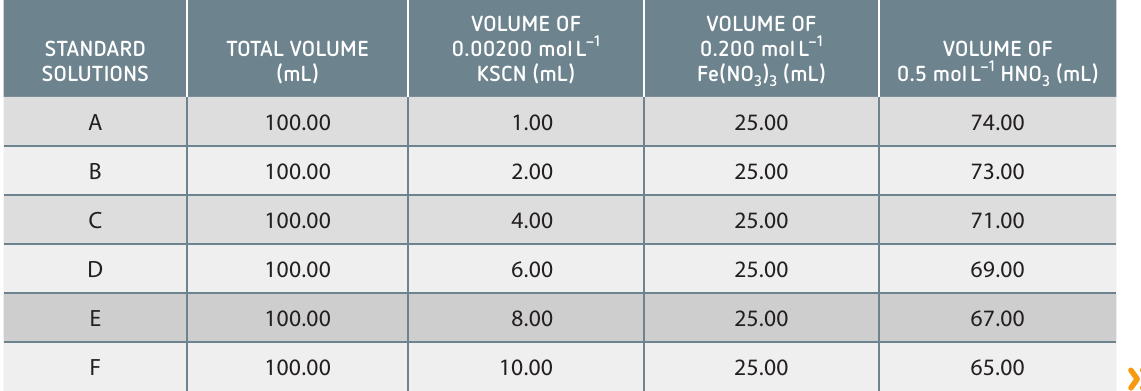
Part A: Creating a calibration curve
You prepare a series of standard solutions with known concentrations of FeSCN by using a large excess of Fe. This ensures that essentially all the SCN reacts to form the complex ion. You then measure the absorbance of each standard solution and plot a graph of absorbance versus concentration. This calibration curve allows you to convert absorbance readings into concentrations for unknown solutions.
Note
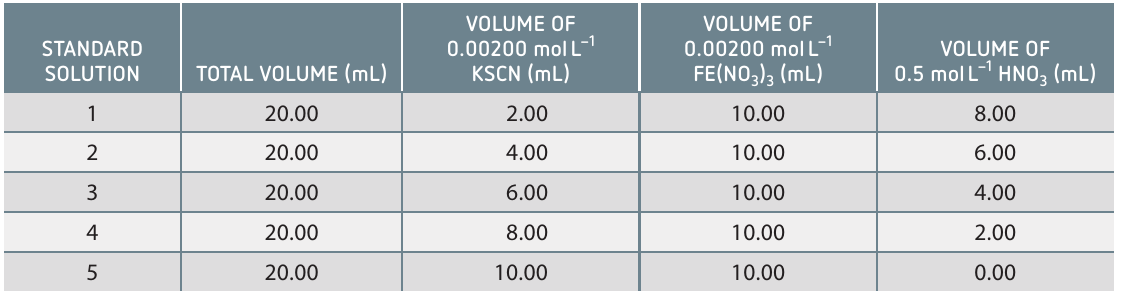
Part B: Measuring equilibrium mixtures
You prepare several solutions with different initial concentrations of Fe and SCN. After these reach equilibrium, you measure their absorbance and use your calibration curve to determine the equilibrium concentration of FeSCN.
Calculating equilibrium concentrations:
Once you know , you can calculate the equilibrium concentrations of the other species using these relationships:
These equations reflect the 1:1:1 stoichiometry of the reaction – for every mole of FeSCN formed, one mole each of Fe and SCN is consumed.
Safety considerations
Important
Safety First
When conducting chemical investigations, always assess potential risks:
- Chemical splash hazard: Wear safety glasses at all times and wash your hands thoroughly after the experiment
- Environmental impact: The FeSCN complex is harmful to aquatic life, so dispose of it in a designated waste bottle rather than pouring it down the sink
- Always follow your school's safety protocols and risk assessment procedures
The ICE method in colourimetry experiments
The ICE method is particularly useful when analysing colourimetry results. Here's how to apply it:
- Calculate the initial concentrations of Fe and SCN based on the volumes and concentrations of the solutions you mixed
- Use the calibration curve to determine the equilibrium concentration of FeSCN from the absorbance measurement
- Calculate the change in concentration for each species using stoichiometry
- Determine the equilibrium concentrations of Fe and SCN by subtracting the change from their initial values
- Calculate using these equilibrium concentrations
Summary
Key Points to Remember:
- Two scenarios for calculating : You either need all equilibrium concentrations, or initial concentrations plus one equilibrium concentration
- Always use the correct number of significant figures in your final answer – match the least precise measurement in your data
- The ICE method (Initial, Change, Equilibrium) helps you organise concentration data and use stoichiometry to find unknown values
- The Beer-Lambert law () shows that absorbance is directly proportional to concentration, making colourimetry useful for measuring concentrations
- Non-destructive measurement techniques like colourimetry are essential for equilibrium studies because they don't disturb the system you're measuring
- Stoichiometric ratios from the balanced equation determine how concentrations change – if coefficients differ, remember to account for this in your calculations