Non-Equilibrium Systems (HSC SSCE Chemistry): Revision Notes
📚Revision Notes
Non-Equilibrium Systems
Understanding equilibrium in chemistry
In chemistry, equilibrium refers to a state of balance in which the amounts of reactants and products remain constant over time. This concept is similar to everyday examples of balance you might encounter. For instance, a see-saw is in equilibrium when forces on both sides are balanced, keeping it horizontal. Similarly, a rainforest ecosystem maintains equilibrium when rainfall balances evaporation and water usage.
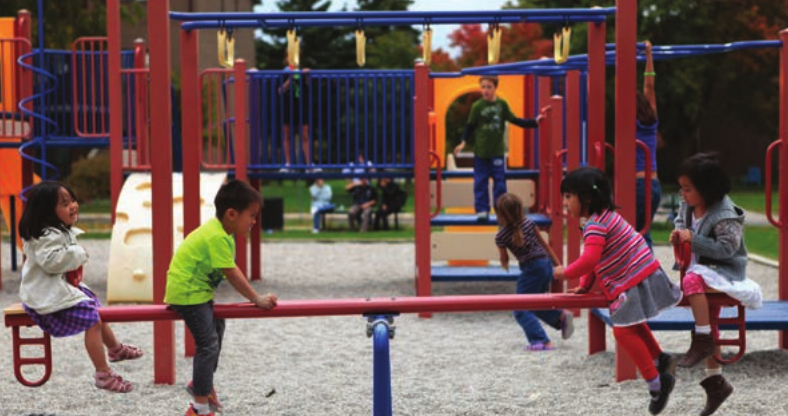
Note
In chemical systems, equilibrium occurs when the rate at which reactants form products equals the rate at which products reform reactants. This creates a dynamic balance where concentrations remain stable, even though reactions continue to occur in both directions.
It's important to understand that whilst the term 'equilibrium' always refers to balance, its specific meaning varies depending on the context. In chemistry, you need to grasp the particular requirements and processes that define chemical equilibrium.
Most chemical reactions you've studied so far have been simple, one-direction processes. These reactions start with reactants and proceed until one reactant is completely consumed, leaving you with products. However, many chemical reactions can actually be manipulated to favour either the formation of more products or the regeneration of reactants.
What are non-equilibrium systems?
Non-equilibrium systems are chemical reactions that proceed in one direction until completion, rather than establishing a balance between forward and reverse reactions. To understand these systems, we need to examine the thermodynamic factors that determine whether a reaction will occur spontaneously.
The two major thermodynamic drivers
Two fundamental forces drive chemical reactions: enthalpy and entropy. These determine whether a reaction will proceed spontaneously (without external energy input) or not.
Important
Entropy () measures the change in disorder or randomness of a system:
- A positive entropy change () indicates increasing randomness, which nature favours
- A negative entropy change () indicates decreasing randomness, which nature resists
Enthalpy () measures the change in heat energy of a system:
- A negative enthalpy change () indicates heat is released (exothermic), which is favourable
- A positive enthalpy change () indicates heat must be absorbed (endothermic), which is unfavourable
Predicting spontaneous reactions
When both drivers point in the same direction, predicting spontaneity is straightforward:
Spontaneous reactions occur when:
- The reaction increases randomness () AND
- The reaction releases heat energy ()
These reactions will continue until one reactant is completely consumed, then stop with no further reaction occurring.
Non-spontaneous reactions occur when:
- The reaction decreases randomness () AND
- The reaction requires continuous heat input ()
Note
These reactions will not proceed in the forward direction. However, the reverse reaction will occur spontaneously.
When drivers oppose each other
Predicting spontaneity becomes more challenging when enthalpy and entropy changes oppose one another. This occurs in two scenarios:
- The reaction increases randomness () BUT requires heat input ()
- The reaction decreases randomness () BUT releases heat ()
In these cases, which driver has the greater effect? This is where we need to use Gibbs free energy to determine the overall outcome.
Gibbs free energy: determining spontaneity
Gibbs free energy () is a thermodynamic quantity that combines the effects of enthalpy and entropy to determine whether a reaction will occur spontaneously at a given temperature (). The formula is:
Where:
- = Gibbs free energy change (in )
- = enthalpy change (in )
- = temperature (in , kelvin)
- = entropy change (in )
Interpreting Gibbs free energy values
Important
The sign of tells us whether a reaction is spontaneous:
- Negative (): The reaction will occur spontaneously
- Positive (): The reaction will not occur spontaneously (but the reverse reaction would be spontaneous)
Worked example: combustion of methane
Example
Worked Example: Determining Spontaneity of Methane Combustion
Let's examine whether the combustion of methane is spontaneous at (standard room temperature).
Reaction:
Data at standard conditions ():
| Species | ||||
|---|---|---|---|---|
| Enthalpy of formation () | ||||
| Entropy () |
Step 1: Calculate enthalpy change
Step 2: Calculate entropy change
Step 3: Calculate Gibbs free energy
First, convert entropy to :
Conclusion: The reaction is spontaneous because the Gibbs free energy is negative.
Real-world applications of spontaneity
Spontaneous combustion reactions
The worked example demonstrates that combustion reactions have negative Gibbs free energy values at room temperature, making them spontaneous. Once initiated with a small amount of activation energy (like a spark or flame), combustion reactions continue until one of the reactants is completely consumed.
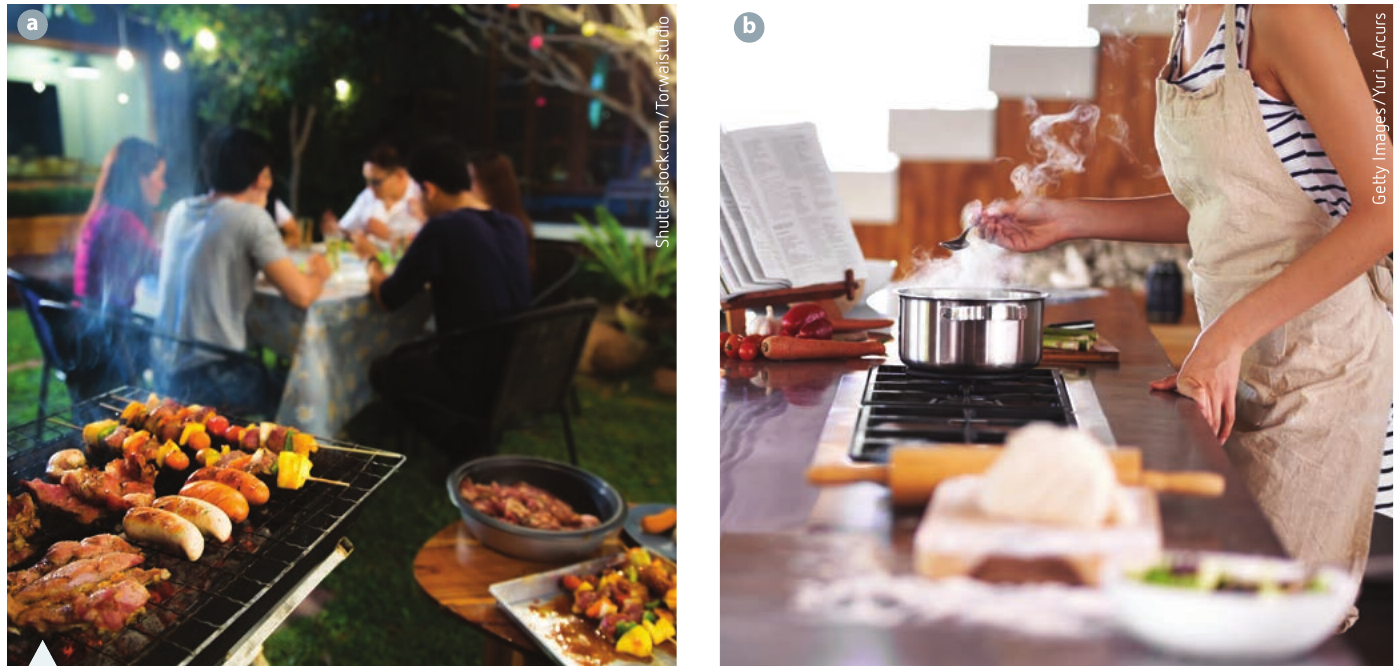
Note
Common examples of spontaneous combustion reactions include:
- Gas cooking on barbecues
- Gas stoves in kitchens
- Burning of fuels in engines
These reactions release significant energy, which we harness for cooking, heating, and powering vehicles.
Non-spontaneous reactions: photosynthesis
Unlike combustion, photosynthesis has a positive Gibbs free energy value, indicating it is not spontaneous. The reaction requires substantial energy input to proceed.
Photosynthesis equation:
Photosynthesis only occurs in green plants because they possess chlorophyll, a catalyst essential for the reaction. Additionally, photosynthesis requires UV energy from sunlight, which is why it only occurs during daylight hours.
Note
Interestingly, respiration (the process occurring in our bodies) is essentially the reverse of photosynthesis - it's the combustion of glucose. Since respiration has a negative Gibbs free energy, it occurs spontaneously, providing the energy we need to live each day.
When systems approach equilibrium
What happens when the Gibbs free energy for a reaction is very close to zero? This represents a special case that leads us towards understanding equilibrium systems.
Recall that:
- Negative means the forward reaction occurs spontaneously
- Positive means the reverse reaction occurs spontaneously
Important
When (approximately zero), neither direction is strongly favoured. This indicates that:
- Reactants can form products
- Products can simultaneously react to reform reactants
In this situation, both forward and reverse reactions can occur at the same time when all chemical species are present. This is the transition point between non-equilibrium systems and true equilibrium systems, where both reactions proceed at equal rates.
Remember!
Summary
Key Points to Remember:
-
Non-equilibrium systems are reactions that proceed in one direction until one reactant is completely consumed, rather than establishing a balance between forward and reverse processes.
-
Gibbs free energy () determines reaction spontaneity: negative values indicate spontaneous reactions, whilst positive values indicate non-spontaneous reactions.
-
Two thermodynamic drivers control reactions: entropy (disorder) and enthalpy (heat energy). Reactions favour increasing randomness and releasing heat.
-
Combustion reactions are spontaneous at room temperature with large negative Gibbs free energy values, which is why they continue once initiated until fuel is exhausted.
-
When , the system approaches equilibrium where both forward and reverse reactions can occur simultaneously, transitioning from a non-equilibrium to an equilibrium system.