Dissolution of Ionic Compounds (HSC SSCE Chemistry): Revision Notes
📚Revision Notes
Dissolution of Ionic Compounds
Water as a solvent
Water serves as one of nature's most effective solvents, and this remarkable property stems from its polar molecular structure. Understanding how water dissolves substances is fundamental to chemistry.
A solvent is the substance that does the dissolving (in this case, water), while a solute is the substance being dissolved (such as a salt). When a solute dissolves in a solvent, it forms a solution. This solution is described as homogeneous, meaning it has uniform composition throughout because the dissolved particles are far too small to be seen with the naked eye.
Note
The polarity of water is what makes it such an effective solvent. The water molecule () has a bent shape, with the oxygen atom carrying a partial negative charge () and the hydrogen atoms carrying partial positive charges (). This uneven distribution of charge makes water an excellent solvent for ionic compounds.
The dissolution process
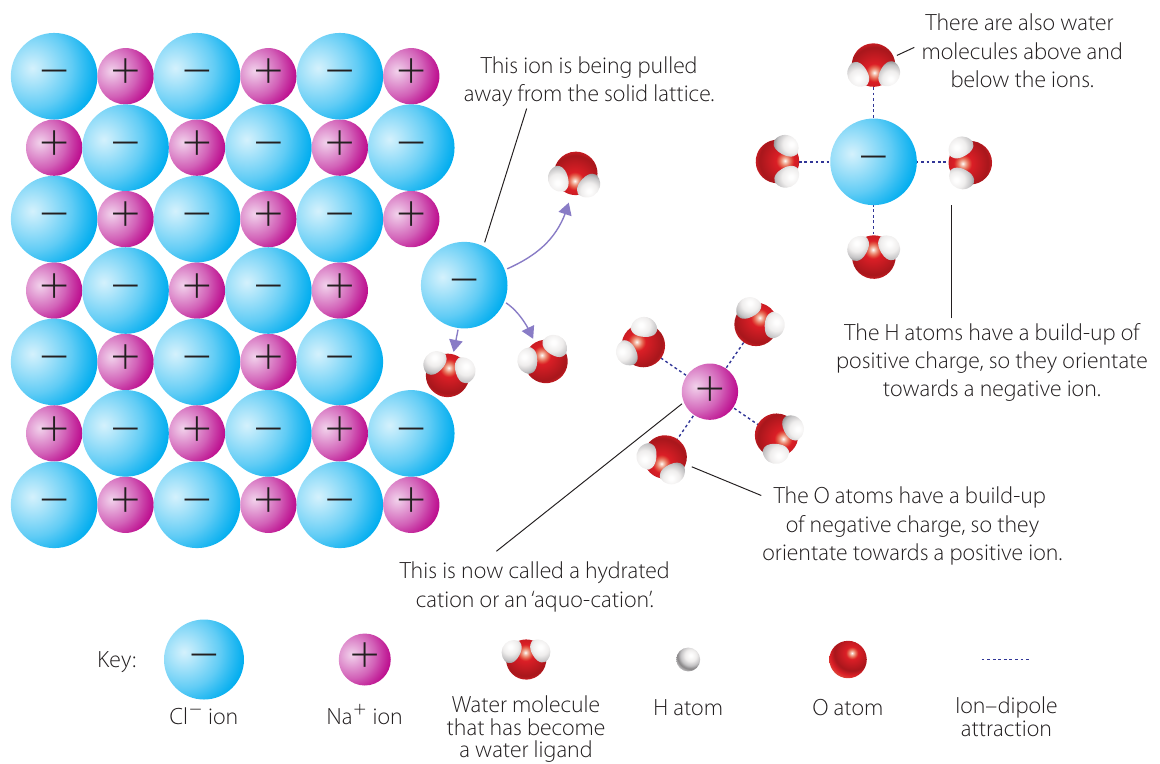
When an ionic salt (such as sodium chloride, ) dissolves in water, a fascinating molecular process occurs involving the formation of ion-dipole bonds. These are attractive forces between the charged ions of the salt and the polar water molecules.
Hydration of anions
The hydrogen atoms of water molecules, carrying partial positive charges, are drawn toward negatively charged ions (anions) in the salt crystal. Multiple water molecules orient themselves around each anion, with their hydrogen atoms pointing toward the negative ion. Additional water molecules continue to gather around the anion until it becomes completely surrounded by a "shell" of water molecules – a state called being hydrated.
Note
Understanding Hydration
When an ion is fully hydrated, it is completely encased in a layer of water molecules. This hydration shell is held together by ion-dipole attractions, which are strong enough to keep the ion separated from the crystal lattice and dispersed in solution.
Hydration of cations
Similarly, the oxygen atoms of water molecules, carrying partial negative charges, are attracted to positively charged ions (cations) in the salt. The water molecules orient themselves with their oxygen atoms pointing toward the positive ion. This process continues until the cation is fully hydrated. A hydrated cation is sometimes called an aquo-cation.
Breaking the crystal lattice
As water molecules surround and hydrate both the anions and cations, they effectively pull these ions away from the solid crystal structure. The attraction between the water molecules and the ions becomes strong enough to overcome the ionic bonds holding the crystal together. Eventually, the ionic bonds within the salt crystal break completely, and the salt has dissolved into individual hydrated ions dispersed throughout the solution.
Energy considerations in dissolution
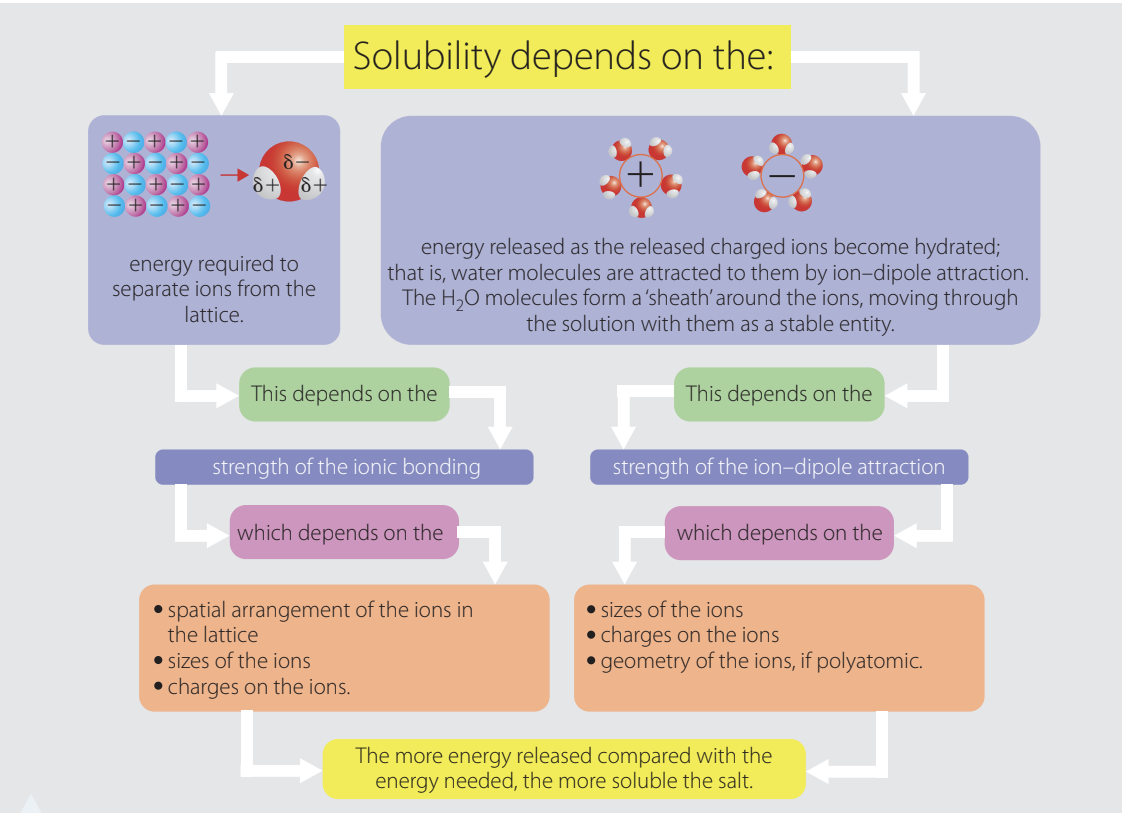
Whether an ionic compound will dissolve in water depends on a delicate energy balance. For dissolution to occur, the energy situation must be favourable.
The energy balance
Two main energy changes occur during dissolution:
- Energy required (lattice energy): Energy must be supplied to separate the ions from their positions in the solid crystal lattice. The ionic bonds holding the crystal together are strong, so this step requires a significant energy input.
- Energy released (hydration energy): When the separated ions become hydrated (surrounded by water molecules forming ion-dipole bonds), energy is released. This is because the ion-dipole attractions between ions and water molecules are energetically favourable.
Important
The Key Principle of Dissolution
A solute dissolves when the energy of the bonds it forms with water is lower than the energy of the bonds between water molecules or between the ions of the substance being dissolved.
In simpler terms: the energy released during hydration must exceed the energy required to break apart the crystal lattice. The greater the difference between energy released and energy required, the more soluble the salt will be.
Example
Energy Balance in Dissolution
Consider the dissolution of an ionic compound:
Step 1: Breaking the crystal lattice
- Energy required (lattice energy) = (endothermic)
Step 2: Hydrating the separated ions
- Energy released (hydration energy) = (exothermic)
Net energy change:
Since the net energy change is negative (exothermic), the compound will dissolve. The hydration energy exceeds the lattice energy, making dissolution energetically favourable.
Factors affecting solubility
The solubility of an ionic compound depends on several factors that influence both lattice energy and hydration energy:
Factors affecting lattice energy:
- Sizes of the ions: Smaller ions can pack more closely together, creating stronger ionic bonds and higher lattice energy
- Charges on the ions: Higher charges create stronger electrostatic attractions in the lattice
- Spatial arrangement of ions in the lattice: How the ions are organized in the crystal structure affects the overall lattice stability
Factors affecting hydration energy:
- Sizes of the ions: Smaller ions have higher charge density and attract water molecules more strongly, releasing more hydration energy
- Charges on the ions: Higher charges create stronger ion-dipole attractions with water molecules
- Geometry of the ions: For polyatomic ions (ions containing multiple atoms), their shape affects how effectively water molecules can surround and hydrate them
Note
Ion Size and Solubility
Ion size affects both lattice energy and hydration energy, but in opposite ways:
- Smaller ions → Higher lattice energy (harder to break apart)
- Smaller ions → Higher hydration energy (more energy released when hydrated)
The balance between these two effects determines whether smaller or larger ions will be more soluble.
Temperature effects
Temperature influences ionic compound dissolution in two important ways:
- Rate of dissolution: Higher temperatures generally increase the rate at which an ionic salt dissolves, as the increased kinetic energy helps water molecules more rapidly surround and hydrate the ions.
- Amount that can dissolve: Temperature also affects the maximum amount of salt that can dissolve in a given volume of water (the solubility). For most ionic compounds, solubility increases with temperature.
Note
Practical Application
This is why hot water dissolves sugar and salt faster than cold water – both in terms of how quickly they dissolve and how much can be dissolved. However, there are exceptions: some ionic compounds become less soluble at higher temperatures.
Summary
Key Points to Remember
-
Water's polar structure makes it an excellent solvent for ionic compounds, enabling the formation of ion-dipole bonds between water molecules and ions.
-
Dissolution involves hydration – water molecules completely surround both anions (negative ions) and cations (positive ions), pulling them away from the crystal lattice.
-
For an ionic compound to dissolve, the energy released during hydration must exceed the energy required to separate ions from the crystal lattice.
-
Multiple factors affect solubility, including ion size, charge, geometry, and spatial arrangement – all of which influence both lattice energy and hydration energy.
-
Temperature affects both the rate of dissolution and the amount of ionic compound that can dissolve in water.