Solubility Rules (HSC SSCE Chemistry): Revision Notes
📚Revision Notes
Solubility Rules
Introduction to aqueous solutions
In chemistry, solutions are homogeneous mixtures where one substance (the solute) is dissolved in another (the solvent). When we talk about aqueous solutions, we mean solutions where water is the solvent. The word 'aqueous' comes from the Latin word aqua, meaning water.
Note
Aqueous solutions are everywhere in nature. Oceans are aqueous solutions containing many dissolved compounds, including ionic substances. All the chemical reactions that keep living things alive happen in aqueous solutions within our cells and bodies.
What happens when ionic substances dissolve
When ionic substances dissolve in water, they undergo a process called dissociation. This means the ionic compound separates into its individual ions, which then move freely and independently through the solution.
For example, when sodium chloride (common table salt) dissolves in water:
The solid sodium chloride breaks apart into sodium ions () and chloride ions (), both of which are surrounded by water molecules and can move throughout the solution.
Understanding solubility categories
Not all ionic compounds dissolve to the same extent in water. Chemists classify the solubility of compounds into three categories:
- Soluble: The compound dissolves to more than (or )
- Insoluble: The compound dissolves to less than
- Sparingly soluble: The compound dissolves in the range to
Note
Exam tip: Units can be written as either or - both mean exactly the same thing!
Precipitation reactions
A precipitation reaction occurs when solutions of certain ionic compounds are mixed together and produce a solid substance called a precipitate.
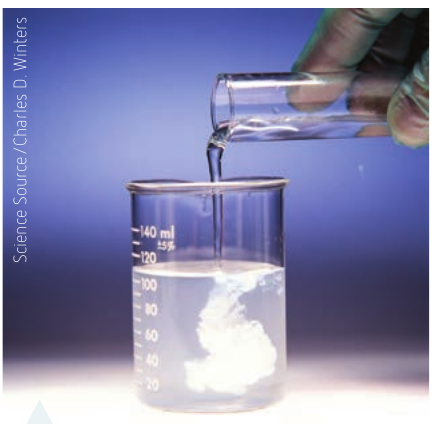
How precipitation happens
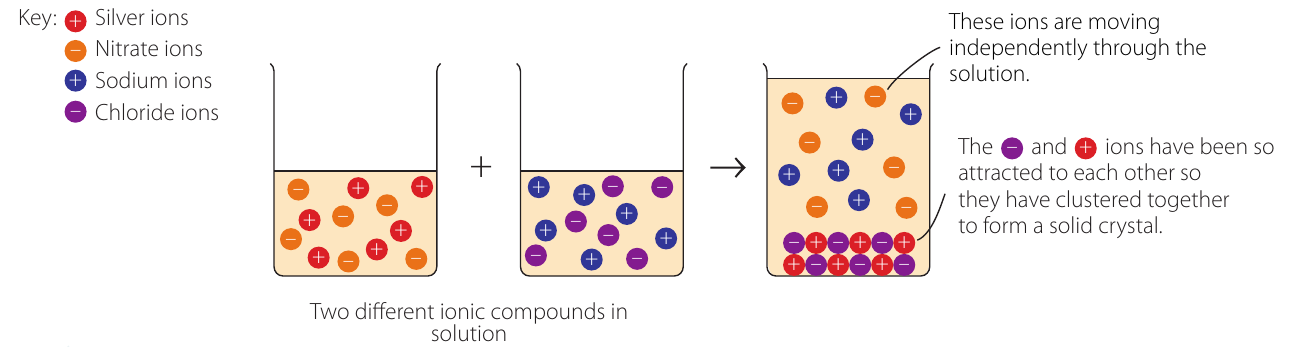
Let's consider what happens when sodium chloride solution is mixed with silver nitrate solution. Initially, we have:
- and ions from the sodium chloride solution
- and ions from the silver nitrate solution
When these solutions are mixed, all four types of ions are moving randomly throughout the combined solution. Each ion is surrounded by water molecules. However, the and ions are more strongly attracted to each other than they are to the water molecules. This causes them to cluster together and form solid silver chloride, which precipitates out of solution.
Spectator ions
In the precipitation reaction above, the and ions don't participate in the reaction. They remain dissolved in the solution before, during, and after the precipitation occurs. We call these non-participating ions spectator ions - they just 'watch' the reaction happen without getting involved.
Writing equations for precipitation reactions
Precipitation reactions can be represented using three different types of equations:
Note
1. Overall equation
This shows all reactants and products as complete, neutral compounds:
2. Complete ionic equation
This shows all the ions present in the solution:
3. Net ionic equation
This shows only the reacting ions (spectator ions removed):
Important
Exam tip: The net ionic equation most accurately represents what's actually happening in the precipitation reaction, so it's the most commonly used form.
Predicting precipitation using solubility rules
Chemists have systematically mixed many different solutions to determine experimentally which compounds are soluble and which form precipitates. These results have been organised into solubility tables that we can use to predict whether a precipitation reaction will occur when two solutions are mixed.
Table of solubility rules
The following table summarises the solubility of common ionic compounds:
| Soluble Anions | Exceptions | Insoluble Anions | Exceptions |
|---|---|---|---|
| None | Group 1, , , soluble; slightly soluble | ||
| slightly soluble | Group 1, , , , soluble | ||
| insoluble; slightly soluble | Groups 1 and 2, soluble | ||
| insoluble; slightly soluble | Group 1, soluble | ||
| , insoluble | Group 1, soluble | ||
| , , insoluble; , slightly soluble | Group 1, soluble |
Important
Key generalisation: All Group 1 and salts are soluble.
This table applies to common cations including: Groups 1 and 2, , , , , , , , , , , , , and .
How to use the solubility table
To predict whether a precipitate will form when two solutions are mixed:
- Write the formulae of the compounds present
- Determine what products would form by swapping the partners of the reacting compounds
- Check the formulae are correct
- Use the solubility table to identify whether any products are insoluble
- If an insoluble product forms, that's your precipitate!
Applying solubility data

Precipitation reactions have important practical applications in chemistry. Chemists often need to identify substances such as cations and anions that may have contaminated food, soil, or water supplies.
Note
For example, precipitation reactions can be used to test for dangerous metals like lead or cadmium in drinking water. They can also be used to remove unwanted substances from water through selective precipitation.
Worked example: Predicting precipitation
Example
Worked Example: Predicting Precipitation
Question 1: What precipitate, if any, will form when aqueous solutions of magnesium iodide and silver nitrate are mixed? If a precipitate forms, write the neutral species and net ionic equations for the reaction.
Solution:
Step 1: Write the formulae of the compounds present
- Magnesium iodide:
- Silver nitrate:
Step 2: Predict the products by swapping partners
Step 3: Use the solubility table to identify if either product is insoluble
- All nitrates are soluble, so is soluble
- All iodides are soluble except and , so will precipitate
Answer: The precipitate is .
Neutral species equation:
Net ionic equation:
Worked example: Selecting a reagent
Example
Worked Example: Selecting a Reagent
Question 2: Select a reagent that could be used to precipitate the cation in , explaining your selection.
Solution:
Step 1: Identify the ions present in solution
- and are the ions present in solution
Step 2: Identify which ion needs to be precipitated
- is the cation to be precipitated
Step 3: Use the solubility table to find suitable anions
Looking at insoluble anions that form precipitates with :
- (barium sulfate is insoluble)
- (barium sulfide is insoluble)
- (barium carbonate is insoluble)
- (barium sulfite is insoluble)
- (barium phosphate is insoluble)
Step 4: Choose an appropriate anion and cation
- Let's select as the anion to precipitate
- We need a cation that won't precipitate with
- is a good choice because all Group 1 salts are soluble
Answer: can be used to precipitate from a solution of .
Important
Exam tip: When choosing a reagent, it's usually best to select a cation from Group 1 or because compounds containing these cations are always soluble. Avoid choosing or as they form precipitates with many anions.
Remember!
Summary
Key Points to Remember:
-
Aqueous solutions are substances dissolved in water. When ionic compounds dissolve, they dissociate into freely moving ions.
-
Precipitation reactions occur when two ionic solutions are mixed and form an insoluble solid (precipitate).
-
Three types of equations: Overall equations show complete compounds, complete ionic equations show all ions present, and net ionic equations show only the reacting ions (most useful for precipitation reactions).
-
Spectator ions are ions that don't participate in the reaction - they remain dissolved in solution throughout.
-
Solubility rules allow us to predict whether a precipitate will form when two solutions are mixed. All Group 1 and salts are soluble!