Review of Basic Concepts (HSC SSCE Chemistry): Revision Notes
📚Revision Notes
Review of Basic Concepts
Introduction
As you progress through your HSC Chemistry course, you'll find that new concepts build upon foundations laid in earlier studies. This revision note covers the fundamental chemistry concepts that you've encountered before, providing a solid foundation for more advanced topics ahead. Understanding these basics thoroughly will help you succeed in your chemistry studies.
Note
Mastering these foundational concepts is essential for success in advanced chemistry topics. Take time to review areas where you feel less confident, as these basics will be referenced throughout your HSC course.
Mixtures and pure substances
In chemistry, we classify substances based on their composition and purity. Understanding the distinction between mixtures and pure substances is essential for chemical analysis and practical work.
What is a pure substance?
A pure substance contains only one type of material, with no contamination from other substances. You can confirm purity by attempting to purify the substance further - if its properties remain unchanged after purification procedures, it's pure. This constant behaviour is a hallmark of pure substances.
In contrast, an impure substance contains small amounts of one or more contaminants mixed with the main substance. Therefore, any impure substance is actually a mixture.
Homogeneous and heterogeneous substances
Two important terms help us describe how uniform a substance appears:
Homogeneous means having uniform composition throughout. When you examine a homogeneous substance, every part looks and behaves the same way. Examples include pure water, sugar crystals, aluminium foil, petrol, and apple juice. You cannot distinguish different regions or components by eye.
Heterogeneous means having non-uniform composition. When you look at a heterogeneous substance, you can recognise different regions or pieces that differ from each other. Examples include strawberry jam (you can see fruit pieces), wood (you can see growth rings and grain), beef (you can see different tissues), and concrete (you can see stones and cement).
Important
The key difference: In homogeneous substances, you cannot see separate parts or regions, even under a microscope. In heterogeneous substances, you can distinguish different components either by eye or with magnification.
Key differences between mixtures and pure substances
| Property | Mixture | Pure substance |
|---|---|---|
| Separation | Can be separated into two or more pure substances using physical methods (filtering, boiling, magnets, manual sorting) | Cannot be separated by physical or mechanical means |
| Uniformity | May be homogeneous (tap water, air) or heterogeneous (fruit cake, concrete) | Always homogeneous (sugar crystals, piece of copper) |
| Properties | Shows properties of the different substances it contains; different parts may show different properties | Has constant properties (appearance, colour, density, melting point, boiling point) throughout the entire sample |
| Variability | Properties change when you alter the relative amounts of substances present | Properties never change, regardless of preparation method or source |
| Composition | Variable composition - you can vary the relative amounts of each substance | Fixed composition - the ratio of components never changes |
| Examples | Sea water, air, coffee, milk, petrol, whisky, brass, 'silver' coins | Table salt, sugar, copper, aluminium, diamond, gold, polyethylene, alcohol |
Elements and compounds
Pure substances fall into two categories: those that can be broken down into simpler substances, and those that cannot.
Elements
Elements are pure substances that cannot be decomposed into simpler substances by chemical means. They represent the most basic forms of matter. Common examples include aluminium, copper, carbon (as diamond or graphite), oxygen, gold, nitrogen, and mercury. There are approximately naturally occurring elements, plus about a dozen artificial elements created by scientists.
Compounds
Compounds are pure substances that can be decomposed into simpler substances, typically into their constituent elements. Common examples include table salt (sodium chloride), sugar (sucrose), water, sodium carbonate (washing soda), ammonium sulfate (a common fertiliser), ethanol (alcohol), and aspirin.
Every compound has three defining characteristics:
- It consists of two or more elements chemically combined
- The elements are always present in the same fixed ratio by mass
- Its properties differ significantly from those of the elements that form it
Note
A compound's properties are completely different from the properties of its constituent elements. For example, sodium (a reactive metal) and chlorine (a poisonous gas) combine to form sodium chloride (table salt), which is safe to eat and has entirely different properties from either element.
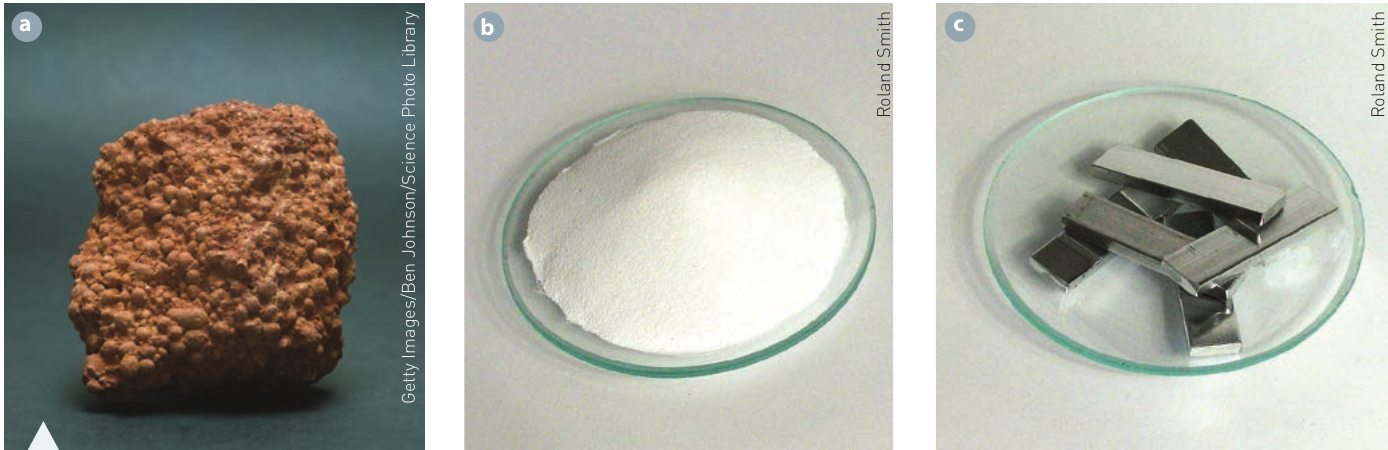
Case study: From bauxite to aluminium
The extraction of aluminium from bauxite ore illustrates the differences between mixtures, compounds, and elements beautifully.
| Property | Bauxite (mixture) | Aluminium oxide (compound) | Aluminium (element) |
|---|---|---|---|
| Appearance | Red pebbly solid | Crystalline white solid | Silvery lustrous solid |
| Melting point | No definite melting point | ||
| Composition | Varies from mine to mine | Constant composition ( aluminium by mass) | Pure element |
| Separation | Can be separated into aluminium oxide, iron(III) oxide, and earth | Can be decomposed by electrolysis into aluminium and oxygen | Cannot be decomposed into simpler substances |
| Density | Varies with composition | ||
| Physical properties | Can be ground into powder fairly easily | Small crystals are hard and brittle | Fairly soft, but malleable and ductile |
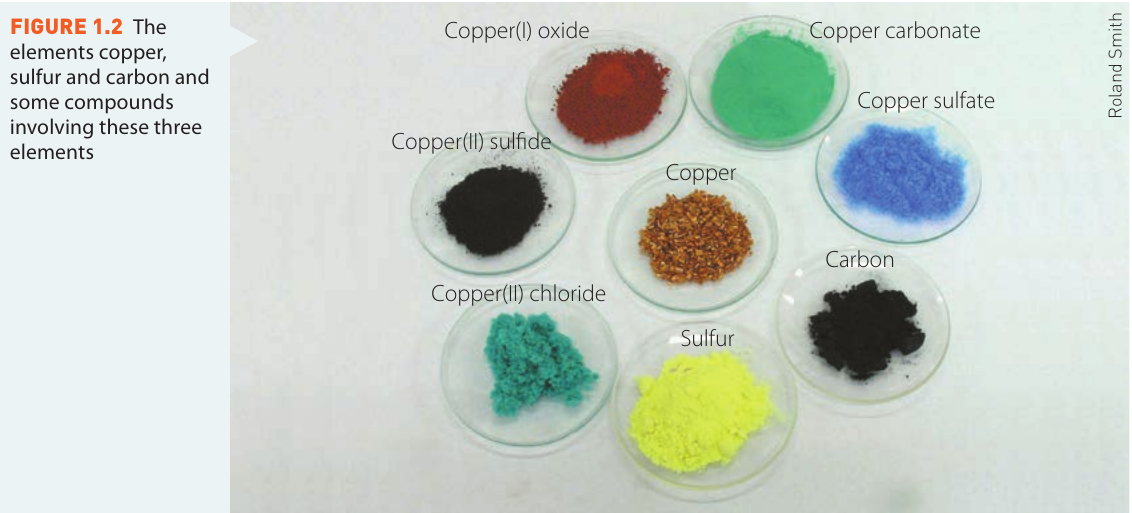
Classification of matter
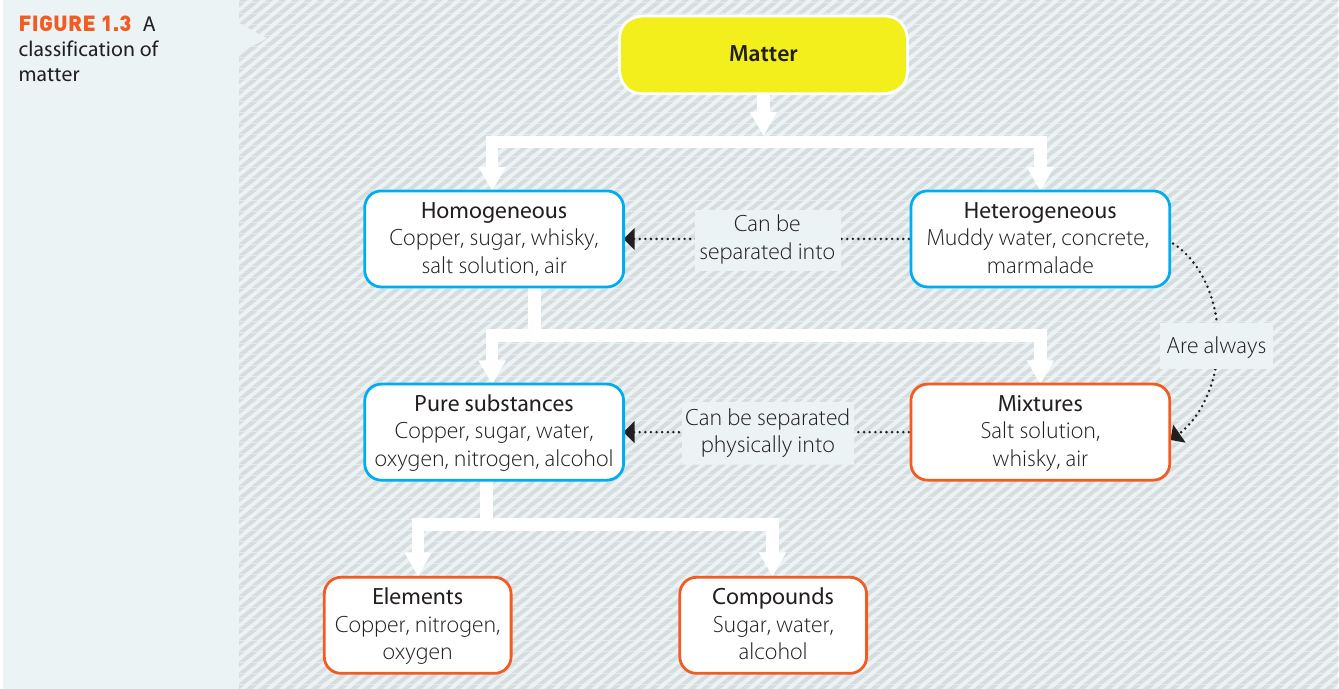
All matter can be classified systematically based on these concepts. The diagram below shows how matter divides into homogeneous and heterogeneous categories, with further subdivisions into mixtures, pure substances, elements, and compounds.
Physical states
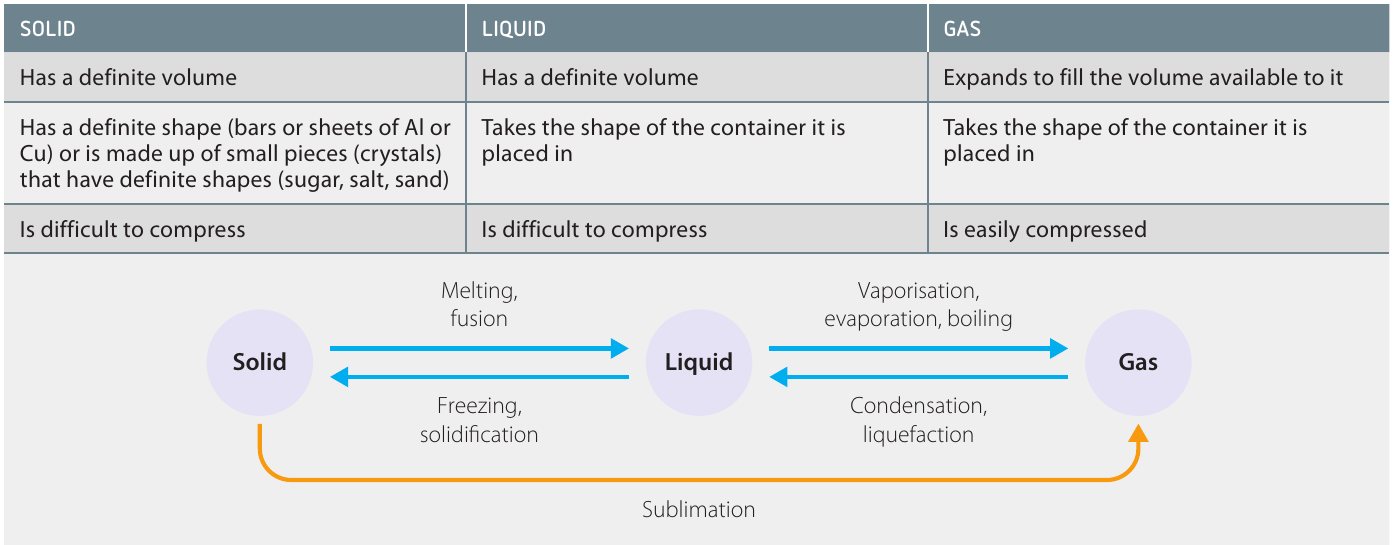
The physical state of a substance refers to whether it exists as a solid, liquid, or gas. These three states of matter (also called phases) have distinct characteristics.
Properties of the three states
| Property | Solid | Liquid | Gas |
|---|---|---|---|
| Volume | Definite volume | Definite volume | Expands to fill available volume |
| Shape | Definite shape (bars, sheets) or made up of small pieces with definite shapes (crystals) | Takes the shape of its container | Takes the shape of its container |
| Compressibility | Difficult to compress | Difficult to compress | Easily compressed |
Changes of state
When substances transition between solid, liquid, and gas states, we call these changes of state. Each transition has specific names:
Melting (or fusion) occurs when a solid changes to a liquid. For example, ice melts to become liquid water at .
Freezing (or solidification) is the reverse process, when a liquid changes to a solid. Liquid water freezes to ice at .
Boiling is the rapid change of a liquid to a gas, with bubbles of vapour forming throughout the liquid. Water boils at at standard atmospheric pressure.
Evaporation (or vaporisation) describes the slower change of a liquid to a gas without visible bubble formation. Unlike boiling, evaporation can occur at temperatures well below the boiling point. Clothes dry through evaporation even on cool days.
Condensation (or liquefaction) happens when a gas or vapour changes to a liquid. Water vapour in air condenses on cold surfaces to form droplets.
Sublimation is the direct change from solid to gas without passing through the liquid phase. Dry ice (solid carbon dioxide) sublimes at room temperature, changing directly to gaseous . Iodine and ammonium chloride also sublime. Interestingly, the reverse process (gas to solid) is also called condensation.
Note
All changes of state are physical changes - no new substances are formed. The chemical identity of the substance remains the same whether it exists as a solid, liquid, or gas.
Solutions and suspensions
When substances mix together, the resulting mixture may be either a solution or a suspension, depending on the particle size.
Solutions
A solution is a homogeneous mixture where dispersed particles (molecules or ions) are extremely small. These particles never settle out and cannot be seen even with a microscope. Common examples include salt dissolved in water, sugar in water, iodine in alcohol, and brandy (which is alcohol and water mixed together).
In a solution, we use specific terms:
- The solute is the substance that dissolves
- The solvent is the liquid that does the dissolving
Example
Example: Making a Sugar Solution
When you dissolve sugar in tea:
- Sugar is the solute (the substance being dissolved)
- Water (in the tea) is the solvent (the substance doing the dissolving)
- The resulting mixture is a solution because the sugar molecules are evenly distributed throughout the water
Common salt and ethanol readily dissolve in water as solvent. Iodine and cooking oil readily dissolve in hexane as solvent. Even mixtures of gases can be described as solutions - air is a solution of oxygen, nitrogen, and other gases.
Suspensions
A suspension consists of particles dispersed through a liquid, but these particles are large enough to settle out when left standing. Suspensions are heterogeneous because the dispersed particles can be seen by eye or microscope. Examples include sand in water, milk, and paint. If you leave muddy water standing, the soil particles eventually settle to the bottom.
Important
Key Difference Between Solutions and Suspensions:
- Solutions have particles so small they never settle and cannot be seen even with a microscope (homogeneous)
- Suspensions have larger particles that will eventually settle out and can be seen with magnification (heterogeneous)
Physical and chemical changes
Understanding the difference between physical and chemical changes is crucial for predicting what happens during chemical processes and laboratory procedures.
Physical changes
A physical change is any change where no new substances form. The material remains chemically the same before and after the change. Physical changes include:
- Changing state: melting lead, boiling water, or subliming iodine
- Changing physical appearance: grinding limestone into powder, rolling copper into sheets, or drawing copper into wires
- Dissolving: sugar in water, iodine in hexane
- Separating mixtures: evaporating sea water to obtain salt, filtering sand from water
In all these examples, the chemical identity of the substances remains unchanged.
Chemical changes
A chemical change (also called a chemical reaction) is any change where at least one new substance forms. In a reaction, the starting substances (called reactants) are transformed into different substances (called products).
Example
Examples of Chemical Changes:
- Heating green copper carbonate produces black copper oxide and colourless carbon dioxide gas
- Burning silvery magnesium ribbon produces white magnesium oxide powder
- Heating a mixture of grey iron filings and yellow sulfur produces homogeneous black iron(II) sulfide
In each case, new substances with completely different properties form during the reaction.
Signs of a chemical reaction
Several observations indicate that a chemical reaction has occurred:
Gas evolution: Bubbles form when zinc granules are added to hydrochloric acid solution, indicating hydrogen gas production.
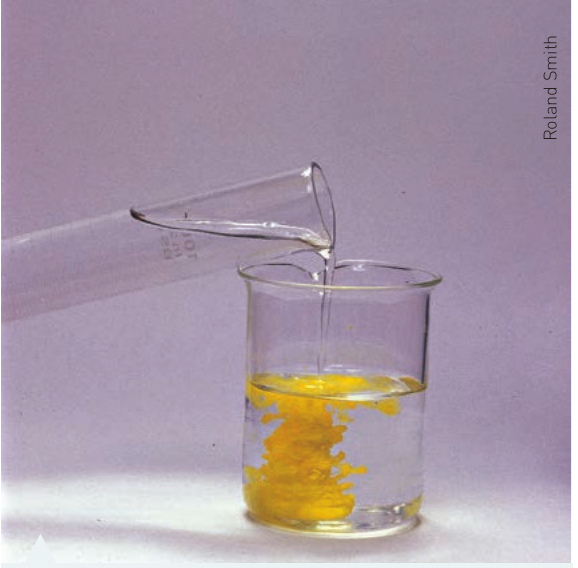
Precipitate formation: A solid forms when two solutions mix. For example, mixing colourless lead nitrate and potassium iodide solutions produces a yellow solid precipitate of lead iodide.
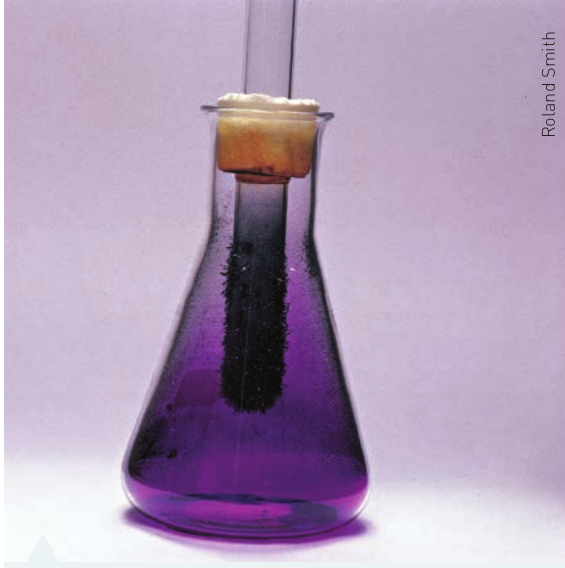
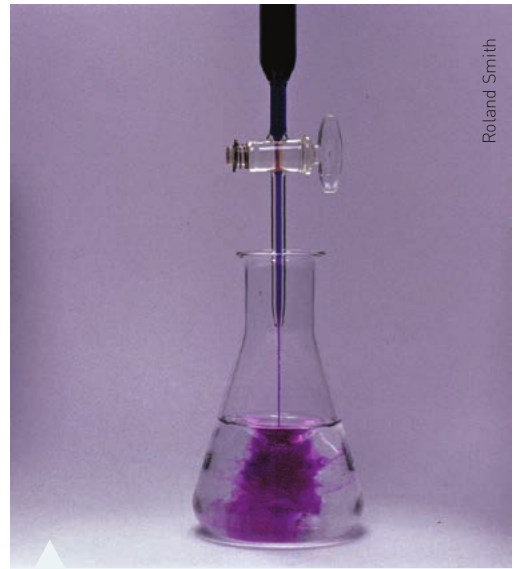
Colour change: Purple potassium permanganate solution becomes colourless when mixed with hydrogen peroxide solution.
Temperature change: Significant heating or cooling occurs. A gas burner flame (a combustion reaction) releases enough energy to heat water in a beaker.
Solid disappearance: A solid disappears by reacting (not just dissolving). White magnesium hydroxide powder (insoluble in water) produces a clear solution when added to hydrochloric acid.
Odour production: A distinctive smell appears. Adding sodium hydroxide to warm ammonium chloride solution releases ammonia gas, which has a sharp, characteristic smell.
Note
Identifying Chemical Reactions in the Laboratory:
Look for these six key indicators:
- Gas bubbles forming
- Precipitate (solid) forming in solution
- Colour change
- Temperature change (heating up or cooling down)
- Solid reacting and disappearing
- New odour appearing
Comparing physical and chemical changes
| Chemical change (reaction) | Physical change |
|---|---|
| At least one new substance forms | No new substances form |
| Difficult to reverse (you cannot 'un-boil' an egg) | Easily reversed (melt a solid, then freeze it again) |
| Generally involves large energy input or output (burning natural gas) | Involves relatively small energy changes (evaporating alcohol, dissolving sugar in water) |
Important
Critical Distinction: The fundamental difference is whether new substances form. If new substances with different properties are created, it's a chemical change. If the substance remains chemically the same, it's a physical change - even if its appearance changes dramatically.
Particle nature of matter
While we've discussed substances at the macroscopic level (what we can see and hold), chemistry also requires understanding the microscopic structure - the tiny particles that make up materials.
All matter consists of small particles, which we can visualise as tiny spheres. The arrangement and motion of these particles explain the properties of solids, liquids, and gases.
Solids
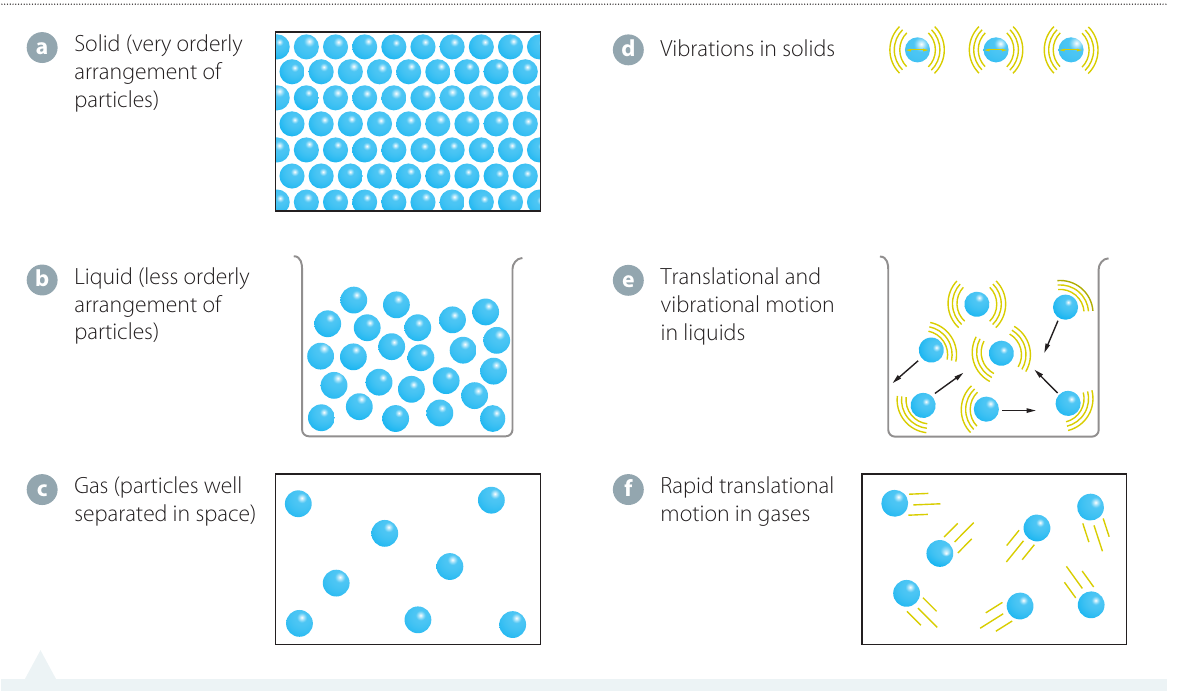
In solids, particles pack closely together in an orderly array. Forces hold particles to neighbouring particles, giving solids definite shapes and making them relatively hard. However, particles in solids aren't completely stationary - they vibrate slightly about their rest positions. This vibration increases with temperature.
Liquids
In liquids, particles arrange in a much less orderly fashion than in solids, and they move about more freely. Liquid particles possess more kinetic energy, and the forces between neighbouring particles are comparatively weaker than in solids. This explains why liquids lack definite shapes and instead take the shape of their container. Liquids flow and deform easily because particles can both vibrate and move randomly from one location to another within the bulk liquid.
Gases
In gases, particles are much further apart than in solids or liquids, and they move in very rapid random motion. The particles are so far apart and moving so rapidly that significant forces between them are negligible. Because of this rapid random motion, gases quickly spread out to fill any available volume.
Note
Particle Arrangement Summary:
- Solids: Closely packed, orderly arrangement, particles vibrate in place
- Liquids: Close together but disordered, particles can move around each other
- Gases: Far apart, particles move rapidly and randomly in all directions
Compression of matter
We imagine particles as hard and incompressible. Compressing a material means pushing particles closer together. In solids and liquids, particles already sit quite close to one another, so these states cannot be compressed much. In gases, large spaces separate particles, making it relatively easy to push particles closer together. This explains why gases compress easily whilst solids and liquids do not.
Atoms, molecules and ions
To explain more properties of matter, we need to consider the actual structure of the particles that make up substances.
Atoms
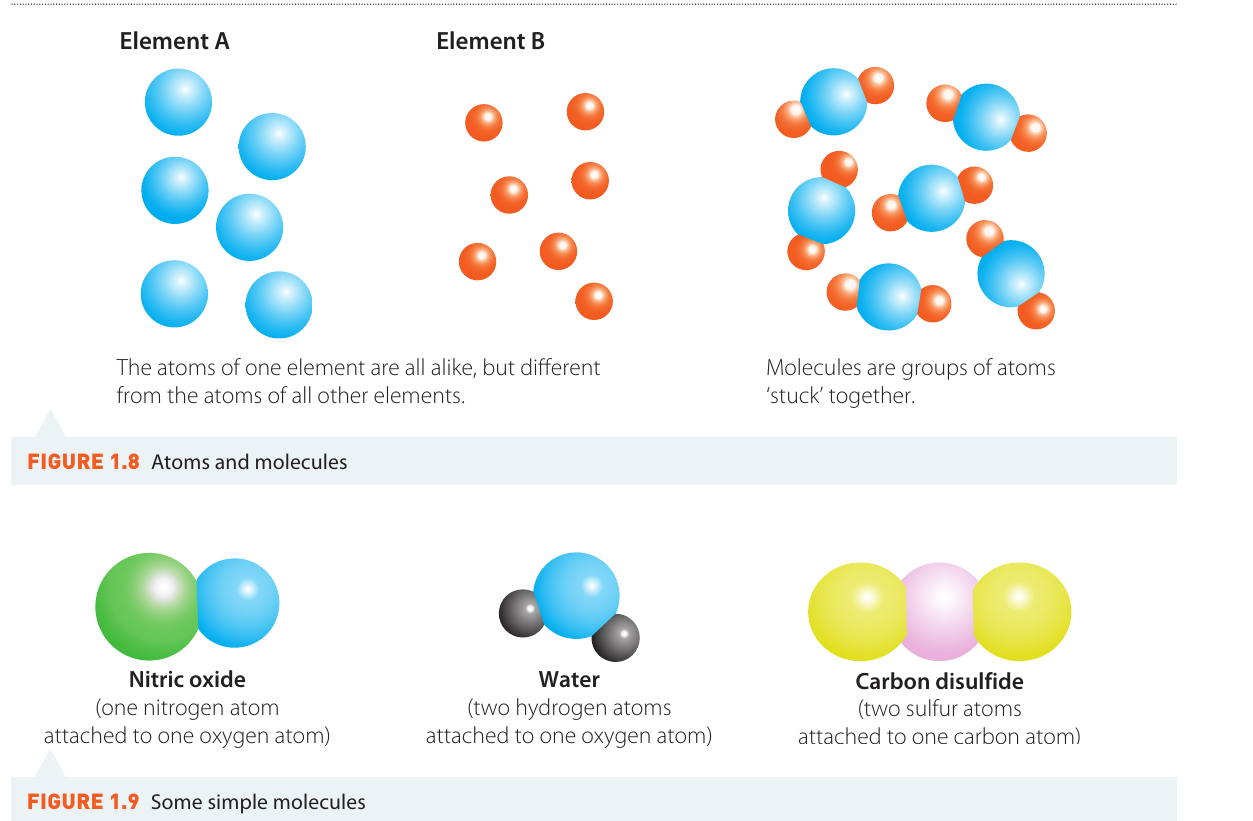
The particles that make up elements are called atoms. An atom is the smallest particle of an element that retains the identity of that element.
You can break atoms into even smaller pieces (electrons, protons, and neutrons - subatomic particles we'll discuss in Chapter 3), but those pieces would no longer be recognisable as the original element. We visualise atoms as tiny spheres. All atoms of one element are identical, but they differ from atoms of all other elements.
Molecules
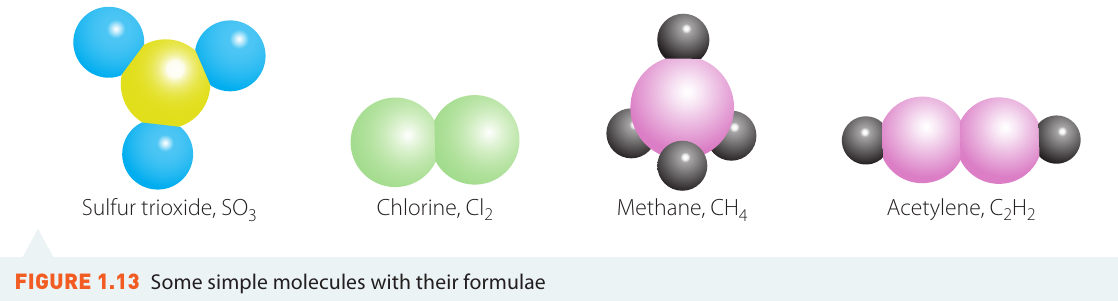
Compounds consist of two or more elements combined in definite proportions by mass. In many compounds, the particles consist of several atoms joined tightly together. We call these particles molecules.
A molecule is the smallest particle of a substance capable of separate existence.
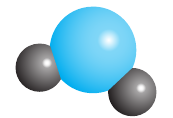
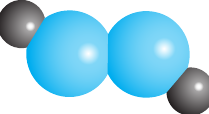
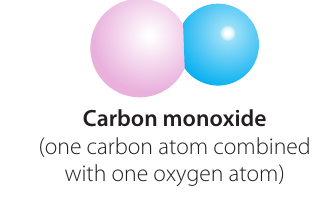
For example, water molecules consist of two hydrogen atoms firmly joined to one oxygen atom. All water molecules are identical. The figure below illustrates atoms and molecules conceptually.
Example
Common Molecular Compounds:
- Water (): two hydrogen atoms bonded to one oxygen atom
- Hydrogen peroxide (): two hydrogen atoms bonded to two oxygen atoms
- Carbon monoxide (): one carbon atom bonded to one oxygen atom
- Carbon dioxide (): one carbon atom bonded to two oxygen atoms
Notice how two elements can combine to form more than one type of compound. Even though hydrogen peroxide and water both contain only hydrogen and oxygen, they have completely different properties. Similarly, carbon monoxide is poisonous whilst carbon dioxide is not, despite both being carbon-oxygen compounds.
Molecules of elements
Some elements exist as molecules rather than individual atoms. Oxygen gas in the atmosphere doesn't consist of separate oxygen atoms - instead, oxygen atoms pair up to form diatomic molecules (). This is true for most common gaseous elements: nitrogen (), hydrogen (), chlorine (), and fluorine () all exist as diatomic molecules.
However, some gaseous elements like helium and argon exist as individual atoms, called monatomic molecules.
Ions
Some compounds form differently. Atoms of one element may transfer electrons (small negatively charged subatomic particles) to atoms of another element, creating ions - positively or negatively charged particles. Positively charged ions are called cations and negatively charged ions are called anions.
The compound that forms is an ionic lattice - an orderly three-dimensional array of positive and negative ions. Sodium chloride (table salt) is a classic example of an ionic compound.
Note
Ionic compounds form when atoms transfer electrons between each other, creating charged particles. These charged ions arrange themselves in a regular, repeating three-dimensional pattern called an ionic lattice. The strong electrostatic attraction between positive and negative ions holds the lattice together.
Examples of ionic compounds include aluminium oxide, copper(II) sulfide, copper(II) chloride, and lead iodide.
Sizes of particles
Atoms are incredibly small, typically to nanometres in diameter ( nanometre = metre). Along the edge of a ruler, approximately to billion atoms would fit side by side. A five-cent coin contains about atoms. A small grain of charcoal contains atoms. If atoms were the size of marbles, oranges would be approximately the size of Earth! Ions are roughly the same size as atoms.
Molecules are slightly larger than atoms since each contains several atoms. A sugar crystal contains molecules. Each sucrose molecule contains atoms ( carbon, hydrogen, and oxygen atoms), so the crystal contains atoms in total.
Important
The incredibly small size of atoms means that even tiny samples of matter contain enormous numbers of particles. This is why we use scientific notation to express these quantities - writing out all the zeros would be impractical!
Symbols and formulae
Chemists have developed a shorthand system for representing elements and compounds efficiently.
Element symbols
Chemical symbols represent elements. These symbols fall into three categories:
Category 1: Single capital letters, typically for very common elements
| Symbol | Element |
|---|---|
| Boron | |
| Carbon | |
| Hydrogen | |
| Iodine | |
| Nitrogen | |
| Oxygen | |
| Phosphorus | |
| Sulfur |
Category 2: Two letters (one capital, one lowercase) when multiple elements begin with the same letter
Examples include: (aluminium), (argon), (arsenic), (barium), (bismuth), (bromine), (calcium), (chlorine), (cobalt), (chromium)
Category 3: Symbols derived from non-English names
- for sodium (from natrium)
- for silver (from argentum)
- for potassium (from kalium)
- for iron (from ferrum)
Important
Writing Chemical Symbols Correctly:
When writing symbols by hand, always use a printed capital letter for the first letter and a lowercase letter for the second. For example, write for cobalt, not (which represents carbon monoxide). Incorrect capitalization changes the meaning!
Formulae for compounds
Combinations of element symbols represent compounds. These combinations are called formulae.
Molecular compounds
For compounds existing as molecules, the formula shows which elements are present and how many atoms of each element are in one molecule.
is the formula for water. It tells us:
- Water contains the elements hydrogen and oxygen
- Each water molecule contains two hydrogen atoms bonded to one oxygen atom
Ionic compounds
For compounds made of ions, the formula shows which elements are present and the ratio in which they occur (since ionic compounds don't contain discrete molecules).
is the formula for aluminium oxide. It tells us:
- Aluminium oxide contains aluminium and oxygen
- The aluminium and oxygen atoms (ions) are present in a ratio - two aluminium atoms for every three oxygen atoms in the ionic lattice
Note
Reading Chemical Formulae:
A subscript in a formula refers to the element immediately before it. When parentheses appear, the subscript outside applies to all atoms within the parentheses.
For example, in :
- The subscript applies only to oxygen (within the brackets)
- The subscript outside the brackets applies to everything inside - both nitrogen and oxygen
- This means nitrogen atoms and oxygen atoms for every copper atom
| Compound name | Formula | Meaning |
|---|---|---|
| Ammonia (molecule) | hydrogen atoms and nitrogen atom in each molecule | |
| Sulfuric acid (molecule) | hydrogen atoms, sulfur atom, and oxygen atoms in each molecule | |
| Boric acid (molecule) | boron atom, oxygen atoms, and hydrogen atoms in each molecule (the subscript applies to all atoms in the brackets) | |
| Magnesium chloride (ionic lattice) | chlorine atoms for every magnesium atom (present as ions, not neutral atoms) | |
| Sodium carbonate (ionic lattice) | sodium atoms and oxygen atoms for every carbon atom (present as ions) | |
| Copper nitrate (ionic lattice) | nitrogen atoms and oxygen atoms for every copper atom (present as ions) |
Remember!
Summary
Key Points to Remember:
-
Pure substances are not contaminated by other substances and have constant properties. Mixtures contain two or more substances that can be physically separated.
-
Homogeneous substances have uniform composition throughout, whilst heterogeneous substances have non-uniform composition with distinguishable parts.
-
Elements cannot be decomposed into simpler substances. Compounds can be decomposed into elements and always have fixed composition by mass.
-
The three states of matter are solid, liquid, and gas. Changes of state (melting, freezing, boiling, condensation, sublimation) are physical changes that don't create new substances.
-
Physical changes don't form new substances and are easily reversed. Chemical changes (reactions) form new substances and are difficult to reverse. In reactions, reactants are converted to products.
-
At the microscopic level, matter consists of particles. In solids, particles are closely packed and vibrate. In liquids, particles are less ordered and can move around. In gases, particles are far apart and move rapidly.
-
Atoms are the smallest particles of elements. Molecules are groups of atoms bonded together. Ions are charged particles that form ionic lattices in some compounds.
-
Chemical symbols represent elements using one or two letters. Chemical formulae use symbols and subscripts to show which elements are present and in what proportions.