Implications of a Reduction in Protection Levels (HSC SSCE Economics): Revision Notes
📚Revision Notes
Implications of a Reduction in Protection Levels
Introduction
Australia's move away from protectionism represents one of the most significant structural changes in the nation's economic history. This shift has deeply integrated Australia into the global economy, affecting firms, individuals, and governments in both the short and long term. Understanding these implications is crucial for analysing Australia's current economic position.
Note
The transition from protectionism to free trade has created both immediate challenges and long-term opportunities, with effects that continue to shape Australia's economy today.
Overview of impacts
The reduction in protection creates both winners and losers, with effects varying significantly between the short run and long run.
Effects on firms
Short-term impacts
When protection levels fall, firms operating in import-competing industries face immediate competitive pressure. Many businesses struggle to survive without the artificial advantage that tariffs and quotas previously provided.
Several outcomes occur in the short run:
- Business closures: Firms in marginal import-competing industries shrink or close entirely unless they can rapidly improve competitiveness. Manufacturing of consumer electronics (televisions, sound systems, microwave ovens) has almost entirely ceased in advanced economies like Australia. Car manufacturing ended in Australia in 2017.
- Why closures happen: Advanced economies cannot compete with the lower wage costs of emerging economies like China and Vietnam, particularly for products requiring high production volumes and large workforces.
- Lower input costs: Simultaneously, many firms benefit from reduced tariffs on imported inputs. For example, mining companies pay less for overseas-produced machinery used to extract coal and gas. This reduces production costs and improves international competitiveness.
Business restructuring responses
Some firms respond to reduced protection by restructuring operations rather than closing. Restructuring strategies include:
- Consolidating manufacturing to a single plant
- Eliminating less profitable product lines
- Finding export opportunities to offset declining domestic market share
- Adopting new production technologies to reduce costs
- Reducing staffing levels
Note
The aim is to develop the innovation and efficiency necessary to compete globally. Operating in a competitive domestic market forces Australian firms to improve, making them better equipped for international markets.
Long-term benefits for efficient firms
In the long run, firms that survive the initial adjustment period become more competitive. Key benefits include:
- Higher investment levels: Successful businesses invest in improved technology and business expansion
- Innovation and productivity: Productivity Commission research shows that reducing tariffs spurs innovation and productivity growth through increased competitive pressure
- Global competitiveness: Firms operating in competitive domestic markets develop capabilities to succeed in international markets
Example
Worked Example: Agricultural Inputs
The removal of tariffs on farm machinery has improved the competitiveness of Australia's agricultural industries. This is why the National Farmer's Federation has supported reducing protection levels.
Impact Assessment: The Productivity Commission estimated that tariffs imposed costs of $1.7 billion in 2020–21 through higher input prices.
Outcome: Lower input costs → Improved farm competitiveness → Industry support for free trade
Changes in export composition
Protection cuts, combined with other microeconomic policies, have altered Australia's export structure. During the 1990s, manufacturing exports grew significantly. However, the 2000s resources boom shifted Australia back toward commodity exports.
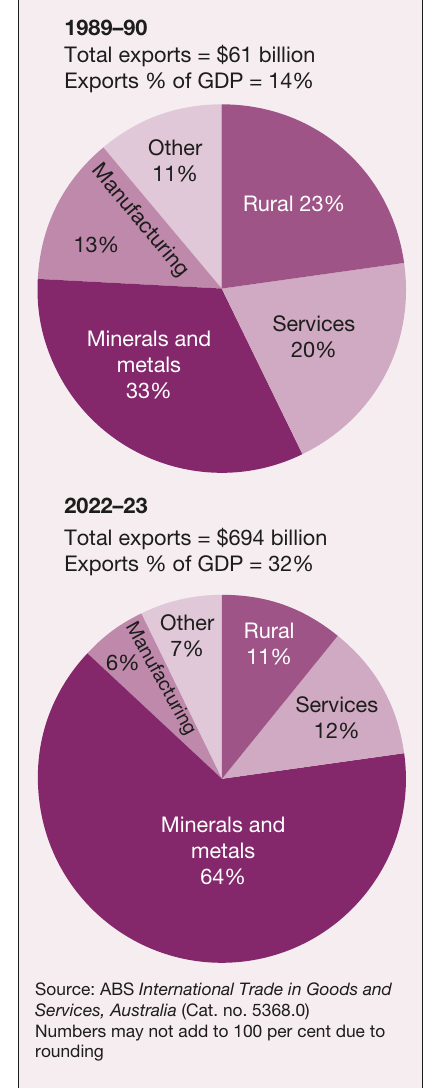
The data shows dramatic changes:
- Minerals and metals increased from 33% (1989–90) to 64% (2022–23)
- Manufacturing fell from 13% to 6%
- Total exports grew from $61 billion to $694 billion
- Exports as proportion of GDP doubled from 14% to 32%
Note
This pattern is expected to continue in the medium term, with natural gas and lithium driving future export growth. Importantly, the substantial overall growth in export volumes indicates increasing integration with the world economy.
Effects on individuals
Negative impacts: structural unemployment
Reduced protection causes substantial dislocation for workers in import-competing industries. The most severely affected workers face:
Important
Regional concentration of job losses
Import-competing industries concentrate in particular regions, especially manufacturing areas of Victoria and South Australia. When protection falls, unemployment in these regions climbs dramatically. Alternative employment sources are limited in these areas.
Skills mismatch problems
Many lost manufacturing jobs are relatively low-skilled, production-line positions. Skills developed in these roles do not transfer easily to other workplaces, particularly when overall manufacturing employment is declining.
Structural unemployment
Workers who lose jobs due to tariff cuts often become structurally unemployed—their skills no longer match available job vacancies. Retraining becomes necessary to develop skills relevant to current economic needs.
Government adjustment programs
Governments fund various adjustment programs to support affected workers. For example, the $155 million Growth Fund supported transition away from the automotive industry after domestic car production ended in 2017. These programs provide job search assistance, relocation assistance, and industry-specific training.
Example
Case Study: Clothing Tariff Cuts
Background: The 2010 reduction of clothing tariffs from 17.5% to 10% was strongly opposed by manufacturing employees.
Estimated Impact: The Productivity Commission estimated the cuts would reduce industry employment by over 5%—equivalent to over 1,500 jobs. Workers protested at Parliament House.
Government Decision: However, the government proceeded because of overall economic benefits, including lower consumer prices. Tariffs were further reduced to 5% in 2015.
Key Lesson: Government policy prioritised aggregate economic benefits over concentrated industry losses.
Positive impacts in the long run
Employment effects are not entirely negative. While short-term unemployment increases, longer-term employment levels may rise. As resources (labour and capital) shift to more productive, internationally competitive sectors, lost jobs should be recouped by growth in efficient industries.
Example
Example: LNG Industry Growth
Before 1989, Australia did not export any liquefied natural gas. Australia is now one of the world's largest LNG exporters. While manufacturing declined, new export industries grew.
Distribution of gains and losses
The overall problem may not be total unemployment rising, but uneven distribution—some communities and individuals win while others lose.
Consumer benefits
All individuals benefit in their capacity as consumers. Lower trade barriers provide:
- Wider variety of goods: Consumers access more products from global markets
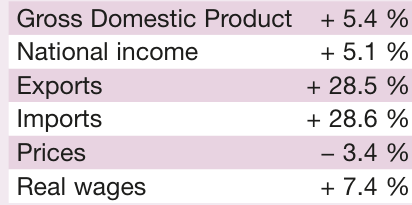
- Lower prices: Research by the Centre for International Economics found Australia's national price level was 3.4% lower in 2016 because of trade liberalisation since 1986
- Better quality: Competition forces firms to improve quality
- Improved customer service: Increased competition drives better service in some sectors
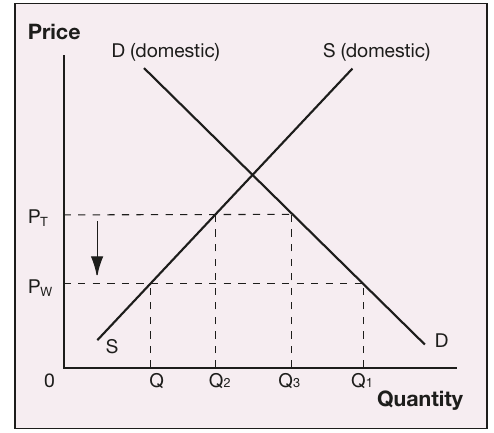
Note
The diagram shows how removing tariff protection lowers the domestic price from to (world price), and increases the quantity of foreign products available from to .
Improved living standards
Trade liberalisation aims to improve living standards through:
- Higher quality goods and services: Globally competitive businesses entering Australian markets force domestic firms to improve
- Greater innovation: Competitive markets encourage firms to differentiate themselves from competitors
- Faster adoption of innovations: Domestic presence of globally operating firms ensures innovations from other markets reach Australia more quickly
Effects on governments
Revenue implications
Cutting tariffs reduces government revenue because tariffs provide indirect tax income. However, this revenue source has declined in importance:
- In early 20th century Australia, tariffs provided the largest revenue source to the Commonwealth Government
- In 2023–24, approximately $1.9 billion in tariff revenue represented only 0.3% of total government revenue
- There is now general agreement about free trade among major political parties (unlike earlier divisions between Protectionist and Free Trade parties)
Spending implications
Reducing protection increases government expenditure requirements:
- Unemployment benefits: More people require income support during structural adjustment
- Retraining programs: Workers need assistance developing new skills
- Industry-specific assistance: Specialised programs like those for motor vehicle industry workers provide job search assistance, relocation assistance, and training
Political consequences
Despite economist consensus that cutting protection benefits the economy, this policy remains unpopular with the wider community.
Important
Why Protection Cuts Are Politically Difficult:
Visible costs:
- Structural unemployment
- Factory closures
- Damage to regional economies
Invisible benefits:
- Benefits spread across the economy
- Take time to materialise
- Harder to attribute directly to policy
Result: Governments risk losing electoral support by pursuing protection reductions.
This explains why governments in many countries, including recently the United States, are reluctant to reduce or even increase protection levels.
Note
Productivity Commission Recommendation:
The Australian Government should better engage with the community to explain why free trade benefits ordinary Australians and why increasing protectionism would harm Australia.
Other economic effects
Impact on economic growth and living standards
Protection phase-outs affect growth differently over time:
Short-term effects
Lower protection may lead to increased imports. Because imports are produced overseas and do not create Australian jobs or income, reducing protection can initially be negative for living standards.
Long-term effects
As resources (labour and capital) move to more productive areas with higher rates of return, economic growth and living standards improve. While many factors matter, economists generally view lower protection as critical to Australia's stronger economic performance in recent decades.
Trade performance and current account
Short-term impacts
The current account balance likely worsens as imports rise due to:
- Cheaper imports from lower tariffs
- Less restrictive quotas
- Higher quality imported products compared to locally made goods
Long-term impacts
Lower protection should improve international competitiveness and the current account as exports grow. Government reports argue Australia's failure to reduce tariffs until the late 1980s contributed to a less competitive export sector and higher current account deficits.
Gradual implementation
The benefits of reduced protection grow over time. This influenced Australia's decision to phase tariffs out over 30 years rather than with large, sudden cuts. Many free trade agreement measures are also phased in gradually rather than activated immediately.
Note
Gradual implementation helps industries adjust to changing business conditions. Most economists agree short-to-medium-term problems are far outweighed by long-term benefits, but gradual phasing makes structural changes easier to manage.
Supply chain resilience debate
The COVID-19 pandemic prompted debate about whether protection phase-out left Australia vulnerable to global supply chain failures.
The issue
Australia experienced supply shortages of essential items during COVID-19, including vaccines, face masks, cars, and televisions. Shortages occurred when transport networks and overseas producers were disrupted or could not expand production to meet demand.
Productivity Commission response (2021)
The Vulnerable Supply Chains report concluded that free trade policies actually make supply chains more resilient. Key findings:
- Fewer trade barriers mean more suppliers available
- Diversification of suppliers, rather than "onshoring" production, best ensures resilience
- Only around 5% of Australia's imports come from vulnerable supply chains
- Roughly two-thirds of these vulnerable imports come from China
- The case for increased industry protection was rejected
Important
Updated Position (2023)
With the United States and other economies increasing production subsidies and local content rules, the Productivity Commission's Advancing Prosperity report recommended:
- Government intervention should be a last resort
- Support only high-risk and critical supply chains
- Any supply chain assistance must be assessed by the Office of Supply Chain Resilience
- Public reporting required on justification, benefits, and costs of any intervention
Remember!
Summary
Key Points to Remember:
Winners and Losers:
- Reducing protection creates both winners (efficient firms, consumers) and losers (import-competing industries, displaced workers) with effects differing between short and long run
Short-term Costs:
- Structural unemployment, business closures, and regional economic damage, particularly in Victoria and South Australia's manufacturing areas
Long-term Benefits:
- Improved competitiveness, innovation, productivity growth, lower consumer prices, and sustainable economic growth
Export Transformation:
- Australia's export composition shifted dramatically toward minerals and metals (64% by 2022–23), with total exports growing from $61 billion to $694 billion
Government Impact:
- Lower tariffs reduce government revenue but this is now minimal (0.3% of total revenue), while spending on adjustment programs increases in the short term
Key Terms:
- Structural unemployment: Unemployment occurring when workers' skills do not match available job vacancies in the economy
- Import-competing industries: Domestic industries that compete with foreign producers in the local market
- Restructuring: Process where businesses reorganise operations to improve efficiency and remain competitive
- Trade liberalisation: The removal or reduction of restrictions on international trade
- Current account: Record of a country's trade balance plus net income and transfers
Note
Exam Tip:
Questions often ask you to distinguish between short-run and long-run effects, or to evaluate winners versus losers. Use specific examples (car manufacturing, clothing tariffs, LNG exports) and statistics (export composition changes, GDP impacts) to support your analysis.
Remember: Benefits are often less visible than costs, which creates political challenges.