Synthesising Evidence from a Range of Sources (HSC SSCE Modern History): Revision Notes
📚Revision Notes
Synthesising Evidence from a Range of Sources
Critical thinking in historical investigation
When completing your historical investigation project, you need to move beyond simply memorising facts and dates. Critical thinking means analysing information carefully and building strong arguments based on solid evidence. It involves thinking clearly and independently about the key issues in your research, allowing you to form well-reasoned judgements about historical events and debates.
Developing your critical thinking skills
Your historical investigation project offers an excellent opportunity to strengthen your critical thinking abilities. Here are five key ways you can develop these skills:
Note
Five Ways to Develop Critical Thinking:
- Understanding how different historical ideas connect logically with each other
- Identifying strong arguments, building your own arguments, and evaluating the arguments of others
- Approaching problems in a systematic, methodical way
- Recognising which ideas and pieces of evidence are most relevant and important to your research
- Reflecting carefully on why you hold certain beliefs and how your own values might influence your interpretation
Memory versus understanding
There is an important difference between having a good memory and truly understanding historical content. Simply remembering and accumulating facts will only allow you to identify or describe what happened in history. However, critical thinking takes you further by enabling you to evaluate and analyse information deeply. This deeper understanding allows you to construct sophisticated historical arguments rather than just recounting events.
Important
When you think critically, you can develop your own informed judgements by thoroughly understanding different perspectives within historical debates. This means you are not just repeating what historians have said, but actively engaging with their interpretations and forming your own reasoned conclusions.
Bloom's Taxonomy framework
Bloom's Taxonomy is a framework created by educational psychologist Dr Benjamin Bloom. It was designed to encourage higher levels of thinking in education, moving beyond rote learning (simply remembering facts). The taxonomy presents six levels of thinking, arranged from basic to advanced:
Example
Bloom's Taxonomy: Six Levels of Thinking
Remember - Recalling facts and basic concepts (define, list, memorise, repeat, state)
Understand - Explaining ideas or concepts (classify, describe, discuss, explain, identify, recognise)
Apply - Using information in new situations (execute, implement, solve, demonstrate, interpret, operate)
Analyse - Drawing connections among ideas (differentiate, organise, relate, compare, contrast, distinguish, examine)
Evaluate - Justifying a position or decision (appraise, argue, defend, judge, support, critique)
Create - Producing new or original work (design, construct, develop, formulate, investigate)
For your historical investigation project, you should aim for the higher levels of this taxonomy. Sophisticated researchers will evaluate their historical topic rather than simply narrating what happened. The best projects demonstrate the create level by developing original ideas and establishing informed judgements based on examining different historical interpretations.
Reading for understanding
Reading is essential for meeting the requirements of your historical investigation project, but you need to read with purpose and focus. The key skill is being explicit about what you are looking for when reading historical texts, ensuring the information you extract will genuinely benefit your research.
Purpose-driven reading strategies
To read effectively for understanding, keep these strategies in mind:
Note
Strategies for Purpose-Driven Reading:
- Always stay clear about what material and ideas you are seeking. Constantly refer back to your research question to ensure the information you gather actually helps answer it.
- Look specifically for key historical terminology and evidence that relates to your topic.
- Make certain that the information you collect will contribute to building a strong understanding of your research project.
Reading for understanding means maintaining focus on your research question so that the information you extract remains both relevant and meaningful. This focused approach helps you recognise the most important elements discovered during your reading.
Effective note-taking
Good reading should result in useful notes that support your research. The process of effective note-taking begins whilst you are reading the material itself.
Note-taking techniques
Start by making notes in the margins of your reading material and highlighting important information. This allows you to easily return to significant sections later. Once you have marked up your sources, summarise those notes so you have all the relevant information organised in one place.
Effective note-taking means keeping an organised record of important information you have read, making it much easier to locate details as you complete your project. Remember that reading is time-consuming, so you need to ensure your reading efforts result in reliable notes you can depend on for your research.
Note
Benefits of Good Note-Taking:
- Quick access to important information when writing your project
- Clear organisation that saves time during the writing process
- Prevention of having to re-read sources to find information
- A structured record that supports building your arguments
Referencing your research
Referencing is the process of acknowledging where your information comes from. Whenever you refer to someone else's words, ideas, or research in your historical investigation project, you must provide a reference. This applies to both written and visual information.
Why referencing matters
Proper referencing serves several important purposes:
- It demonstrates to your teacher the extensive reading and research you have undertaken
- It allows your teacher to locate and check the sources you have used
- It shows that you have examined various historical perspectives and interpretations
- It strengthens your historical arguments by showing they are based on solid research
- It demonstrates your academic integrity and ethical approach to scholarship
Avoiding plagiarism
Important
Referencing is crucial for avoiding plagiarism, which means wrongly taking another person's language, thoughts, ideas or expressions and presenting them as your own original work. Plagiarism is a serious academic offence. By acknowledging all the sources you have used to support your historical arguments, you demonstrate honest scholarship and respect for other historians' work.
Always provide references when you:
Note
When to Reference:
- Quote someone's exact words
- Paraphrase or summarise someone's ideas
- Use statistics or data from a source
- Refer to someone's research findings
- Include images, diagrams, or other visual materials
Creating a bibliography
A bibliography provides a complete list of all the sources you consulted during your research. It appears at the end of your historical investigation project and serves as an acknowledgement of where your information came from. Your bibliography gives your teacher the opportunity to examine the nature and diversity of sources you have used throughout your project.
Purpose and importance
Developing strong bibliography skills is essential preparation for university-level work. A well-constructed bibliography demonstrates the breadth and depth of your research. It shows whether you have consulted a variety of source types and how thoroughly you have investigated your topic.
Key features of a bibliography
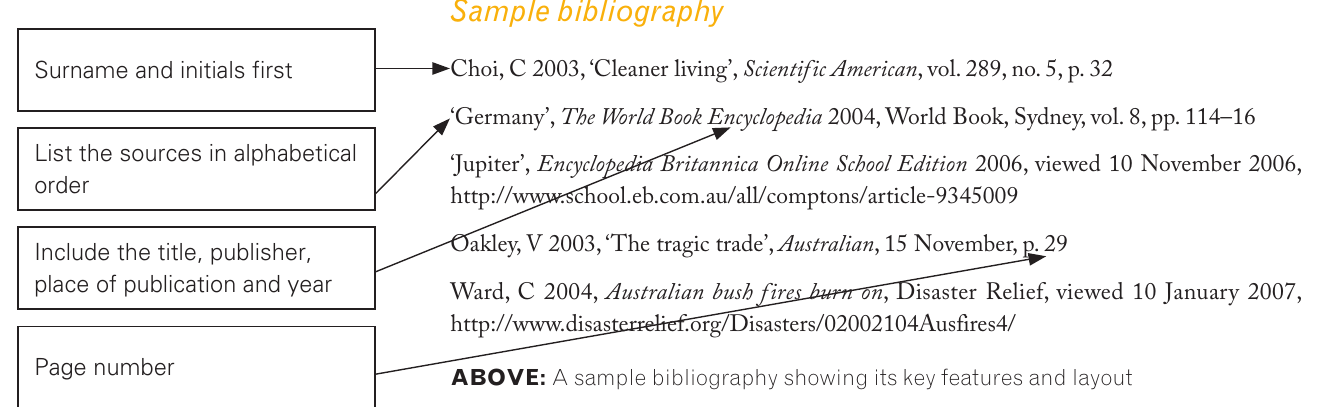
Your bibliography should include specific information for each source:
Note
Essential Bibliography Components:
- Author's surname and initials listed first
- Sources arranged in alphabetical order by surname
- Title of the book, article, or webpage
- Publisher and place of publication (for books)
- Year of publication
- Page numbers for specific articles or chapters
- URL and access date for online sources
Important
Each entry in your bibliography must follow a consistent format. Pay careful attention to punctuation, italics for titles, and the order of information. Different referencing styles exist (such as Harvard, APA, or Chicago), so check which style your teacher requires and follow it consistently throughout your bibliography.
Remember!
Summary
Key Points to Remember:
- Critical thinking is essential for historical investigation - it means analysing and evaluating information rather than just memorising facts.
- Use Bloom's Taxonomy to guide your thinking towards higher levels, particularly analyse, evaluate and create.
- Always read with purpose by keeping your research question in mind and looking for relevant historical evidence and terminology.
- Take organised, summarised notes that you can easily refer back to when writing your project.
- Reference all sources properly to demonstrate your research, avoid plagiarism, and maintain academic integrity.
- Create a well-formatted bibliography in alphabetical order with complete information for each source, showing the breadth of your research.