Trump’s Election Win (HSC SSCE Modern History): Revision Notes
📚Revision Notes
Trump's Election Win
Introduction: A surprising victory
On 8 November 2016, Donald Trump secured a surprising victory in the United States presidential election. His win shocked many Americans and observers around the world, as most opinion polls, journalists, academics and political commentators had predicted that Hillary Clinton would win comfortably. The Australian government was reportedly completely unprepared for Trump's victory, demonstrating how unexpected the result was internationally.
The election result sparked immediate reactions across America. While many people took to the streets in protest, expressing their dismay at Trump's victory, it remained true that millions of Americans had voted for him and legitimately elected him as their next President.
Note
The 2016 election result was so unexpected that even international governments had not prepared contingency plans for a Trump victory. This demonstrates how strongly the political establishment and media consensus had favored Clinton's chances.
The transition period
Following the election, the United States entered a transition phase. During this time, President-elect Trump assembled his team to form his executive branch and develop policies for implementation when he officially became President.
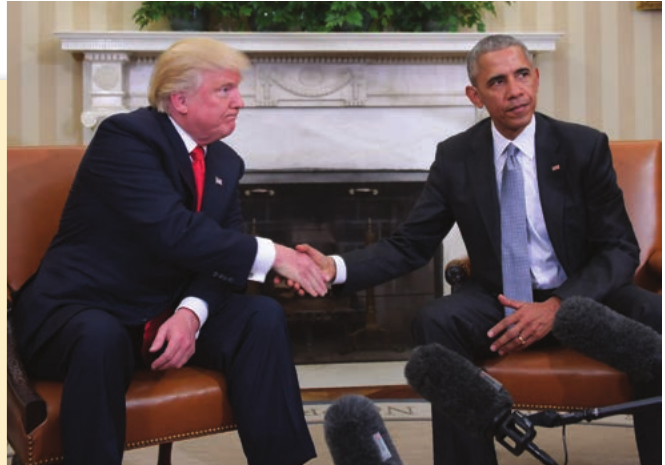
Two days after the election, outgoing President Barack Obama met with Trump at the White House for a 90-minute discussion. The meeting was notably civil, with Obama telling Trump, "we are going to do everything we can do to help you succeed because if you succeed the country succeeds." This demonstrated the democratic tradition of peaceful transfer of power in American politics, even when the incoming and outgoing presidents represented different political parties and ideologies.
Note
The Peaceful Transfer of Power
The cordial meeting between Obama and Trump exemplified one of the foundational principles of American democracy. Despite their profound political differences, both leaders demonstrated their commitment to maintaining stability and continuity in government during the transition period.
Understanding the electoral result
The Electoral College versus popular vote
Trump secured victory by winning 306 Electoral College votes, well above the 270 required to win the presidency. The Electoral College is a group of 538 people who serve as the formal electors casting electoral votes for president. A candidate must win a majority of at least 270 electors to become president.
However, in terms of the popular vote (the actual number of individual votes cast by American citizens), Hillary Clinton won by almost 2.9 million votes. Clinton received 65,844,954 votes (48.2%) compared to Trump's 62,979,879 votes (46.1%). This discrepancy between the Electoral College result and the popular vote was a significant feature of the 2016 election.
Important
Understanding the Electoral College System
The 2016 election highlighted a crucial feature of American democracy: a candidate can win the presidency while losing the popular vote. This is only possible because of the Electoral College system, where victory depends on winning states rather than winning the most individual votes nationwide. Understanding this difference is essential for explaining how Trump could become president despite fewer Americans voting for him than for Clinton.
Reasons for Trump's election success
Many experts have analysed Trump's unexpected victory and identified several contributing factors. These reasons are interconnected and together help explain why Trump succeeded despite the predictions against him.
Change of party
After eight years of President Obama, a Democrat, many voters were ready for something new. Trump, as the Republican candidate, represented change and a departure from the previous administration's policies. In contrast, Hillary Clinton appeared to many voters as someone who would simply continue Obama's approach. This desire for change benefited Trump, as voters often favour alternating between political parties after extended periods of one party's leadership.
Note
Historical voting patterns in the United States show that voters frequently desire a change of party after eight years of one party controlling the White House. This "pendulum effect" has influenced many presidential elections throughout American history.
Unorthodox candidate and anti-establishment appeal
Trump recognised that many Americans were frustrated with how Washington politics had operated for years. He positioned himself as a political outsider who would challenge the established system. Journalist Philip Rucker noted in The Washington Post that the 2016 election became the "summer of the political outsider", with both Trump and Bernie Sanders (a popular left-wing candidate who lost the Democratic Party nomination to Clinton) gaining support by tapping into people's anger with the status quo and their desire for authentic political leaders.
Historian Niall Ferguson argued that Trump won because he successfully tapped into the "ugly mood" of the American electorate. According to this interpretation, Trump benefited from a disconnect between elite politicians and ordinary people. The establishment, represented by Clinton, failed to recognise the depth of public anger and frustration with traditional politics.
Change of government processes: 'Draining the swamp'
Unlike Clinton, who was a career politician, Trump came from the business world. He promised to "drain the swamp" by selecting fewer appointees with prior government experience for his cabinet. Australia's Ambassador to the United States, Joe Hockey, suggested that for many voters, Trump represented a welcome "disruption into the mainstream of American politics". This outsider status appealed to voters who felt that professional politicians had failed them.
Note
Key Campaign Slogan
The phrase "drain the swamp" became one of Trump's most memorable campaign slogans, referring to his promise to remove corruption and career politicians from Washington. This message resonated particularly strongly with voters who felt alienated from traditional political processes.
FBI investigation into Clinton's emails
Just one week before polling day, Clinton appeared to have an unassailable lead in national polls. However, her lead shrank dramatically after the Federal Bureau of Investigation (FBI) announced they were reopening their investigation into her use of a private email server during her time as Secretary of State under Barack Obama.
Although Clinton was cleared of any criminal wrongdoing before election day, the timing of this announcement severely damaged her campaign. Many potential voters were scared off by the renewed questions about her trustworthiness. After the election, Clinton herself blamed this event as a major factor in her loss to Trump.
Important
Campaign Timing Matters
The FBI investigation demonstrates how events in the final days of a campaign can significantly influence electoral outcomes, even if they don't result in actual charges or convictions. The announcement came at a critical moment when many undecided voters were making their final decisions, and the renewed controversy created doubt that Clinton's campaign couldn't overcome in the limited time remaining.
Clinton's unpopularity with voters
Hillary Clinton faced significant challenges with voter perception. Among Democratic Party voters, she was not particularly popular, with many preferring her rival candidate Bernie Sanders during the primary elections. Among Trump's Republican supporters, she was nicknamed "Crooked Hillary" and became a figure of intense dislike. Some people even voted for Trump primarily to ensure Clinton didn't win rather than out of strong support for Trump himself.
Trump supporters frequently chanted "Lock her up" at rallies, referring to the email scandal. Trump successfully exploited the doubts many voters held about Clinton, portraying her as an untrustworthy career politician whilst presenting himself as something different. Both these narratives resonated strongly with many voters.
Important
Tactical Campaign Errors
Clinton made a significant tactical error when she labelled Trump's supporters as a "basket of deplorables". This comment angered many voters who felt dismissed and looked down upon by the political establishment. It reinforced Trump's narrative that Clinton was an elitist who didn't understand or respect ordinary Americans, further damaging her campaign among the very voters she needed to win.
Appeal to 'forgotten Americans'
Ronald Brownstein, writing in The Atlantic, observed that "Two Americas collided in the presidential race and the side that was genuinely passionate about its champion walked away the narrow winner". Trump ran a populist campaign that promoted national interests ahead of international ones, which directly appealed to what he called the "forgotten Americans".
Generally speaking, Clinton's support came from educated younger people and the middle class, whilst Trump attracted older and working-class conservative voters. These working-class voters, particularly in the Rust Belt states (industrial regions in the Midwest and Great Lakes area that had experienced economic decline), felt abandoned by traditional politicians and responded enthusiastically to Trump's message.
Crucially, Hillary Clinton made a major tactical error by not campaigning in the Rust Belt states. This decision proved costly, as these states ultimately swung the election in Trump's favour.
Note
Understanding Populism
A populist campaign focuses on appealing to ordinary people who feel neglected or exploited by the established elite and political system. Trump's populist message resonated particularly strongly with working-class voters who felt that globalization and traditional political policies had left them behind economically.
The Electoral College system
As mentioned earlier, the American Electoral College system meant that Trump could win the presidency despite losing the popular vote. The candidate with the most votes from the people doesn't automatically win the election in the United States. Instead, victory depends on securing enough Electoral College votes, which are distributed by state. This system allows a candidate to lose the overall popular vote but still win the presidency by securing victories in key states.
Understanding Trump's victory
The election of Donald Trump demonstrated that multiple factors combined to produce an unexpected result. For many voters, Trump was a charismatic and popular figure who represented change, authenticity and a challenge to the political establishment. His business background, unorthodox campaign style and willingness to speak in ways that professional politicians avoided all contributed to his appeal.
The combination of Clinton's weaknesses, the FBI investigation timing, Trump's appeal to working-class voters, and the mechanics of the Electoral College system all played crucial roles. This comprehensive list of factors shows that Trump's victory wasn't due to any single cause but rather the convergence of multiple political, social and institutional elements.
Important
Avoiding Oversimplification in Historical Analysis
When analysing Trump's election victory, avoid oversimplifying by pointing to just one factor. The most sophisticated historical analysis recognises that multiple interconnected factors contributed to this outcome. Each factor reinforced the others, creating a perfect storm of circumstances that led to Trump's unexpected victory.
Remember!
Summary
Key Points to Remember:
-
Trump won the 2016 presidential election on 8 November 2016 with 306 Electoral College votes, despite losing the popular vote to Hillary Clinton by nearly 2.9 million votes.
-
Multiple factors contributed to Trump's surprise victory, including voter desire for change after eight years of Democratic leadership, Trump's positioning as a political outsider, and Clinton's various weaknesses as a candidate.
-
The FBI's last-minute announcement about reopening its investigation into Clinton's emails significantly damaged her campaign in the final week before the election.
-
Trump successfully appealed to "forgotten Americans" in working-class Rust Belt states, whilst Clinton failed to campaign adequately in these crucial areas.
-
The Electoral College system allowed Trump to win the presidency despite losing the popular vote, demonstrating a key feature of American democracy that differs from simple majority rule.