Etchings and Evidence from the Site (HSC SSCE Modern History): Revision Notes
📚Revision Notes
Etchings and Evidence from the Site
Introduction to inscriptions at Q Station
Scattered throughout the Q Station site are approximately 1600 sandstone inscriptions, carvings and paintings that provide valuable historical evidence about those who were quarantined from the 1800s until the early 1980s. These markings were created using various methods including chiselling, carving, inking, scratching and painting the rock face.
Note
An inscription is a marking, scratching, etching or painting that has been chiselled, inked or engraved on sandstone rock at the Quarantine Station.
Unlike the accommodation areas which were segregated by class and race, the inscriptions are mixed together across time periods and social groups. For example, a Chinese inscription from one era can be found alongside an earlier English engraving at the wharf. Each inscription uses different languages and cultural symbols, creating a diverse historical record.
These engravings can be seen throughout the site on:
- Sandstone cliffs near the wharf
- Drains and slate covers
- Tree trunks
- Concrete blocks
- Building walls
The inscriptions reveal important historical information about:
- Names of quarantined individuals
- Ships they arrived on
- Family members who died during the journey
- Diseases they suffered from
- Scandals and events during their stays
- Emotional states (despair, joy, relief)
The Forest Monarch inscription
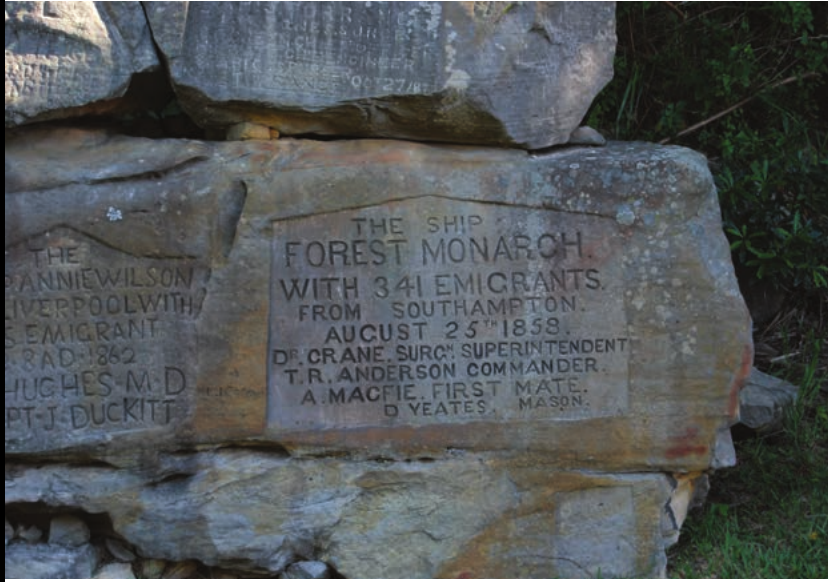
One significant inscription was carved by stonemason Daniel Yeates and documents the journey of the ship Forest Monarch from Southampton, England in August 1858. The engraving records that 341 emigrants departed from Southampton and lists the key officials responsible for passengers:
- Dr Crane (surgeon superintendent)
- T.R. Anderson (commander)
- A. Macfie (first mate)
The story behind the inscription
Interestingly, the inscription only records how many people left Southampton, not how many survived to reach Sydney. This omission tells its own story. During the four-month voyage, tragedy struck the Yeates family.
Daniel Yeates's second wife, Mary Ann Yeates, died from a condition called 'debilitas scorbulus' - better known as weakness and scurvy. Her death is commemorated on a simple headstone marked with the initials M.A.Y. and an elaborate cross outline.
Important
Scurvy resulted from malnutrition and lack of Vitamin C from fresh fruit and vegetables. Symptoms included:
- Bleeding gums
- Oozing sores
- Skin infections
- Complete exhaustion
This disease was a common killer on long sea voyages and demonstrates the harsh conditions faced by emigrants.
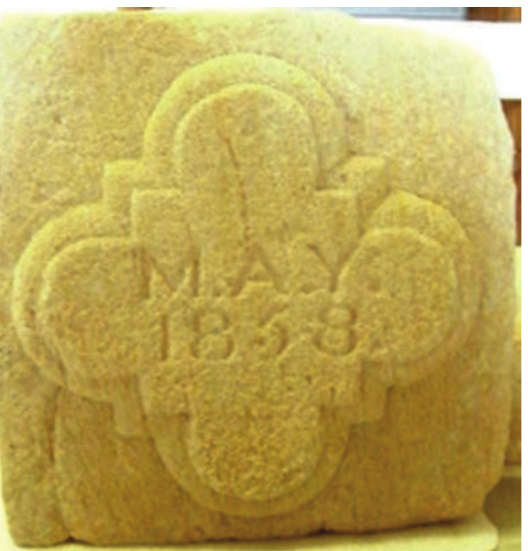
Mary Ann was a young mother caring for a two-year-old child named William and a newborn baby, Maria, who was born just before they boarded the ship. William died during the journey, and Mary Ann had to cope with this loss while caring for her newborn. Her death under these circumstances demonstrates how difficult and dangerous sea journeys were for vulnerable passengers, particularly the sick and very young.
Daniel Yeates, aged 32, arrived in Sydney having to care for young children from both his first and second marriages whilst finding his place during the gold rush that was sweeping the colony.
Historical significance of the inscription
The inscriptions carved into Sydney's sandstone reveal important information about:
- Skills and technology of the period
- Desirable trades in the colony (stonemasonry was highly valued for construction)
- Properties of Sydney sandstone (plentiful and relatively easy to work with)
- Personal remembrance and commemoration
Note
Daniel Yeates's decision to carve the number who left Southampton rather than recording those lost to sickness may have been:
- A mark of remembrance for those who died
- A way to emphasise the significance of the voyage itself
- A demonstration of his professional skills as a stonemason
Immigration context: the gold rush era
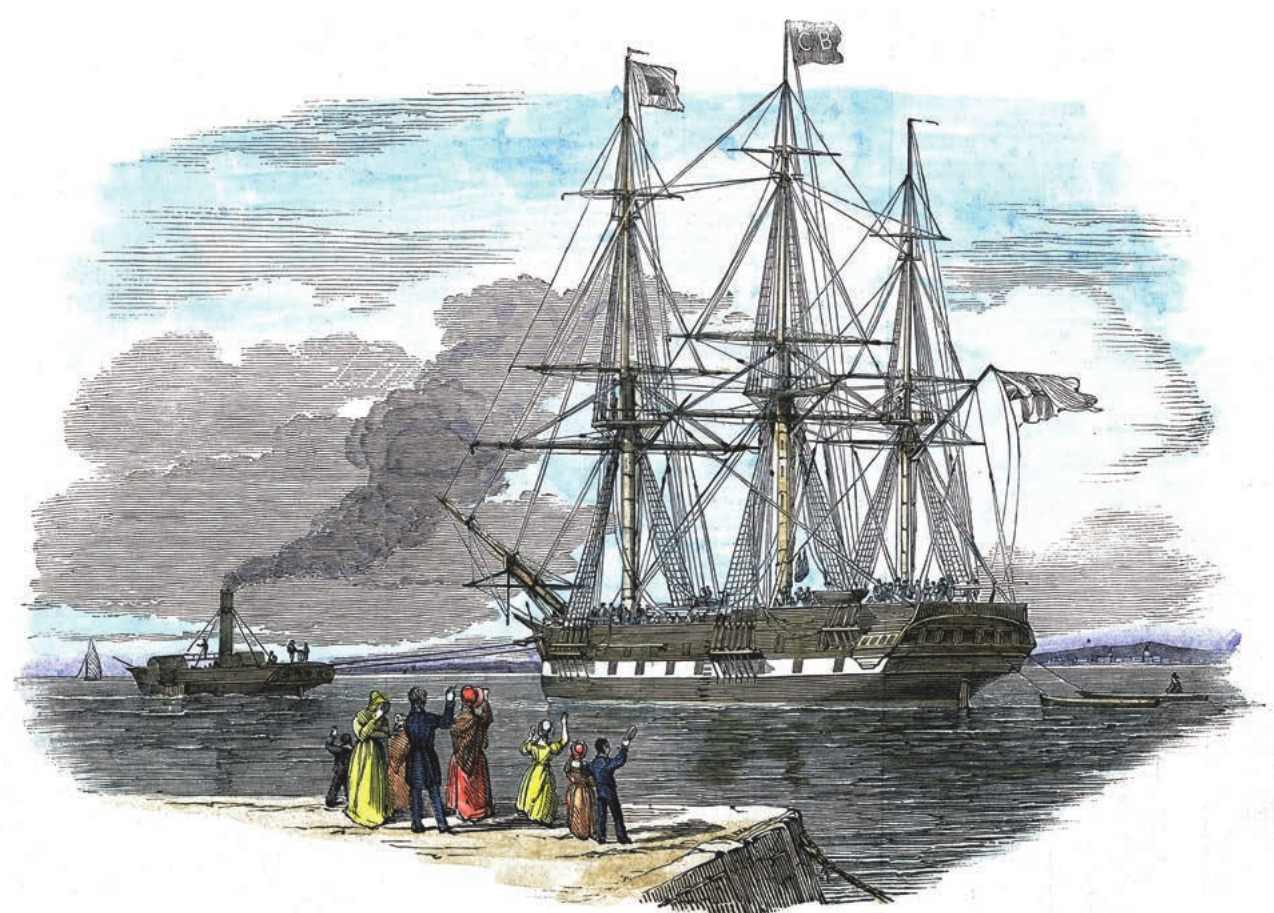
The Forest Monarch was one of many ships bringing waves of immigrants to Australia during the gold rush. This migration boom had significant demographic impacts:
- From 1851, the populations of New South Wales and Victoria more than doubled from 437,000 to 1,152,000
- Every year from 1851 to 1861, over 50,000 new migrants arrived by ship
- Most were young, male and eager to create a new life
Origins and motivations of immigrants
Immigrants came from various places including:
- China
- Ireland
- Britain
- Scotland
Many were fleeing difficult circumstances:
- The potato famine in Ireland (a period of mass starvation, disease and emigration between 1845 and 1852 which caused Ireland's population to fall by 20-25%)
- Avoiding arrest for involvement with the Chartist movement in Britain (a working-class movement for political reform that existed from 1838 to 1857)
These immigrants believed that hard work rather than class should provide opportunities for advancement. Many possessed valuable skills:
- Masons
- Carpenters
- Wheelwrights
- Coopers (people who made and repaired wooden barrels for holding beer, wine and other liquids)
- Miners
- Shopkeepers
Unintended consequences of mass migration
Important
Whilst migration brought economic growth and prosperity, it also created problems:
- More rapid spread of diseases
- Increased infections and contagions in the new colonies
- Need for expanded quarantine facilities
This demonstrates how population growth and disease transmission are interconnected.
Disease mortality evidence from the Third Cemetery
Death records from the Quarantine Station reveal the numbers who died from various diseases from 1881 to 1925, providing the grave number for each death. By the 1880s, grave sites had become overcrowded and, according to news reports, gave off an offensive odour. The Third Cemetery was created in 1881 to address this problem.
Recent archaeological work on the Third Cemetery has identified the number of deaths from each disease:
| Disease | Number of burials | Percentage of total deaths |
|---|---|---|
| Smallpox (1881-82) | 6 burials | 2.5% |
| Scarlet fever (1883-84) | 5 burials | 2.1% |
| Smallpox (1884-85) | 4 burials | 1.7% |
| Smallpox (1887-88) | 15 burials | 6.2% |
| Bubonic plague (1900-01) | 105 burials | 43.6% |
| Pneumonic influenza (1918-19) | 63 burials | 26.1% |
There were another 44 isolated deaths (17.8%) from infectious diseases or other causes recorded as resulting in burials.
Summary
Key findings from the evidence:
- Bubonic plague caused the most deaths, accounting for 43.6% of total burials
- Pneumonic influenza was the second deadliest disease at 26.1%
- Scarlet fever (1883-84) resulted in the fewest deaths with only 5 burials (2.1%)
- The high death toll from bubonic plague suggests it was the most difficult disease to contain at North Head
Chinese inscriptions and racial discrimination
Some inscriptions reveal class and race tensions during the quarantine period. One particularly significant inscription was written in Chinese characters and dates from the 1880s. The translation reads:
We set out from Hong King on [?] of April of the sixth year of the Kuang Hsu Era. On the eighth of May, one person detained, and we were all left struck on account Of this person having a [disease]. The Westerners' regulations are really useless. We should not rest until [we] have killed off all foreigners. Chu [?] of Nein Yip, July 10th.
This inscription reveals contempt and disdain towards Western authorities and demonstrates the growing hostility between Chinese migrants and colonial society.
The SS Java quarantine case (1880)
This inscription provides the first evidence of Chinese detainees at North Head. The passengers were detained because of a smallpox outbreak on the ship SS Java in 1880.
Note
Key facts about the quarantine:
- 299 Chinese passengers were quarantined for 64 days
- No deaths were recorded during this period
- This quarantine period was much longer and harsher than normal
Historians have questioned whether the extended quarantine was justified:
- Although smallpox is a severe disease, there were no actual cases during the quarantine period
- The real reasons for such a long and oppressive stay may have been anti-Chinese feeling and racial fear rather than genuine disease concerns
- Chinese passengers spent over a month on the ship before coming ashore
- European passengers received more comfortable accommodation on shore
- Quarters for Chinese passengers were segregated from the white areas
Evidence of systemic discrimination
The Colonial Treasurer's report reveals the extent of anti-Chinese sentiment at the time:
It would be totally impossible to keep these Chinese within the limits of the Quarantine Ground. If they escaped into nearby Manly or the city of Sydney itself ... the consequences might have been very serious ...
Important
This statement shows that authorities viewed Chinese migrants as a threat to public safety, regardless of their actual health status.
The tone of the Chinese inscription is violent and murderous, calling for Chinese passengers to kill foreigners. This anti-Western sentiment reflects:
- The state of race relations in the lead-up to the White Australia Policy
- How Asian migrants were frequently blamed for disease outbreaks
- The frustration and anger of Chinese passengers subjected to discriminatory treatment
Smallpox epidemic and racial blame (1881)
Chinese migrants were blamed for the smallpox epidemic of 1881, despite evidence showing:
- Only 168 cases involved victims from a Chinese background
- The issue was politically contentious
Sir Henry Parkes, the then Premier of New South Wales, declared that China was a major risk to Australia and therefore all ships with Chinese passengers should be detained. Once detained, Chinese passengers faced strict measures:
- Clothes and personal items were burnt to supposedly stop contamination
- Much harsher quarantine conditions than European passengers
Legal restrictions on Chinese immigration
By 1881, the New South Wales Parliament passed the Immigration Restriction law, which restricted the travel of Chinese and Asiatic peoples. These laws and prevailing attitudes paved the way for the White Australia Policy in 1901.
Note
From the 1880s onwards, different colonies introduced restriction clauses and acts to limit the number of Chinese migrants. The inscriptions at Q Station provide physical evidence of how these discriminatory policies affected real people.
The SS St Albans inscription (1917)
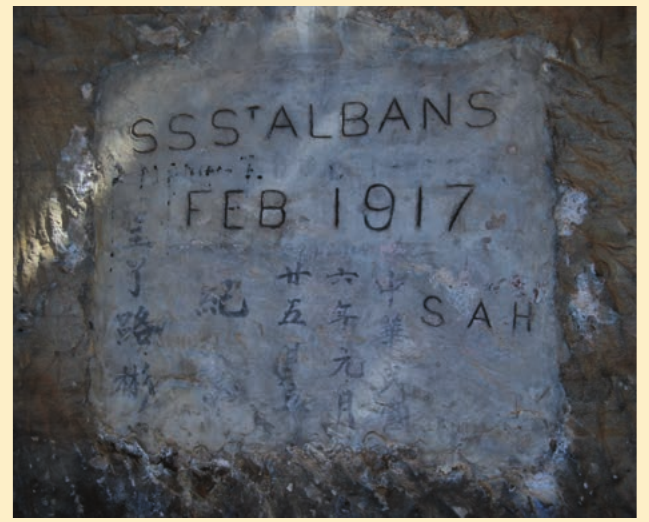
By 1917, World War I was still raging in Europe, but trade and migration continued between Australia and Canton (now Guangzhou) and other parts of Asia. The ship SS St Albans, originating from the port of Kobe in Japan, stopped at Canton to collect more passengers.
When the ship's doctor noted a case of smallpox, the ship was quarantined for three weeks upon arrival in Sydney. The Chinese characters inscribed on sandstone are attributed to Leong Wo, who was responsible for the day-to-day running of the ship. His duties included:
- Ensuring the anchors would hold
- Lighting the signal lamps
- Overseeing the crew
- Taking advice from ship's officers
Significance of the inscription
The translation of the Chinese characters reads: 'Erected in the sixth year of the Republic, first month, twenty-fifth day; to commemorate St Alban's.'
Note
The date is significant as the inscription refers to the end of the Qing (Manchu) Dynasty in China in 1911, some six years earlier. This may suggest:
- A new life commencing with the sea journey
- Hope for a fresh start in a new country
- Cultural pride in the end of imperial rule
The cross-cultural message, using both English and Chinese characters, is unusual and demonstrates:
- Cultural exchange between Chinese and Western passengers
- Bilingual communication at the site
- Changing attitudes towards Chinese migrants compared to the 1880s
Case study: Nellie McCain and the bubonic plague
Smallpox was not the only disease to affect Sydney. In 1900, the bubonic plague claimed its first victim to be sent to the Quarantine Station.
Eleanor Matilda McCain, known as Nellie, was fourteen years old and attending Lower Fort Street School when she fell ill on 16 March 1900. Vomiting and nauseous, Nellie left school and a doctor was summoned the following day. Within an hour of the doctor's visit on 17 March, Nellie had died. It was a tragic and virulent case of the Black Death.
Symptoms of bubonic plague
Important
The disease presented with severe symptoms:
- Headaches
- Fatigue
- Nausea
- Chills and high temperatures
- Noticeably swollen lymph glands in the neck, groin and armpits
- These swollen glands (called buboes, giving the disease its name) became mottled and purple
- Eventually the buboes burst with oozy pus
Most deaths occurred within one to nine days after infection.
In 1900, 103 official deaths from the plague were recorded in Sydney, though undoubtedly there were more unreported cases.
The inquest and quarantine response
Nellie's death was both the first and the most unexpected. An inquest was held into her case. Interestingly, the classic buboes were not evident on her body, but the autopsy showed she had suffered from a virulent infection of 'plague bacilli'.
Note
Immediate actions taken:
- The morgue near Circular Quay was isolated
- All of Nellie's family were sent into quarantine at North Head
- Her parents were barred from attending her burial in the Third Cemetery
Her body was carefully prepared to prevent contamination:
- Interred in a coffin filled with disinfectant
- Wrapped or mummified in several sheet layers and sail cloth fabric
- The sarcophagus (a box-like funeral receptacle for a corpse) was lowered three metres into the earth
- A temporary rather than permanent headstone was used
Her death was well documented, yet her remains are not clearly marked today. This demonstrates the need for commemoration and documentation that the inscriptions at Q Station provide.
Public panic and quarantine measures
Panic erupted in Sydney following Nellie's death. The public surged into the Health Board office, attempting to access a serum or vaccine that had been imported from India. However, the serum proved inadequate to stem the plague.
Example
Final statistics from the outbreak:
- 263 people were infected and quarantined at North Head
- Another 1496 people who had been in contact with those infected were also quarantined
- The Quarantine Station buried those who died in the Third Burial Ground
- Wooden temporary grave markers were used
This case demonstrates how the physical evidence at Q Station - including burial sites and records - provides crucial information about disease management and public health responses in early twentieth-century Australia.
Historical significance of inscriptions as evidence
The inscriptions at Q Station serve multiple historical purposes:
Summary
Personal documentation:
- Record individual experiences and journeys
- Commemorate lost family members
- Express emotional states
Cultural evidence:
- Show multilingual and multicultural interactions
- Reveal class and race tensions
- Demonstrate skills and technologies of different periods
Social history:
- Document immigration patterns during the gold rush
- Provide evidence of discriminatory policies
- Show disease outbreaks and public health responses
Archaeological value:
- Physical evidence that can be dated and analysed
- Complements written historical records
- Provides perspectives from ordinary people, not just officials
Unlike official records which may be incomplete or biased, the inscriptions offer direct testimony from those who experienced quarantine. They are temporally and socially interconnected, creating a rich tapestry of Australian immigration history.
Remember!
Summary
Key Takeaways:
-
1600 inscriptions at Q Station provide valuable archaeological evidence about quarantined individuals from the 1800s to 1980s, created through various methods on sandstone and other surfaces.
-
The Forest Monarch inscription by stonemason Daniel Yeates documents the harsh realities of 1850s sea voyages, including deaths from scurvy and the challenges faced by immigrant families during the gold rush era.
-
Disease mortality data from the Third Cemetery shows that bubonic plague (1900-01) caused the most deaths at 43.6%, followed by pneumonic influenza (1918-19) at 26.1%, providing crucial evidence about disease containment difficulties.
-
Chinese inscriptions reveal significant racial discrimination, with Chinese passengers on the SS Java quarantined for 64 days in 1880 despite no deaths, demonstrating how anti-Chinese sentiment led to harsher treatment and contributed to the White Australia Policy.
-
The case of Nellie McCain, the first bubonic plague victim in 1900, shows how inscriptions and burial evidence document public health crises, with 263 people infected and careful burial procedures implemented to prevent contamination.