Resistance to Japan (HSC SSCE Modern History): Revision Notes
📚Revision Notes
Resistance to Japan
During the late 1920s and 1930s, China faced growing aggression from Japan. This period tested the fragile unity between the Guomindang (GMD) and the Chinese Communist Party (CCP), ultimately leading to the Second Sino-Japanese War (1937-1945). Despite their rivalry, both parties would need to cooperate to resist Japanese invasion.
Note
As Jiang Jieshi himself stated, employing a Chinese proverb: "The Japanese are only a disease of the skin, the Communists are a malady of the heart."
This quote reveals Jiang's priorities - he viewed the internal communist threat as more dangerous than external Japanese aggression, a perspective that would shape China's response to Japanese expansion.
Japanese expansion into China
Japan had been gradually increasing its presence in China for decades. Through various conflicts and treaties, Japan had gained significant territory and influence. Following the Opium Wars, Japan secured a concession in Shanghai. After defeating Russia in the Russo-Japanese War of 1904, Japan gained influence in Korea and Manchuria. The Sino-Japanese War of 1894 gave Japan control of Taiwan (which they called Formosa). The Treaty of Versailles in 1919 allowed Japan to replace Germany in the Shandong 'sphere of influence'.
The rise of Japanese militarism
During the 1930s, the Japanese military gained increasing control over the Japanese government and exercised greater influence over the emperor. Military leaders believed that world conquest required first conquering China, and conquering China meant first taking Manchuria. This aggressive expansionist ideology would drive Japanese policy throughout the decade.
One obstacle to Japanese control of Manchuria was the regional warlord Zhang Zuolin, who supported Chinese unity and opposed Japanese expansion. In 1928, Japanese officers ordered his assassination by bombing his train. The Japanese military then attempted to bribe his son, Zhang Xueliang, who responded defiantly on 29 December 1928 by raising the Chinese National flag throughout Manchuria, declaring his loyalty to a united China.
The Mukden Incident (1931)
The Japanese military presence in Manchuria was known as the Guandong Army - a jingoistic military unit that grew impatient with their government's cautious approach. On 18 September 1931, Guandong soldiers disguised as railway guards staged a false attack on Japanese railway lines near Mukden, causing minimal damage. This fabricated incident became the pretext for a full military takeover of Manchuria. The Japanese government, unable to control its own military, was forced to accept this action.
Note
This became known as an example of 'the tail wagging the dog' - where subordinates acted independently of authority. This pattern of the military acting without government approval would repeat throughout the 1930s.
The Shanghai Incident (1932)
To distract attention from their activities in Manchuria, Japanese officials created another pretext in Shanghai. In January 1932, hired thugs attacked a group of Japanese monks, killing one. This manufactured incident gave Japanese forces an excuse to attack Chinese quarters of the city. When Chinese forces resisted, the Japanese air force bombed civilian areas indiscriminately.
The 19th Route Army, led by Cai Tingkai, mounted brave resistance that rallied support from workers, warlords, the Green Gang, and even the Song Sisters. Jiang Jieshi was reluctant to commit his elite 5th Route Army, fearing all-out war with Japan. Under pressure, he secretly sent some troops to support the defence. Eventually, Japanese forces withdrew, but thousands of soldiers and civilians had been killed - estimates range from 6,000 to 35,000. Meanwhile, Japan completed its conquest of Manchuria within five months.
Important
The pattern of manufactured incidents - attacking their own property or citizens to create pretexts for military action - became a key Japanese strategy for expansion without formal declarations of war.
On 1 March 1934, Japan established the puppet state of Manzuguo (Manchukuo), installing China's last emperor, Puyi, as a puppet emperor - a ruler with no real power who served as a figurehead for Japanese control.

The Xi'an Incident (December 1936)
Jiang Jieshi's response to Japanese aggression seemed to be ignoring Japan whilst focusing on destroying the Communist base in Shaanxi province. This strategy frustrated two of his own marshals, Yang Yucheng and Zhang Xueliang, who believed that 'Chinese should not fight Chinese' when Japan was the real threat.
The arrest of Jiang Jieshi
Determined to eliminate the Communists after the Long March, Jiang travelled to Xi'an on 12 December 1936 to personally oversee the campaign against the Shaanxi Soviet. He stayed at local hot springs for bathing. Zhang Xueliang, who had been communicating with the Communists and was displaced from his Manchurian homeland by Japanese occupation, decided to act. Zhang's troops arrested Jiang whilst he was at the hot springs.
Note
Interestingly, when troops came to arrest him, Jiang fled and hid between boulders until discovered. The irony is that his given name, 'Jieshi', literally means 'between rocks'.
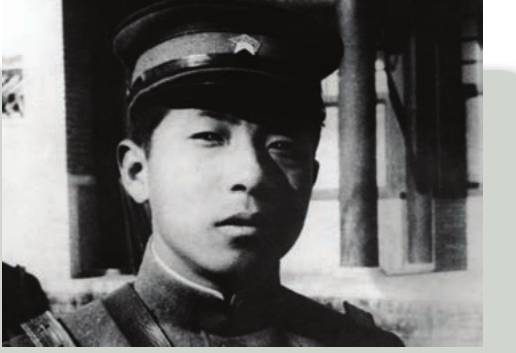
Negotiations and the Second United Front
Zhou Enlai arrived to negotiate on behalf of the Communists. Some called for Jiang's execution, but Jiang's wife, Song Meiling, flew from Nanjing to assist negotiations. With encouragement from Moscow, Communist leaders concluded that only Jiang could lead a united China against Japan.
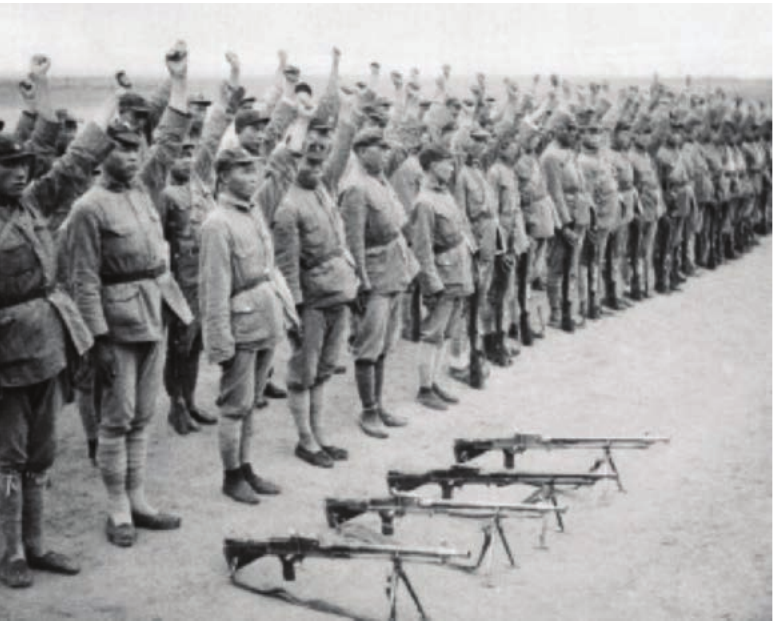
Jiang returned to Nanjing as a national and international hero. He agreed to end the blockade of the Yan'an Soviet and enter a second alliance with the CCP (the first had lasted from 1922-27). This became known as the Second United Front. In return, the Communists agreed to subordinate the Red Army (the Communist Army under Zhu De) to GMD military command. The Red Army was renamed the Eighth Route Army and Fourth Route Army - communist units that were nominally under GMD command. Their headquarters moved to Xi'an.
Zhang Xueliang: The Young Marshal
Zhang Xueliang (1901-2001) was the son of Manchurian warlord Zhang Zuolin, who ruled Manchuria until his assassination in 1928. Known as 'The Young Marshal', Zhang overcame opium addiction and ruled Manchuria until forced out by Japanese occupation in 1931. He then became a marshal in GMD forces and was stationed near Xi'an when ordered to attack the Communist base in 1936.
Note
After the Xi'an Incident, Zhang accompanied Jiang back to Chongqing and remained under house arrest. This continued after Jiang retreated to Taiwan, lasting until 1961 - a punishment of over two decades for his role in the incident.
The Second Sino-Japanese War (1937-1945)
The Marco Polo Bridge Incident (7 July 1937)
Japan had established a strong position in northern China, and the Guandong Army's young officers were eager to expand Japan's empire further. They were encouraged by the rise of fascism and Nazism in Europe and concerned about the Second United Front between the GMD and CCP.
On 7 July 1937, a Japanese detachment knocked on the closed gates of the town of Wanping, demanding to search for a missing soldier. When refused entry, the Japanese opened fire and local Chinese soldiers returned fire. This incident occurred near a marble bridge that Marco Polo had mentioned in his travels, so it became known outside China as the 'Marco Polo Bridge Incident'. The Chinese call it the Lugouqiao (Reed Channel Bridge) Incident. This manufactured crisis became another example of 'the tail wagging the dog', committing Japan to full-scale conquest.
Japanese occupation and atrocities
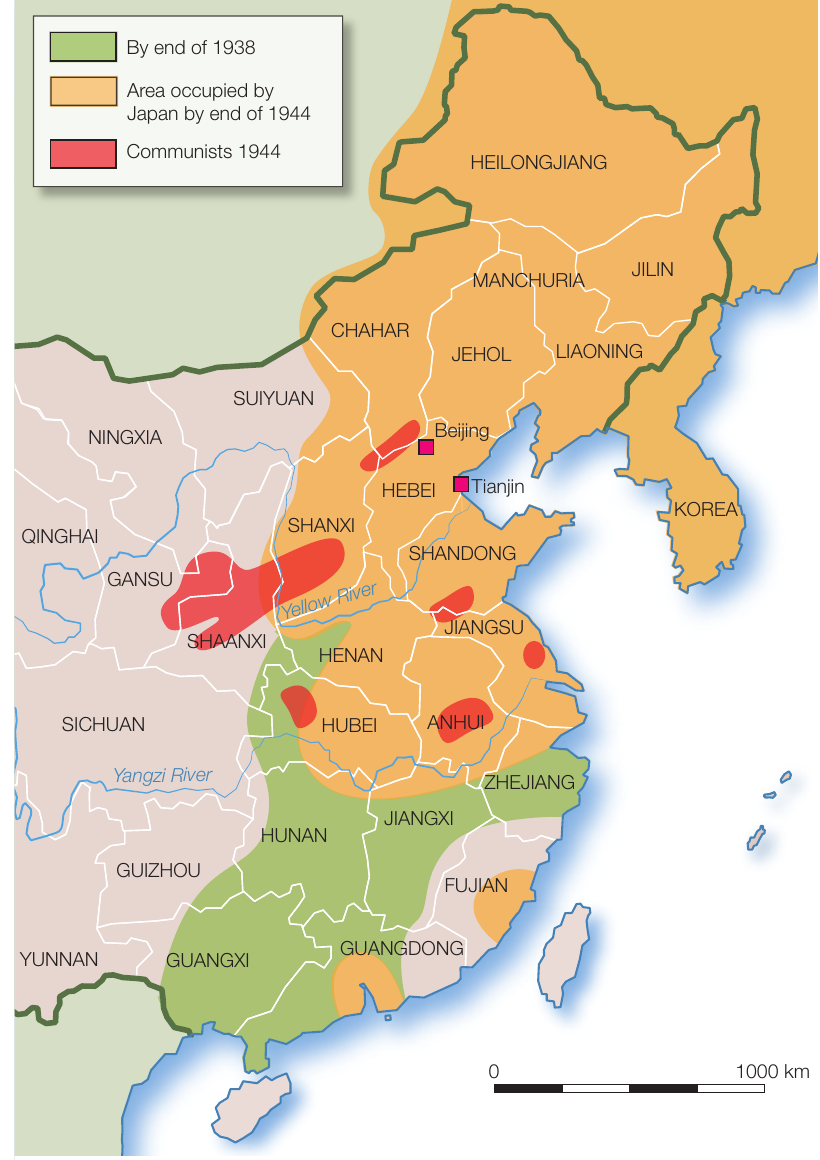
Despite fierce resistance from some GMD armies, Japanese technological superiority and preparedness meant eastern coastal China was quickly occupied. Beijing (which Jiang had renamed Beiping) fell quickly, as did Tianjin, Hangzhou, and Shanghai. Taiyuan held out longer, but eventually fell as well.
Important
The behaviour of Japanese troops towards Chinese soldiers and civilians during this period remains a source of great shame in Japanese history and continues to strain relations between the countries today. Chinese accounts document widespread murder, rape, mutilation, and live burial by the Japanese Imperial Army.
The Rape of Nanjing (December 1937)
The most infamous atrocity occurred following the Japanese capture of Nanjing, the GMD capital, in mid-December 1937. After capturing the ancient walled city, many Japanese soldiers went on a killing spree. Historians estimate that at least 20,000 women were raped and then killed. In total, at least 200,000 people were murdered. Some soldiers held competitions to see who could behead the most Chinese in one day. Hospital patients were murdered in their beds. The only refuge was in foreign compounds within the city.
Important
This horrific event remains a deeply sensitive issue in Sino-Japanese relations and is known as the Rape of Nanjing or the Nanjing Massacre. The exact death toll continues to be debated, but even conservative estimates place it among the worst atrocities of the 20th century.
Jiang Jieshi's defensive strategies
The main GMD forces regrouped at Wuhan. With aircraft and pilots supplied by Stalin, leader of the Soviet Union, GMD forces mounted a strong defence of Wuhan. In June 1938, Jiang made a controversial decision - he ordered the destruction of dams holding back the mighty Yellow River (Huang He). This slowed the Japanese advance but also killed many Chinese peasants in the resulting floods. This sacrifice bought time for the government to relocate the capital to Chongqing in Sichuan province, in the upper reaches of the Yangzi River.
Japanese puppet governments
Japan established puppet governments to legitimise their control. In Manchuria, they created Manzuguo (Manchukuo, meaning 'Manchu nation'), installing Puyi as puppet emperor. They also established a puppet regime in Nanjing to claim legitimacy over China.
However, Japan's attack on Pearl Harbor in Hawaii in December 1941 changed the situation dramatically. Jiang was pleased to gain US support, believing it was only a matter of time before Japan's defeat would return him to power. Jiang and his wife Song Meiling were regarded as heroes in the West. When Song Meiling visited the US Congress to appeal for arms and money, her charm, fluent English, and good looks won American support.
Life in the Yan'an Soviet
After the Xi'an Incident, the Communists gained a period of respite and could build up their base in Yan'an, Shaanxi province. Mao and other leaders developed better working relationships with local peasants, even sending Army soldiers into the fields to boost food production.
The 'Yan'an Way'
The Long Marchers had to adapt to local conditions, switching from a rice diet to wheat and sorghum. They learned to live in cave-like homes dug into the sides of yellow cliffs. There was a strong sense of egalitarianism (belief in equality for all) made easier by the mutual poverty of the region and absence of rich landlords. Mao lived in a cave-like home with a vegetable garden at the front, just like everyone else.
Note
The Communists established schools to address the 95 per cent illiteracy rate amongst peasants and to teach communist political doctrine. Music and dance were adapted to convey the communist perspective. They founded an anti-Japan University in Yan'an, which served as effective propaganda. The Soviet even overprinted GMD stamps for its own postal service.
Military strategy against Japan
Initially, the Communists tried to inflict serious damage on Japanese forces with their 'One Hundred Regiments Offensive'. However, Japanese reprisals were severe, particularly against villages associated with attacks. The Eighth Route Army then shifted to a strategy of harassment rather than open warfare, using guerrilla tactics to wear down the enemy.
Young people flock to Yan'an
Soon young people, especially women, travelled to the Soviet. Some came to fight against Japanese occupation, feeling the GMD was insincere in resisting Japan. Many women came to assert their independence by avoiding or escaping arranged marriages. The cruelty of some mothers-in-law was legendary in China, and women often had no say in selecting their future husband. Once trapped in a bad marriage, there was no escape except death or Yan'an.
This influx of young, attractive, and sometimes sophisticated women from cities like Shanghai proved tempting for some older Communist leaders, who divorced their wives to marry the newcomers.
Mao and Jiang Qing
Note
Mao reportedly had an affair with Lily Wu, an attractive Shanghai actor, causing a scandal. She was sent away, and Mao's wife, He Zizhen, was sent to Moscow for 'medical reasons'. This allowed Mao to begin a relationship with another young Shanghai actor called Lan Ping, who changed her name to Jiang Qing. They eventually married, though the Party insisted she remain out of political decisions - which she did until 1966 (when she would play a major role in the Cultural Revolution).
Edgar Snow and international attention
Arguably the most influential foreign visitor to Yan'an was Edgar Snow, an American journalist who wrote Red Star Over China. Much of the world had assumed the Communists had disappeared after the Long March. Most Chinese did not know there was a Communist base in Shaanxi. Snow's glowing account of the Long March and life in the Soviet drew positive attention to Mao's base both within China and internationally, significantly boosting Communist propaganda efforts.
American involvement and the Dixie Mission
With Stalin's forces occupied fighting Hitler's invasion of the Soviet Union from 1941, China's hope seemed to rest with the United States after Japan attacked Pearl Harbor.
General Stilwell in Chongqing
In 1942, President Roosevelt sent General Joseph Stilwell to Chongqing to advise and organise Chinese forces. Stilwell was shocked by the corruption, lack of training, and poor equipment in the GMD forces. He tried to assume military command but was blocked by Jiang. Both Stilwell and Jiang complained to President Roosevelt, who took the expedient path of replacing Stilwell rather than addressing the fundamental problems.
The Dixie Mission to Yan'an (1944)
In contrast, a visit to Yan'an led by Colonel David Barrett in 1944 impressed American observers. This became known as the Dixie Mission (possibly because the Communists were seen as comparable to American Civil War rebels). Mao naturally presented the best propaganda showcasing Communist efficiency and organisation. Roosevelt's special emissary, Patrick Hurley, arrived soon after and also praised the Soviet's policies.
Important
The stark contrast between the corrupt, inefficient GMD and the organised, apparently egalitarian CCP would influence American perceptions and later policy debates. However, none of the US officials could convince Jiang to cooperate fully with Communist forces or to reform his approach to governing and warfare.
Timeline: From Japanese surrender to Communist victory
The period following Japan's surrender in August 1945 saw a rapid shift in China's political landscape. Despite attempts at negotiation, civil war resumed between the GMD and CCP. The following timeline shows key events:
| Date | Event |
|---|---|
| 14 August 1945 | Japan surrenders following atomic bombings |
| 12 July 1946 | Civil war begins between GMD and CCP |
| 19 March 1947 | GMD captures Yan'an |
| 13 May 1947 | Major PLA (People's Liberation Army) offensive in Manchuria |
| September 1948 | Jiang's new gold yuan currency collapses |
| 13 January 1949 | CCP armies occupy Beijing |
| 1 October 1949 | People's Republic of China declared by Mao |
| 10 December 1949 | Jiang and GMD retreat to Taiwan |
Remember!
Summary
Key points about resistance to Japan:
-
Japan gradually expanded into China through manufactured incidents (Mukden 1931, Shanghai 1932, Marco Polo Bridge 1937) rather than declared war, often with the military acting independently of government ('the tail wagging the dog')
-
The Xi'an Incident (1936) forced cooperation between GMD and CCP in the Second United Front, as Zhang Xueliang arrested Jiang to stop 'Chinese fighting Chinese' whilst Japan was invading
-
The Second Sino-Japanese War (1937-1945) saw brutal Japanese atrocities, especially the Rape of Nanjing where at least 200,000 were killed, whilst Jiang's defensive strategy included relocating the capital to Chongqing
-
The CCP used the period in Yan'an to build an egalitarian society that attracted young people (especially women escaping arranged marriages) and impressed foreign visitors like Edgar Snow and the American Dixie Mission
-
The contrast between the corrupt, inefficient GMD in Chongqing and the organised, propaganda-savvy CCP in Yan'an influenced both Chinese popular opinion and American observers, setting the stage for eventual Communist victory