Imperialism & Great Power Rivalry (HSC SSCE Modern History): Revision Notes
📚Revision Notes
Imperialism & Great Power Rivalry
Introduction: European dominance of the world
By 1900, European Great Powers controlled most of the world. This dominance resulted from centuries of technological advancement, particularly in seafaring and military weaponry. These developments allowed European nations to build powerful merchant and naval fleets, enabling them to explore distant lands and establish colonies across the globe.
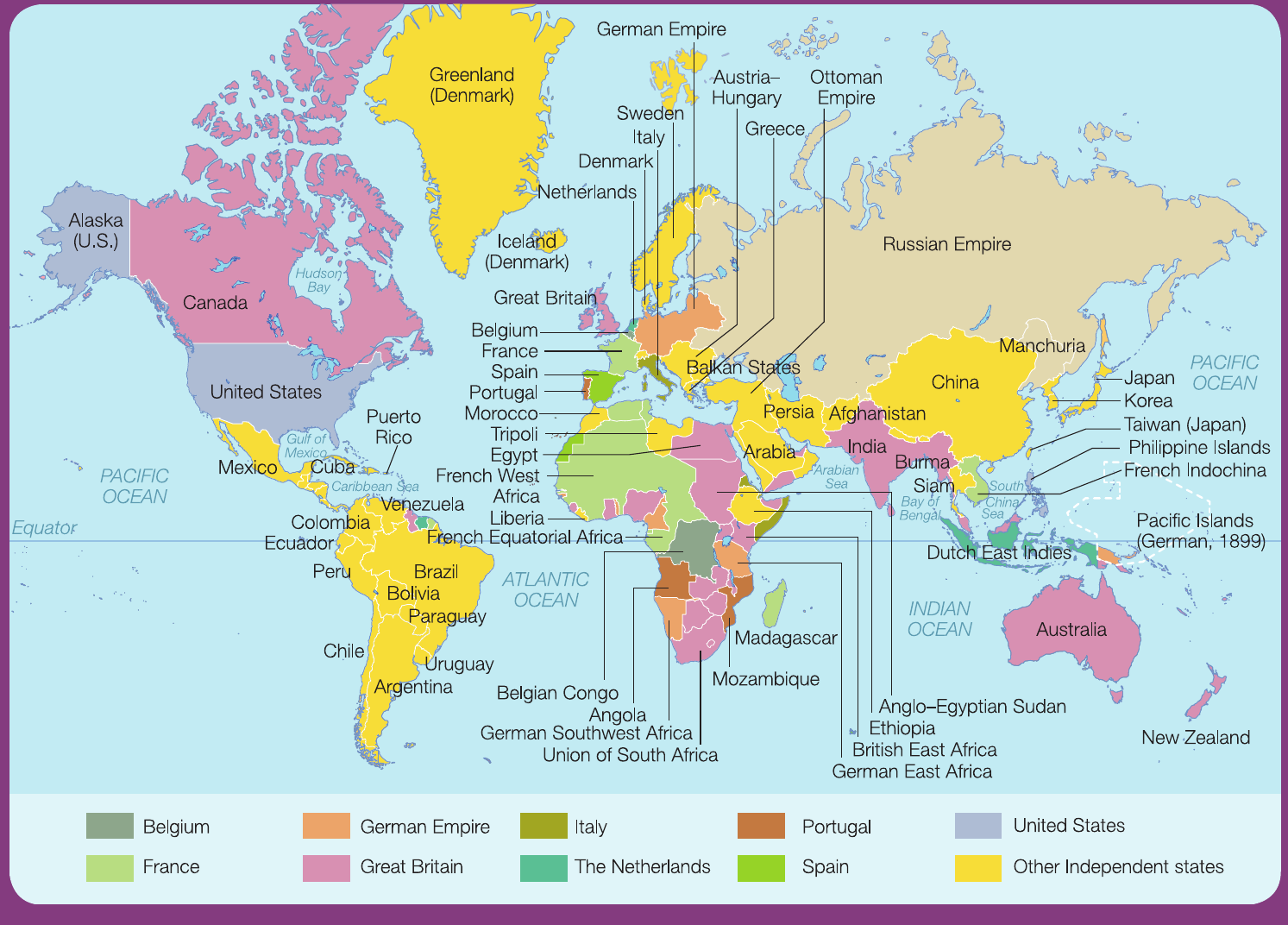
The peoples living in these newly discovered territories often lacked the technology needed to resist European invasion. Over several centuries, European seafaring nations constructed vast empires and established extensive trade networks. These networks allowed them to extract raw materials that enriched their home economies.
Note
European colonies served a dual purpose in the imperial system. They provided essential raw materials that fed European industries, and simultaneously created captive markets for European manufactured goods. This system became even more powerful with the advent of the Industrial Revolution, creating a self-reinforcing cycle of economic dominance.
The Industrial Revolution and its impact
The Industrial Revolution began in Great Britain around 1750 and gradually spread to other European countries. This transformation changed societies from agricultural economies to manufacturing powerhouses.
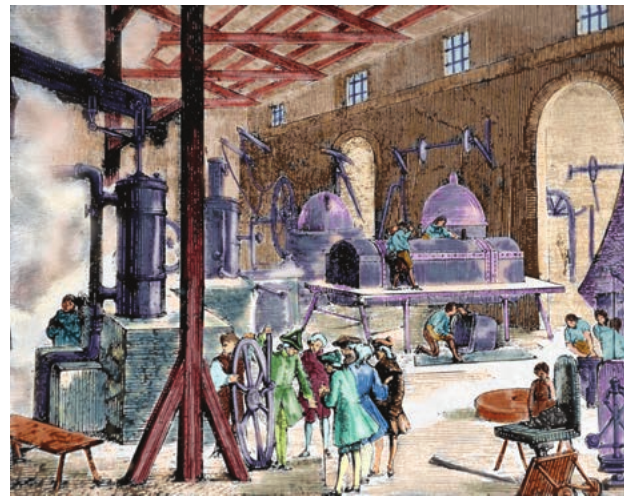
The Industrial Revolution intensified free market capitalism, which became the defining characteristic of modern nations. Combined with earlier voyages of exploration, industrialisation made the small nations of Europe the masters of the rest of the world. However, by the nineteenth century, these same developments threatened to tear Europe apart through intense competition and rivalry.
Important
Definition: Imperialism
Imperialism refers to the activity and ideology of empire-building. It describes a system in which one country rules over other countries, sometimes using force to gain control of them. This concept became the driving force behind European expansion and would ultimately contribute to the tensions leading to World War I.
Imperial rivalry and conflict
In their quest to build global empires, European powers frequently came into conflict with one another. Over the centuries, many wars erupted due to intense geopolitical rivalry between the Great Powers. Historians call this competition 'imperial rivalry' because most disputes involved disagreements over colonial possessions.
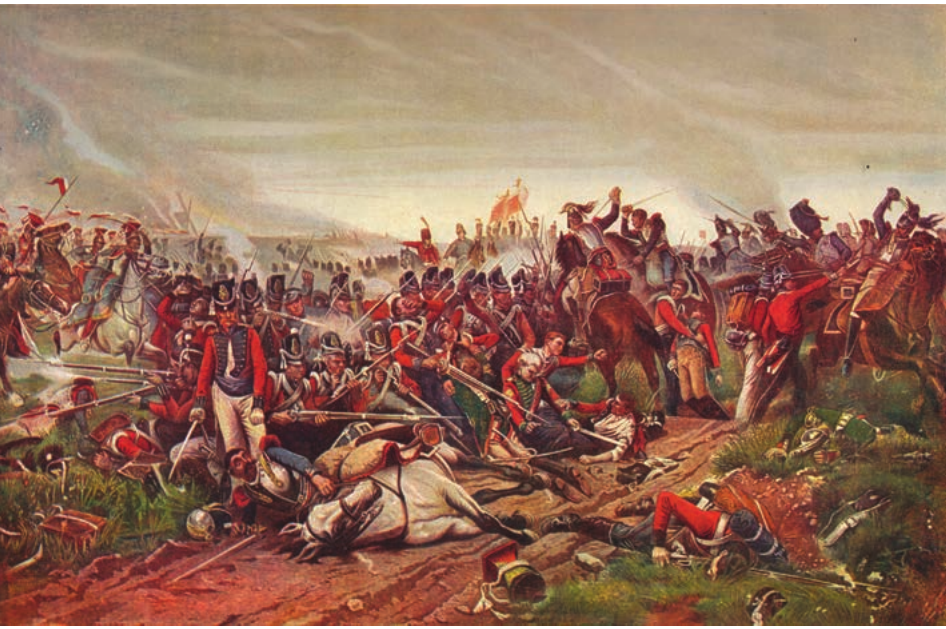
Sometimes these colonial disputes erupted into major wars on the European continent itself. During the nineteenth century, the Napoleonic Wars caused unprecedented levels of destruction.
Note
The scale of European warfare during this period was staggering. The Napoleonic Wars involved armies numbering in the hundreds of thousands and devastated large parts of Europe. This foreshadowed the even greater destruction that would come with World War I.
New imperialism (1870–1914)
From the mid-nineteenth century onwards, European control over the world tightened considerably. Britain formally took control of India in 1858. France took control of Polynesia in 1840 and Indochina in 1887. All the imperial powers became caught up in what became known as 'the race for empire'.
European colonial powers competed fiercely to acquire remaining unclaimed territories around the world. This rivalry intensified dramatically with the formation of two new nations in Europe in 1871: Italy and Germany. After unification, both nations experienced strong nationalism and sought colonies of their own. They wanted colonies to boost their prestige and help fuel their growing economies.
The scramble for Africa
One major result of this period of new imperialism was the carving up of Africa between European imperial powers. This process became known as 'the scramble for Africa'.
Important
By 1914, over 90 per cent of Africa was under European control. This represents one of the most dramatic examples of imperial expansion in human history, accomplished in less than half a century.
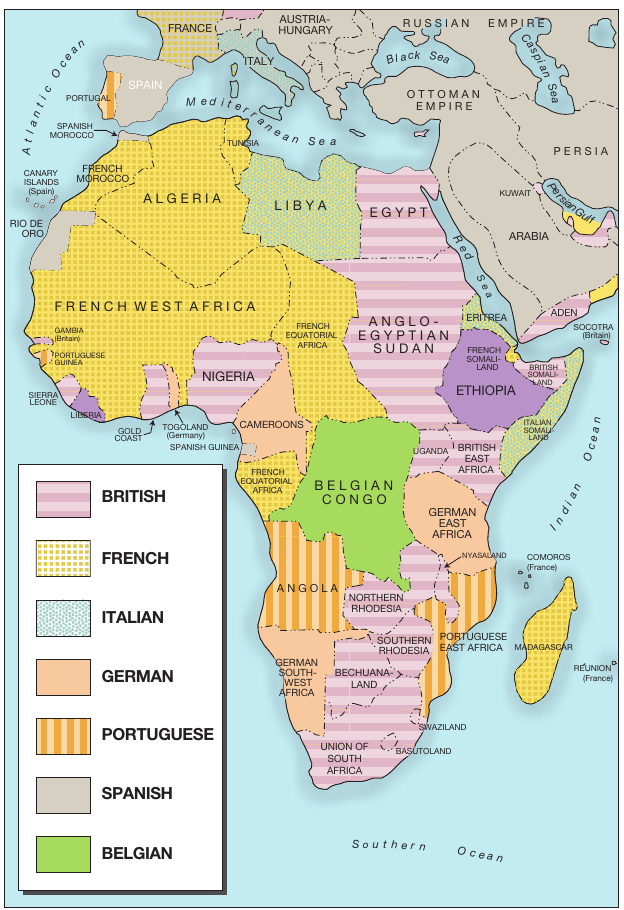
The map above shows how European powers divided Africa amongst themselves. Different colours represent different colonial powers:
- British territories (pink)
- French territories (yellow with dots)
- German territories (orange)
- Belgian territories (green)
- Portuguese territories (orange with stripes)
- Italian territories (grey)
- Spanish territories (yellow-green)
The British Empire
During this period, the British Empire reached its peak. By 1914, it covered roughly one quarter of the globe and ruled over 400 million people (approximately one quarter of the world's population).
Note
"The sun never sets on the British Empire"
This famous phrase captured the reality of British global dominance. Because the empire spanned the globe, some part of it was always in daylight. To support this vast empire, Britain maintained the world's largest navy, which ruled the high seas and sometimes acted as the world's policeman.
Under Queen Victoria's reign (1837–1901), Britain changed its approach to trade. It abandoned mercantilist policies in favour of free trade, believing this offered the best hope of ensuring prosperity for Britain and all European nations.
British insecurity
Despite the enormous size and success of its empire, Britain became increasingly insecure. Several factors contributed to this anxiety:
The Boer War (1899-1902) against Dutch settlers in South Africa revealed weaknesses in British military capability. This conflict damaged British confidence and exposed vulnerabilities in their armed forces.
Concerns about Russian imperial ambitions in Asia led Britain to conclude a treaty with Japan in 1902 (the Anglo-Japanese Treaty) to balance Russian power in that region.
Note
Anxiety about French imperial ambitions prompted Britain to sign an alliance with France in 1904. This agreement, called the Entente Cordiale, meant both countries promised to respect each other's colonial possessions. It also included a secret agreement for mutual aid in the event of war.
In 1907, Britain dealt with the Russian threat by concluding the Anglo-Russian Agreement with Russia's Tsarist rulers.
Important
By 1910, Britain's feelings of vulnerability intensified further when both the United States and Germany overtook Britain in manufacturing output. This marked a significant shift in the global balance of economic power.
The Russian Empire
Tsarist Russia was also anxious despite its apparent power. Russia was the largest of the Great Powers, with the longest unbroken border lining the frontiers of its vast empire. This empire stretched from the Baltic Sea in Europe to the Pacific Ocean in Asia.
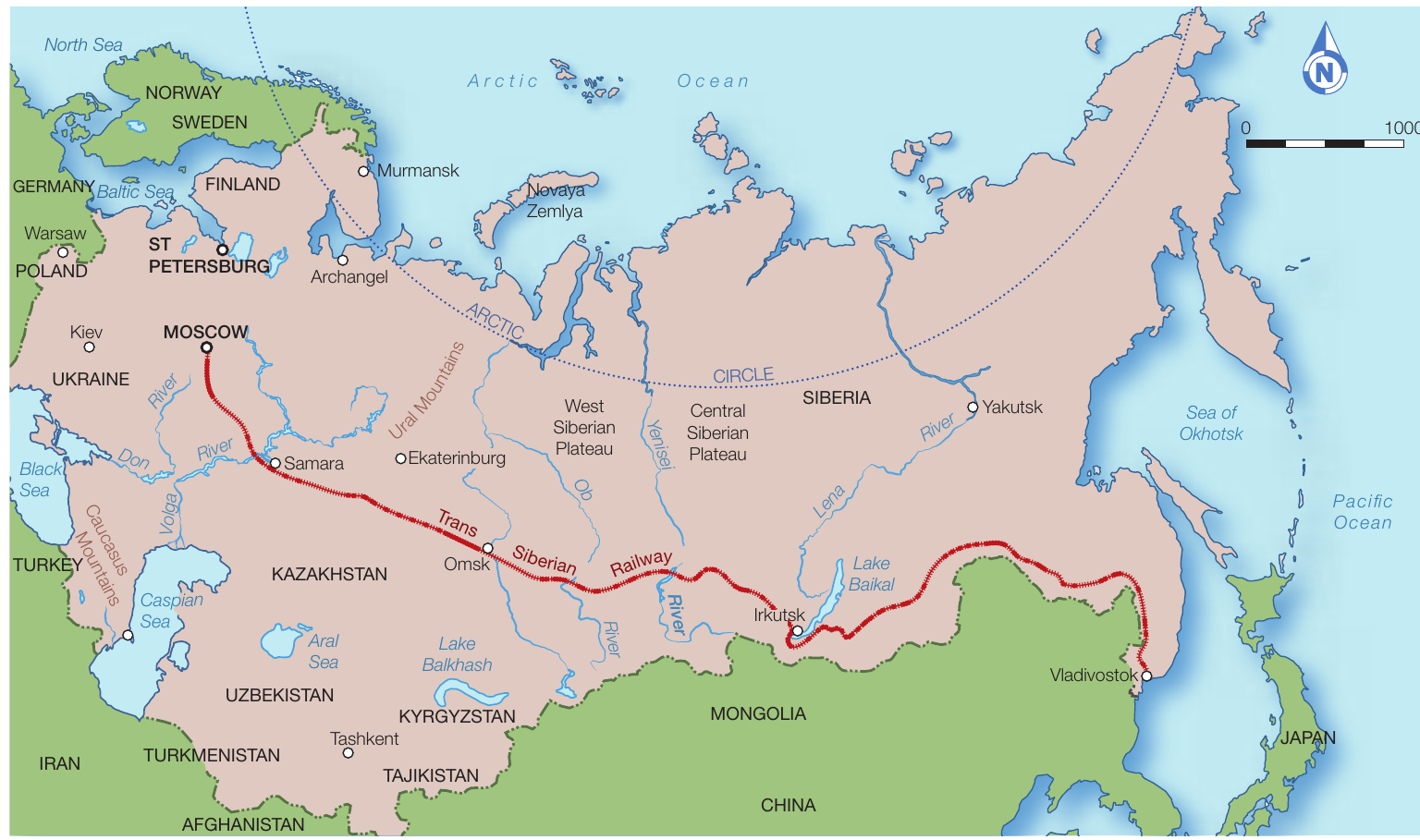
Russia appeared to be the greatest and most formidable of the Great Powers. However, it was keenly aware of its perennial problem: economic backwardness compared to other European Great Powers. Russia remained very much an agricultural economy whilst other powers industrialised.
Russian modernisation attempts
During the 1890s, Russia embarked on an ambitious industrialisation programme under Finance Minister Sergei Witte (1892–1903). However, this modernisation programme created new internal problems:
Important
Russia's Modernisation Paradox
Rapid industrialisation created serious internal tensions:
- Growing classes of landless peasants displaced from traditional agriculture
- Restless workers in new sprawling industrial centres facing harsh conditions
- Agitation for change in a system that allowed no criticism of the state
- All strikes and protests were illegal
- No legitimate outlets for dissent existed
These problems would eventually contribute to the revolutionary movements that would shake Russia in 1905 and ultimately bring down the Tsarist regime in 1917.
To compensate for domestic weaknesses and slow modernisation, Russian leadership looked to further expansion eastward. Russia took advantage of the crumbling Chinese empire, particularly seeking to expand into Manchuria and Korea. Russia especially wanted to secure access to the warm waters of the Pacific Ocean.
The Ottoman Empire
The Ottoman Empire was created in 1453 when Ottoman Turks captured Constantinople. For hundreds of years it remained one of the world's strongest empires. In 1683, the Ottomans threatened to expand into the heart of Europe by sending a 200,000-strong army to lay siege to Vienna in Austria. However, a coalition of European nations defeated them.
During the following century, Ottoman power gradually declined. The empire struggled to keep control over its territories and was forced to relinquish control over Egypt and North Africa. In 1850, Tsar Nicholas I referred to the Ottoman Empire as 'the sick man of Europe'.
By the mid-1800s, the Ottomans faced severe economic problems and could not compete with other Great Powers whose economies were thriving. By the late 1800s, the Young Turk movement called for internal political reforms.
In the early 1900s, the Ottomans lost control of their remaining European territories after a series of wars in the Balkans. Other Great Powers coveted the remaining Ottoman territories.
Strategic importance of the Dardanelles
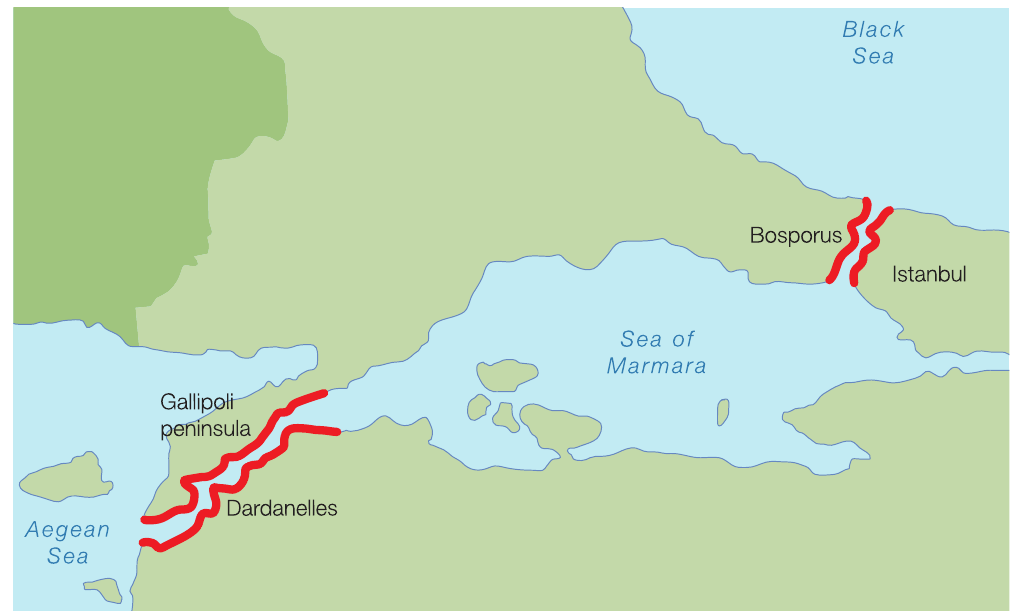
The Russians had a specific desire for control over the Dardanelles. This meant the Ottoman rulers regarded Russia as their main threat.
Important
Why the Dardanelles Mattered
The map above shows the strategic importance of the Dardanelles and Bosphorus straits. Control of these waterways would give Russia unimpeded access from the Black Sea to the Mediterranean Sea for its merchant and naval fleets. This would transform Russia's strategic position, giving it year-round access to warm-water ports and global trade routes.
Since France was Russia's ally, the Ottomans could not consider a French alliance. Austria-Hungary also sought to extend its influence at Ottoman expense. Though some Ottoman moderates favoured an alliance with Britain, Germany ultimately signed a secret treaty with the Ottoman rulers on 2 August 1914. The Ottomans pledged to enter the war on Germany's side one day after Germany declared war on Russia.
Asia: China and Japan
China's decline
In Asia, the once-great Qing Dynasty in China crumbled whilst its neighbour Japan modernised. China's decline accelerated after the Boxer Rebellion (1899–1901) and the foreign intervention that suppressed it. Foreign powers then demanded heavy financial compensation (indemnities) from the Chinese government.
Finally, in 1911, the Chinese revolution brought down the Qing Dynasty. China then descended into decades of chaotic government.
Note
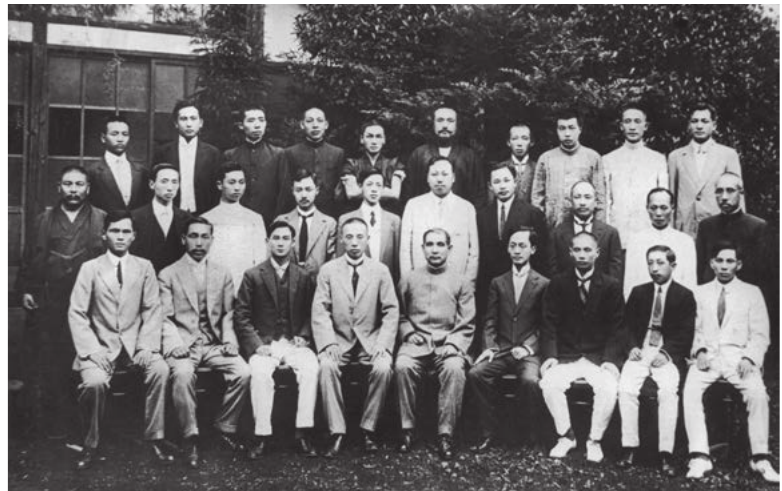
The photograph above shows Sun Yat-Sen and members of his Guomindang Party. This political party aimed to modernise China after the 1911 revolution. Nineteen-eleven was a time of optimism for China, but hopes were soon dashed when Yuan Shikai seized power.
Japan's rise
In contrast to China's decline, Japan successfully modernised its economy and military along European lines. This process started with the Meiji Restoration of 1868.
Japan viewed Russian expansion into Manchuria and Korea as a threat to its own imperial ambitions. In 1904, Japan launched an attack on the Russian Eastern fleet and continued to inflict defeats on Russian forces by both land and sea.
Important
Historic Turning Point: The Russo-Japanese War
In 1905, the Russo-Japanese War ended with the Treaty of Portsmouth. This war had historic significance as the first time in the modern era that an Asian power had defeated a European power. This victory shocked the world and demonstrated that European military superiority was not inevitable. It also inspired nationalist movements across Asia and Africa.
The United States
Across the Pacific Ocean, the United States emerged as an economic powerhouse after expanding westwards to the Pacific. Since its foundation, the US had expressed little interest in seeking an overseas empire.
However, this changed when the US acquired Hawaii in 1898 to enhance its western security. In the same year, the US also acquired the Philippines after the brief Spanish-American War.
Note
American Exceptionalism
For the time being, the US remained content with its geopolitical position and showed no signs of imperial ambition or militaristic tendencies. Though the US navy was formidable, its army ranked only 17th in the world, after Portugal. Many Americans took pride in the fact that the US did not follow the old ways of Europe and was not a militaristic nation. This situation would change in 1915 when Americans began to feel the impact of the Great War.
Summary
Key Points to Remember:
-
European dominance of the world by 1900 resulted from technological advances in seafaring and weaponry, combined with the Industrial Revolution
-
New imperialism (1870-1914) saw intense competition between European powers, resulting in the 'scramble for Africa' where over 90% of Africa came under European control by 1914
-
The British Empire was the largest, covering one quarter of the globe and ruling 400 million people, but Britain felt increasingly insecure and formed alliances with Japan (1902), France (1904) and Russia (1907)
-
Russia was the largest empire geographically but remained economically backward, attempting industrialisation whilst facing internal unrest
-
The Ottoman Empire declined from its former power, becoming known as 'the sick man of Europe', with control of the Dardanelles a major point of strategic rivalry
-
Japan successfully modernised and defeated Russia in 1904-1905, whilst China's Qing Dynasty collapsed in 1911, marking the first modern victory of an Asian power over a European power
Exam Focus:
When studying imperialism and Great Power rivalry:
- Understand the connection between technological advancement and European dominance
- Know the key dates: 1870-1914 (new imperialism), 1904-1905 (Russo-Japanese War), 1911 (Chinese Revolution)
- Be able to explain why even powerful empires like Britain felt insecure
- Understand the strategic importance of key locations like the Dardanelles
- Remember that imperial rivalry was a major cause of tension before World War I