Trends in the Periodic Table (VCE SSCE Chemistry): Revision Notes
📚Revision Notes
Trends in the Periodic Table
The periodic table is more than just a list of elements organised by their electronic configuration. It's a powerful tool that helps us understand and predict the properties of elements. By examining the position of an element in the periodic table, you can determine key characteristics such as atomic radius, electronegativity, and first ionisation energy.
Understanding the periodic table structure
The periodic table organises elements in a way that reveals patterns in their properties. The group number tells you how many valence electrons an atom of that element has, while the period number indicates how many electron shells are occupied in an atom.
Note
The Russian chemist Dimitri Mendeleev first published his periodic table in 1869. He observed that element properties follow repeating patterns, which he described as the periodic law. This periodicity (repeating pattern) in element properties is what makes the periodic table such a valuable tool for chemists.
Trends in electronic configuration
To understand why element properties follow patterns, let's examine the electronic configurations of the alkali metals in group 1. These elements (lithium, sodium, potassium, rubidium and caesium) are all relatively soft metals that react vigorously with water and oxygen.
Their electronic configurations are:
- Li:
- Na:
- K:
- Rb:
- Cs:
Note
Notice that all these elements have similar valence shell electronic configurations—each has one electron in an s-subshell. This similarity in electron arrangement gives elements in the same group similar chemical properties and explains the periodicity we observe.
As you move down a group, the number of electron shells increases. This means valence electrons occupy higher energy subshells and experience a weaker attraction to the nucleus. This changing attractive force between valence electrons and the nucleus as you move down a group creates observable trends in element properties.
Effective nuclear charge
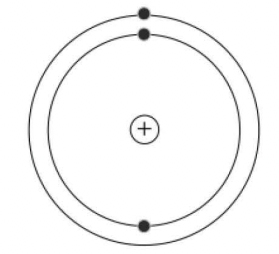
Effective nuclear charge (sometimes called core charge) measures the attractive force that valence shell electrons experience towards the nucleus. This concept is crucial for predicting element properties and explaining trends across periods.
Consider a lithium atom with an atomic number of 3. It has three protons in its nucleus, two electrons in the first shell, and one electron in the second shell. The valence electron is attracted to the three positive charges in the nucleus, but it's also repelled by the two electrons in the inner shell. These inner shell electrons shield the valence electron from the full nuclear attraction. The valence electron effectively experiences the nucleus as if there were only a +1 charge. Therefore, lithium has an effective nuclear charge of +1.
Important
The formula for calculating effective nuclear charge is:
For example, a chlorine atom has 17 protons and seven valence shell electrons. The number of inner-shell electrons is 10, so the effective nuclear charge is .
Worked example: calculating effective nuclear charge for aluminium
Example
Worked Example: Calculating Effective Nuclear Charge for Aluminium
Let's determine the effective nuclear charge of an aluminium atom.
Step 1: Find the number of electrons using the periodic table
Aluminium has an atomic number of 13, so it has 13 protons and 13 electrons.
Step 2: Determine the electronic configuration
With 13 electrons, the electronic configuration is .
Step 3: Calculate the effective nuclear charge
The third shell is the valence shell in aluminium. There are 10 inner-shell electrons in the first and second shells.
Effective nuclear charge =
Effective nuclear charge by group
The effective nuclear charge for main group elements corresponds to their group number:
| Group | Effective nuclear charge |
|---|---|
| 1 | +1 |
| 2 | +2 |
| 13 | +3 |
| 14 | +4 |
| 15 | +5 |
| 16 | +6 |
| 17 | +7 |
| 18* | +8 |
*Note: Helium has an effective nuclear charge of +2.
How effective nuclear charge changes in the periodic table
The attraction between the nucleus and valence electrons changes predictably across the periodic table:
| Direction | Trend in effective nuclear charge | Trend in attraction between nucleus and valence electrons |
|---|---|---|
| Down a group | Remains constant | Effective nuclear charge stays constant down a group, but valence electrons are held less strongly because they are further from the nucleus due to additional shells in the atom. |
| Left to right across a period | Increases | The valence electrons are more attracted to the nucleus as the effective nuclear charge increases. |
Note
All observed trends in the periodic table can be related to these changes in attraction between valence electrons and the nucleus.
Electronegativity
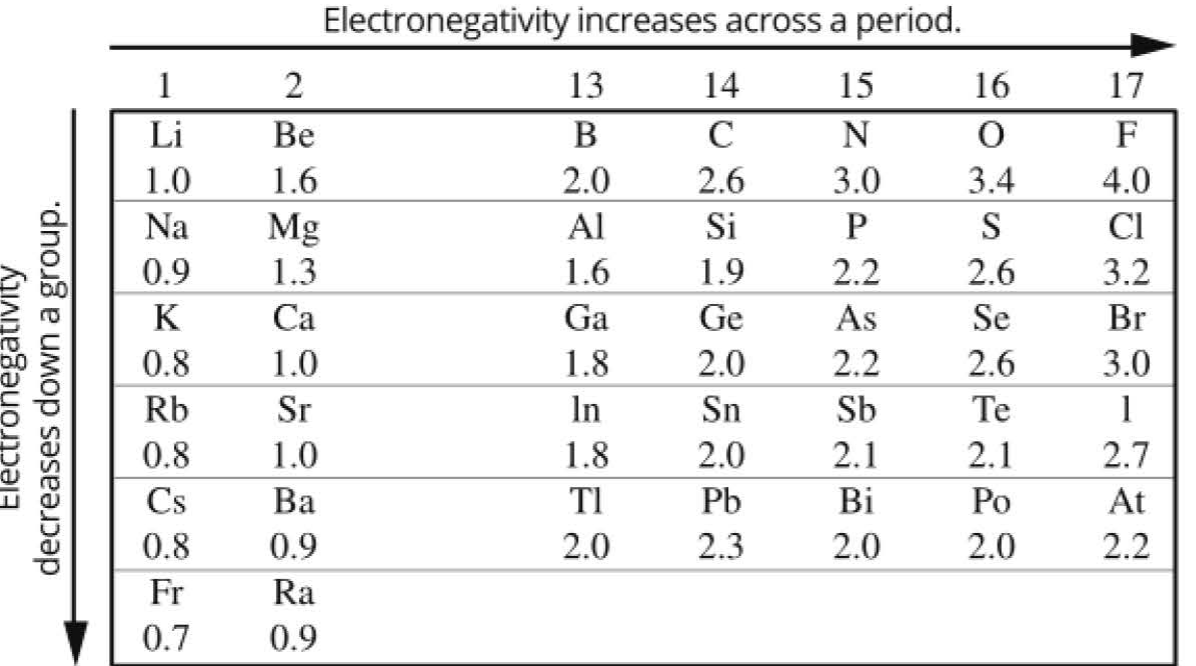
Electronegativity is the ability of an atom to attract electrons towards itself when forming a chemical bond. It measures how strongly an atom pulls on the electrons of nearby atoms. Since the positive pull comes from the nucleus, atoms with greater effective nuclear charge have higher electronegativity.
The diagram below shows electronegativity values for many main group elements. Note that noble gases (group 18) are not listed because they have a stable outer shell and don't readily form bonds with other atoms.
Electronegativity trends explained
| Direction | Trend in electronegativity | Explanation |
|---|---|---|
| Down a group | Decreases | The effective nuclear charge stays constant and the number of shells increases down a group. Therefore, valence electrons are less strongly attracted to the nucleus as they are further from it. As a result, electronegativity decreases. |
| Left to right across a period | Increases | The number of occupied shells in the atoms remains constant but the effective nuclear charge increases across a period. Therefore, valence electrons become more strongly attracted to the nucleus. As a result, electronegativity increases. |
Important
Exam tip: Fluorine is the most electronegative element in the periodic table with a value of 4.0.
Atomic radius
Atomic radius is a measurement of the size of atoms. It represents the distance from the nucleus to the valence shell electrons. Scientists usually measure atomic radius by halving the distance between the nuclei of two atoms of the same element that are bonded together.
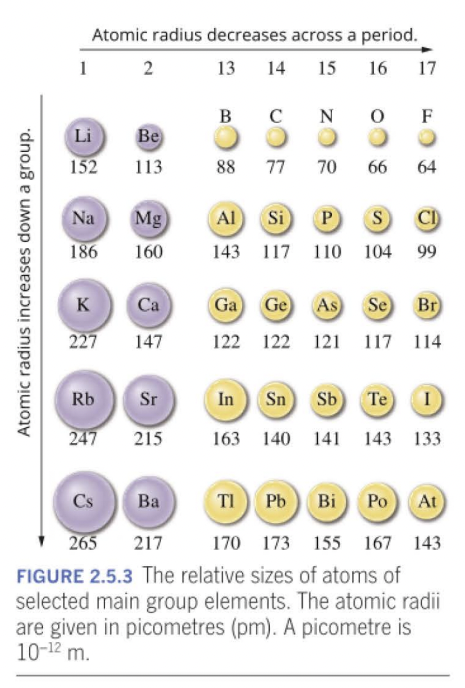
How atomic radius is measured
Atoms don't have sharply defined boundaries, so we cannot measure their radii directly. Instead, we measure the distance between nuclei of atoms of the same element in molecules. For example, in a hydrogen molecule (), the two nuclei are 74 picometres (pm) apart. The radius of each hydrogen atom is assumed to be half that distance, i.e. 37 pm.
Note
The formula is:
where is the atomic radius and is the distance between nuclei.
As you move across a period, atomic radius decreases. This occurs because as effective nuclear charge increases, valence shell electrons are pulled in more tightly towards the nucleus.
Atomic radius trends explained
| Direction | Trend in atomic radius | Explanation |
|---|---|---|
| Down a group | Increases | Effective nuclear charge stays constant and the number of shells increases as you move down a group. As a result, atomic radius increases. |
| Left to right across a period | Decreases | As you move across a period, the number of occupied shells in the atoms remains constant but the effective nuclear charge increases. The valence electrons become more strongly attracted to the nucleus, so atomic radius decreases across a period. |
Important
Exam tip: Remember that atomic radius decreases across a period because the effective nuclear charge increases, pulling valence electrons closer to the nucleus.
First ionisation energy
When an element is heated, its electrons can move to higher energy shells. If an atom receives sufficient energy, an electron can be completely removed from the atom. When this happens, the atom has one fewer electron than protons in the nucleus and becomes a positively charged ion.
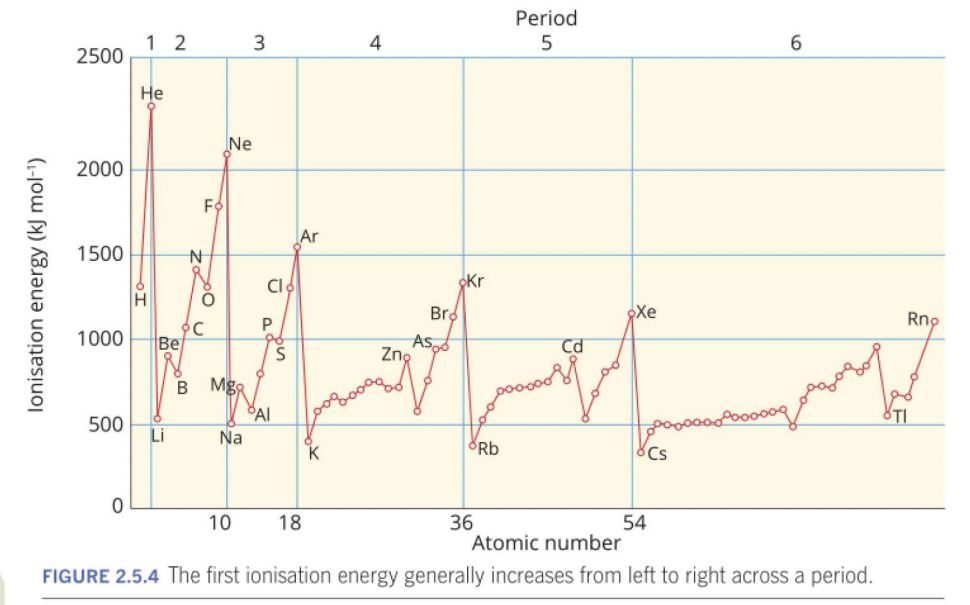
First ionisation energy is the energy required to remove one electron from an atom of an element in the gas phase. For example, the first ionisation energy of sodium is 494 kJ per mole of sodium atoms. (A mole is a way of counting atoms—you'll learn more about this in later chapters.)
Note
The magnitude of first ionisation energy reflects how strongly valence electrons are attracted to the nucleus. The more strongly valence electrons are attracted to the nucleus, the more energy is required to remove one of them, and the higher the first ionisation energy.
First ionisation energy trends explained
| Direction | Trend in first ionisation energy | Explanation |
|---|---|---|
| Down a group | Decreases | Effective nuclear charge stays constant and the number of shells increases down a group. Therefore, valence electrons are less attracted to the nucleus as they are further from it. As a result, the energy required to overcome the attraction between the nucleus and the valence electron is less, and first ionisation energy decreases down a group. |
| Left to right across a period | Increases | Effective nuclear charge increases and the number of occupied shells remains constant across a period. As a result, valence electrons become more strongly attracted to the nucleus, and more energy is required to remove an electron. Therefore, first ionisation energy increases across a period. |
The s- and p-block elements follow these patterns consistently. As effective nuclear charge increases across a period, so does ionisation energy. As atomic radius increases down a group (due to additional electron shells), electrons are further from the nucleus, so valence electrons in elements lower in a group can be removed more easily, meaning ionisation energy decreases.
Trends in metals and non-metals
One of the most useful distinctions in the periodic table is the classification of elements as metals, metalloids, or non-metals. Metalloids share properties of both metals and non-metals.
Understanding whether an element is a metal or non-metal helps you predict how it will bond with other elements. The reactivity of both metals and non-metals also follows predictable trends in the periodic table.
Metal reactivity trends
The properties of metals arise from their tendency to readily lose electrons. As you move down a group, valence shell electrons are further from the pull of the nucleus and are therefore lost more easily. This means that as you go down a group, metals become more reactive.
Across a period, the opposite occurs—as effective nuclear charge increases, metals become less reactive. This means the most reactive metals are in group 1.
Important
Consequently, the most reactive metal in the periodic table is in the bottom left corner: francium.
Non-metal reactivity trends
In contrast, the properties of non-metals arise from their tendency to readily gain electrons. In general, non-metals become less reactive as you move down a group, because valence electrons are further from the nucleus. Non-metals become more reactive across a period, as effective nuclear charge increases. The noble gases are an exception to this rule, as they are inert (unreactive).
Important
Consequently, the most reactive non-metal is in the top right of the periodic table (excluding noble gases): fluorine.
Remember!
Summary
Key Points to Remember:
-
The periodic table organises elements to reveal patterns in their properties. Group number indicates valence electrons; period number indicates electron shells.
-
Effective nuclear charge measures the attractive force on valence electrons. It equals the number of protons minus the number of inner-shell electrons. It stays constant down a group but increases across a period.
-
Electronegativity, atomic radius, and first ionisation energy all show predictable trends. Down a group: electronegativity and ionisation energy decrease, while atomic radius increases. Across a period: electronegativity and ionisation energy increase, while atomic radius decreases.
-
Metal reactivity increases down a group and decreases across a period. Non-metal reactivity decreases down a group and increases across a period.
-
The most reactive metal is francium (bottom left), and the most reactive non-metal is fluorine (top right, excluding noble gases).