Qualitative Testing of Organic Compounds (VCE SSCE Chemistry): Revision Notes
📚Revision Notes
Qualitative Testing of Organic Compounds
Introduction
When synthesising organic compounds, chemists often produce a mixture containing the desired product along with unwanted substances. These unwanted substances include:
- Intermediates: Compounds formed during the reaction pathway
- By-products: Substances produced alongside the intended product (such as isomers)
Note
Example: Preparing Propan-1-ol
When preparing propan-1-ol from propane, the reaction produces both 1-chloropropane (the desired intermediate) and 2-chloropropane (an unwanted isomer), plus other chlorinated compounds. This demonstrates how synthesis rarely produces pure products directly.
After synthesis, chemists must:
- Separate the desired product from by-products
- Purify the product
- Confirm the identity and purity of the final product
This note covers laboratory techniques for isolating products and qualitative tests for identifying organic compounds.
Purification and separation techniques
Distillation
Distillation separates liquids that have different boiling points. This technique works best when the liquids have boiling points that differ by at least 50°C.
How distillation works:
- The mixture is placed in a round-bottom flask and heated to the boiling point of the liquid you want to collect
- Vapour rises from the flask and passes into a water-cooled condenser
- The condenser cools the vapour below its boiling point, causing it to condense
- The condensed liquid (called the distillate) is collected in a beaker
- Liquids with higher boiling points remain in the flask
Note
Key term: A condenser is glassware used to cool hot vapours back into liquids. The water jacket surrounding the condenser provides continuous cooling to ensure efficient condensation.
Fractional distillation
When liquids have boiling points that are close together (less than 50°C apart), fractional distillation provides better separation. This technique is particularly useful for separating volatile liquids - liquids that evaporate easily at low temperatures.
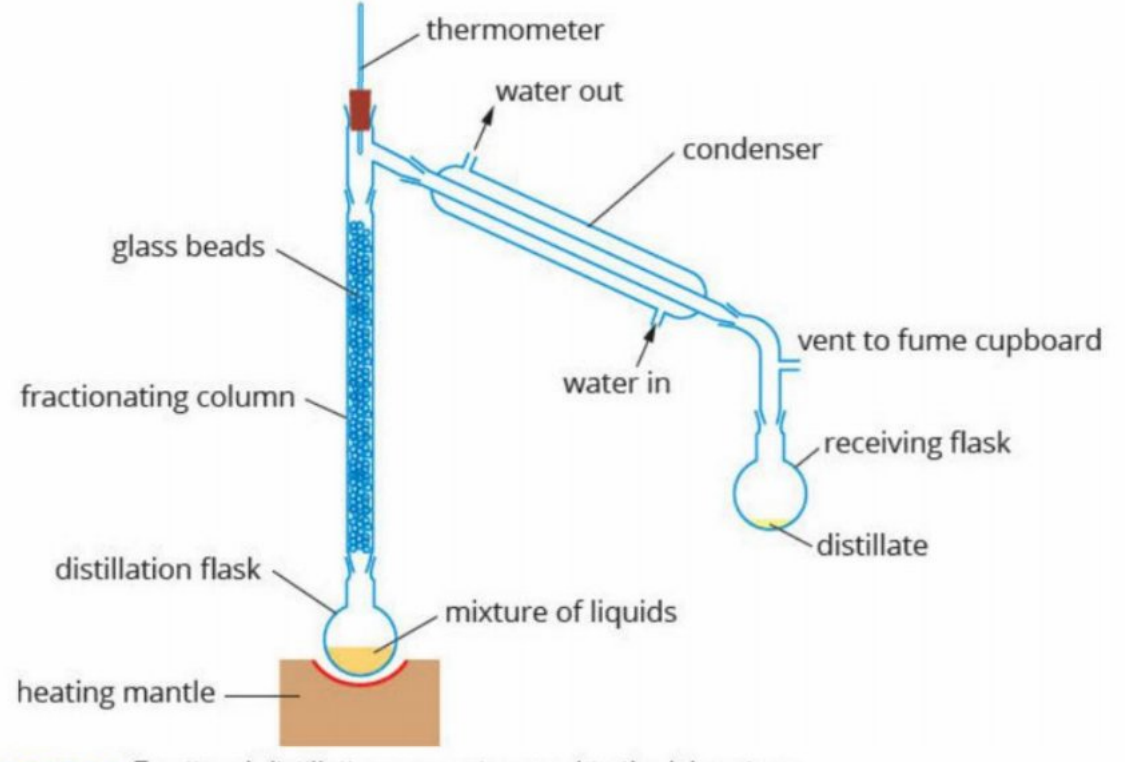
Key features of fractional distillation apparatus:
- A fractionating column packed with glass beads or shelves provides a large surface area for vapour to condense on
- Anti-bumping granules are added to the flask to prevent violent boiling
- A temperature gradient exists up the column (cooler at the top, hotter at the bottom)
How fractional distillation works:
The process can be thought of as multiple simple distillations happening simultaneously:
- The mixture is heated, and vapours rise from the flask
- These vapours contain a higher concentration of the lower boiling point components
- Vapours rise up the column until they reach a height where the temperature is low enough for condensation
- The condensed liquid trickles back down and is reheated by rising vapours, causing it to evaporate again
- Each evaporation-condensation cycle enriches the vapour in the most volatile component
- When vapour reaches the top of the column, it ideally consists of only the most volatile component
- The temperature at the top remains relatively stable
- The vapour enters the condenser, cools, and the distillate drips into the collection vessel
Example
Worked Example: Separating Ethyl Ethanoate
Ethyl ethanoate is synthesised by reacting ethanol with ethanoic acid:
| Component | Boiling point (°C) |
|---|---|
| CH₃COOCH₂CH₃ | 57 |
| CH₃CH₂OH | 78 |
| H₂O | 100 |
| CH₃COOH | 118 |
The reaction mixture is heated, and the component with the lowest boiling point (ethyl ethanoate) boils first. The temperature at the top of the column stabilises around 57°C. The fraction collected between 55-59°C contains pure ethyl ethanoate, while higher boiling point components remain in the flask.
Industrial application: Crude oil fractional distillation
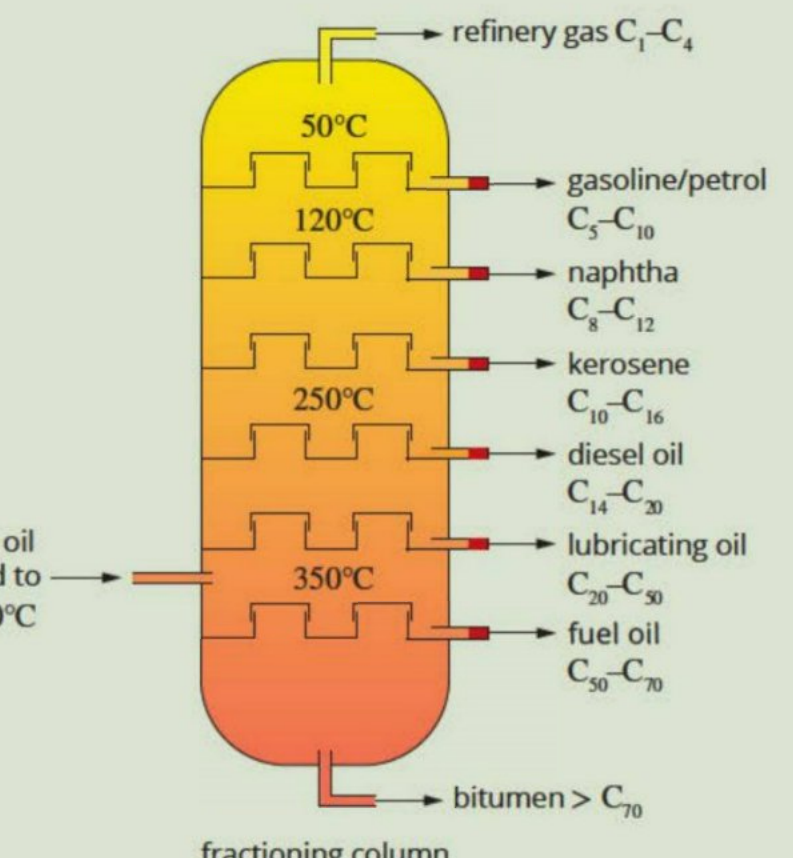
Crude oil is a mixture of hydrocarbons formed from plant and animal remains over millions of years. At oil refineries, crude oil undergoes fractional distillation in a fractionating tower.
Note
The crude oil is heated to over 300°C and separated into fractions. Each fraction contains hydrocarbons with similar boiling points and molecular masses:
- Refinery gas (C₁-C₄) at 50°C (top)
- Gasoline/petrol (C₅-C₁₀) at 120°C
- Naphtha (C₈-C₁₂)
- Kerosene (C₁₀-C₁₆) at 250°C
- Diesel oil (C₁₄-C₂₀)
- Lubricating oil (C₂₀-C₅₀) at 350°C
- Fuel oil (C₅₀-C₇₀)
- Bitumen (>C₇₀) at bottom
Over 90% of crude oil components are used as fuels.
Melting point determination
Melting point determination provides information about both the identity and purity of solid organic compounds.
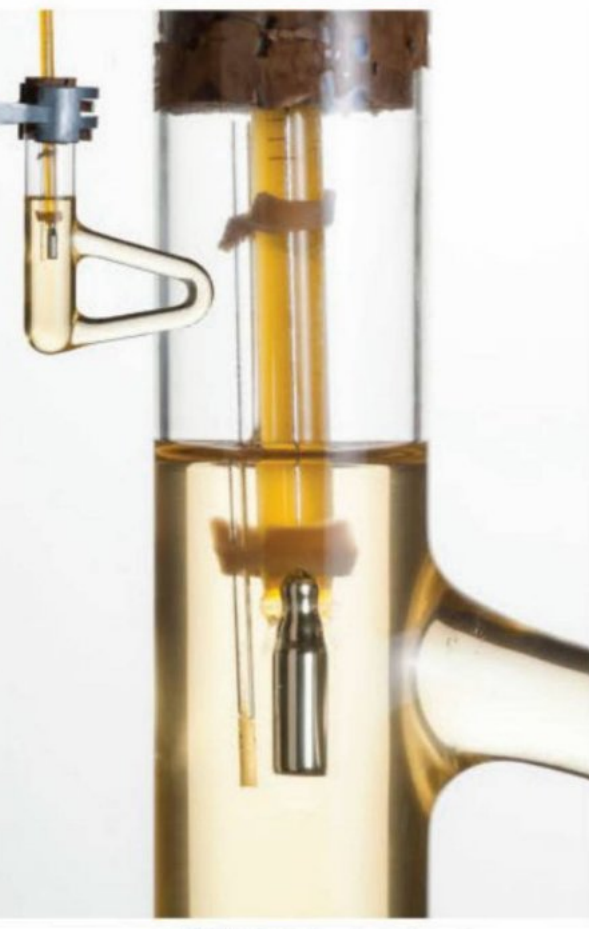
Understanding melting points:
- A sharp melting point means the difference between the temperature at which melting begins and when it's complete is small (typically 0.5-2°C)
- Pure substances have sharp melting points because all molecules are identical and pack together in an orderly arrangement, maximising intermolecular forces
- Impure substances have lower melting points and broader melting point ranges (more than 2°C) because different molecules disrupt the crystal structure
Important
Key principle: The boiling points of organic molecules depend on the strength of their intermolecular forces. When melting occurs, these forces are broken.
Interpreting melting point ranges:
| Melting point range | Indication |
|---|---|
| 0.5-2°C (narrow) | Reasonably pure substance |
| >2°C (broad) | Presence of impurities |
Method:
- Add the sample to a small glass capillary tube (closed at one end)
- Attach the capillary tube to a thermometer and insert into a Thiele tube containing oil
- Slowly heat the oil
- Record two temperatures:
- When the sample starts to melt
- When the sample is completely liquified
- The melting point range is the difference between these temperatures
Using melting points for identification:
To identify an unknown solid:
- Compare the experimentally determined melting point with known values
- If the melting point is higher than the expected value, the sample is not the desired product
- If the melting point is lower, the sample is either impure or not the desired product
Mixed melting point determination:
To confirm identity, mix the unknown substance with a pure sample of the suspected compound and measure the melting point:
- If the mixture has a wide melting point range below the expected value, the compounds are different
- If the mixture melts at the expected temperature, the unknown is confirmed as that compound
Example
Worked Example: Identifying Aspirin
If an unknown is thought to be aspirin (melting point 135°C):
- Mix it with pure aspirin and measure the melting point
- A wide range below 135°C means the unknown is not aspirin
- Melting at 135°C confirms the unknown is aspirin
Qualitative tests for functional groups
After separating a desired product, chemists use simple chemical tests to confirm the presence of specific functional groups.
Testing for carbon-carbon double bonds
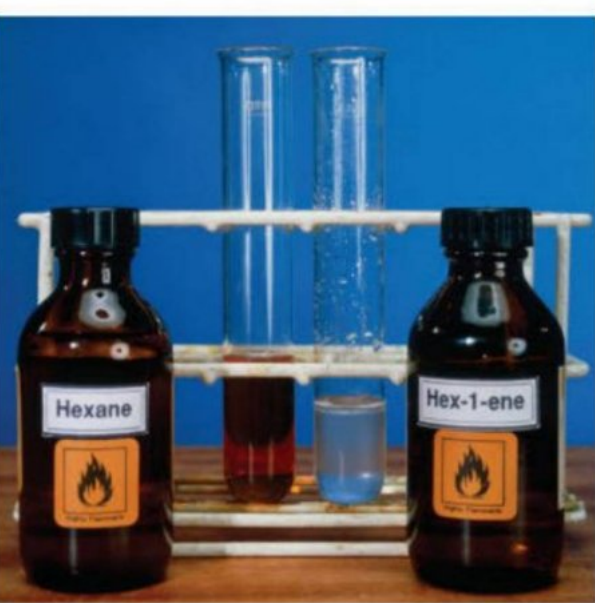
The bromine test is a quick and easy way to detect carbon-carbon double bonds (C=C).
Principle:
Alkenes are unsaturated hydrocarbons that readily undergo addition reactions. In these reactions, small molecules add across the carbon-carbon double bond.
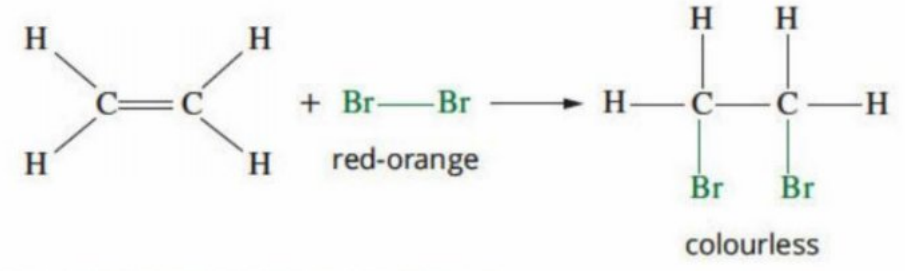
When ethene reacts with bromine:
Observations:
Note
- Bromine solution is red-orange in colour
- When added to a compound containing C=C bonds, the mixture rapidly decolourises (becomes colourless)
- This happens because bromine reacts to form a colourless dibromo product
- When bromine is added to an alkane (no double bonds), the red-orange colour remains
Testing for hydroxyl groups
Two types of tests can identify the hydroxyl functional group (-OH) in alcohols:
1. Esterification test
Method:
- Gently heat a mixture of the organic compound with ethanoic acid and a few drops of sulfuric acid (catalyst)
- Pour the reaction mixture into cold water
- Smell the surface of the water
Observations:
- If a hydroxyl group is present, you will detect the characteristic smell of an ester
Explanation:
Alcohols react with carboxylic acids to form esters:
(R represents an alkyl group)
If no ester smell is detected, the hydroxyl group is not present.
2. Oxidation tests
After confirming the presence of a hydroxyl group, oxidation tests can determine the type of alcohol:
Important
Classification of Alcohol Oxidation:
- Primary alcohols oxidise to carboxylic acids
- Secondary alcohols oxidise to ketones
- Tertiary alcohols are resistant to oxidation
Test A: Acidified potassium dichromate
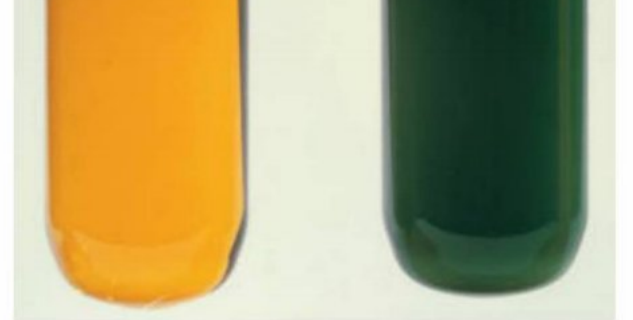
Observations:
- Dichromate ion (Cr₂O₇²⁻) solution is orange
- When added to a primary or secondary alcohol, the dichromate is reduced to chromium(III) ions (Cr³⁺)
- The colour changes from orange to green
- With tertiary alcohols, the orange colour remains unchanged
Test B: Acidified potassium permanganate
Observations:
- Permanganate ion (MnO₄⁻) solution is deep purple
- When added to a primary or secondary alcohol, the permanganate is reduced to manganese(II) ions (Mn²⁺)
- The colour changes from purple to colourless
- With tertiary alcohols, the purple colour remains unchanged
Testing for carboxyl groups
The carboxyl functional group (-COOH) can be detected using sodium hydrogen carbonate.
Method:
- Add a small amount of solid sodium hydrogen carbonate (NaHCO₃) to the organic compound
Observations:
- Effervescence (fizzing) occurs if the carboxyl group is present
- Carbon dioxide gas is produced
Confirmation test:
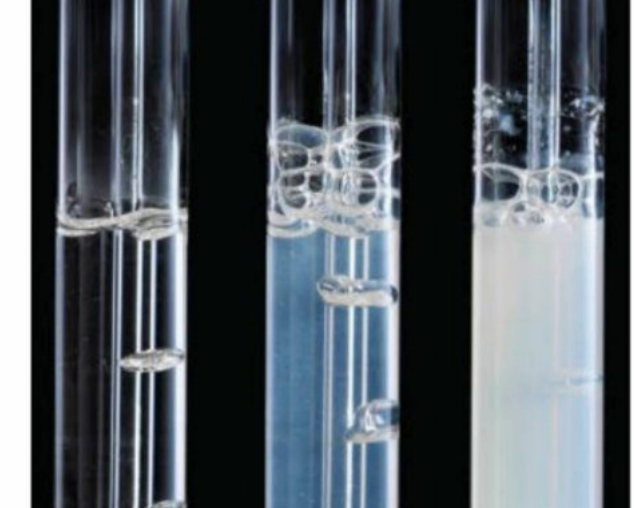
Bubble the gas through limewater:
- The limewater turns 'milky' or 'cloudy' due to precipitation of calcium carbonate
Explanation:
When metal hydrogen carbonates react with acids, the products are a salt, water, and carbon dioxide:
Summary of qualitative tests
| Chemical test | Method | Observations | Explanation |
|---|---|---|---|
| Carbon-carbon double bond | Add bromine (Br₂) solution to the unknown compound | Red-orange colour rapidly decolourises | Addition reaction occurs. As bromine adds across the C=C bond, the solution loses colour: R₂C=CR₂ + Br₂ → R₂BrC-CBrR₂ |
| Carboxyl group | Add solid sodium hydrogen carbonate (NaHCO₃) to the unknown compound | Effervescence occurs as colourless gas is produced. When bubbled through limewater, the solution turns milky/cloudy | NaHCO₃(s) + RCOOH(aq) → RCOONa(aq) + CO₂(g) + H₂O(l) Limewater test: Ca(OH)₂(aq) + CO₂(g) → CaCO₃(s) + H₂O(l) |
| Hydroxyl group | Gently heat mixture of organic compound with ethanoic acid and sulfuric acid. Pour into cold water | Characteristic smell of ester on water surface | Condensation reaction between hydroxyl and carboxyl groups: ROH(l) + CH₃COOH(l) → CH₃COOR(l) + H₂O(l) |
Identifying unknown compounds - worked example
Example
Worked Example: Identifying Unknown Liquids
A student has five colourless liquids (A, B, C, D, E) known to be:
- Butane
- But-1-ene
- Butan-1-ol
- Butanoic acid
- 2-methylpropan-2-ol
Test results:
| Test | A | B | C | D | E |
|---|---|---|---|---|---|
| Solubility in water | Soluble | Soluble | Insoluble | Soluble | Insoluble |
| Bromine solution | No reaction | No reaction | No reaction | No reaction | Colour disappears |
| Sodium hydrogen carbonate | Gas evolved | No reaction | No reaction | No reaction | No reaction |
| Acidified potassium permanganate | No colour change | No colour change | No colour change | Purple → colourless | No colour change |
Step 1: Classify by homologous series
- Butane = alkane
- But-1-ene = alkene
- Butan-1-ol = alcohol
- Butanoic acid = carboxylic acid
- 2-methylpropan-2-ol = alcohol
Step 2: Classify by polarity
- Butane and but-1-ene are non-polar (insoluble in water)
- Butan-1-ol, butanoic acid, and 2-methylpropan-2-ol are polar (soluble in water)
Step 3: Use solubility test
Liquids C and E are insoluble → must be butane and but-1-ene Liquids A, B, and D are soluble → must be the two alcohols and the carboxylic acid
Step 4: Use bromine test
Bromine decolourises with E → E contains C=C bond ∴ E = but-1-ene ∴ C = butane
Step 5: Use sodium hydrogen carbonate test
Gas evolved with A → A contains carboxyl group ∴ A = butanoic acid
Step 6: Use acidified potassium permanganate test
Colour change (purple → colourless) with D → D is a primary or secondary alcohol Butan-1-ol is a primary alcohol 2-methylpropan-2-ol is a tertiary alcohol
∴ D = butan-1-ol ∴ B = 2-methylpropan-2-ol
Iodine number
Iodine number (also called iodine value or iodine index) measures the degree of unsaturation in fats and oils.
Definition: The iodine number is the mass of iodine (in grams) that reacts with 100 g of a fat or oil.
Background
Fats and oils contain triglycerides - large molecules made from glycerol and three fatty acids. Understanding their structure helps explain their chemical behavior:
- Fatty acids have a carboxyl group attached to a long hydrocarbon chain
- Fatty acids are classified as saturated (no C=C bonds) or unsaturated (contain C=C bonds)
- Halogens like iodine undergo addition reactions with unsaturated fatty acids
- Iodine is safer to use than bromine (which releases toxic fumes)
- Iodine solutions are stable and can be standardised
Important
Key relationship: One I₂ molecule reacts with one C=C double bond
This mole ratio allows us to calculate the number of double bonds in a fatty acid molecule.
Calculating the number of double bonds
Example
Worked Example: Determining Double Bonds in Linoleic Acid
A 0.010 mol sample of linoleic acid reacts completely with 40 mL of 0.50 M iodine solution. How many C=C bonds are in each linoleic acid molecule?
Step 1: Calculate moles of iodine
Step 2: Calculate the mole ratio
Step 3: Interpret the ratio
2 moles of iodine react with 1 mole of linoleic acid
∴ There are 2 carbon-carbon double bonds in each linoleic acid molecule
Calculating iodine number
Typical iodine numbers:
| Fat or oil | Iodine number (g I₂ per 100 g) |
|---|---|
| Beef fat | 42-48 |
| Butter | 25-42 |
| Canola oil | 110-126 |
| Coconut oil | 6-11 |
| Fish oil | 190-205 |
| Linseed oil | 170-204 |
| Olive oil | 75-94 |
| Peanut oil | 82-107 |
| Sesame oil | 100-120 |
| Sunflower oil | 110-145 |
Note
Observations from the data:
- Vegetable oils tend to be more unsaturated than animal fats (higher iodine numbers)
- Higher iodine numbers indicate more reactive, less stable, softer fats/oils
- These are more susceptible to oxidation
Example
Worked Example: Calculating Iodine Number for Oleic Acid
Calculate the iodine number for oleic acid with semi-structural formula CH₃(CH₂)₇CH=CH(CH₂)₇COOH and molar mass 282.0 g mol⁻¹.
Step 1: Count C=C bonds
From the formula, there is 1 carbon-carbon double bond per molecule
Step 2: Convert 100 g to moles
Step 3: Calculate moles of I₂ needed
Step 4: Calculate mass of I₂
Answer: Iodine number of oleic acid = 90.0
Summary
Key Points to Remember:
- Distillation separates liquids with boiling points differing by at least 50°C, while fractional distillation separates liquids with similar boiling points using a fractionating column
- Pure substances have sharp melting points (0.5-2°C range); impure substances have broader ranges (>2°C) and lower melting points
- Bromine test: Red-orange bromine decolourises with alkenes (C=C present); colour remains with alkanes
- Hydroxyl test: Esterification produces characteristic smell; oxidation tests distinguish primary/secondary (react, colour change) from tertiary alcohols (no reaction)
- Carboxyl test: Sodium hydrogen carbonate produces effervescence and CO₂ (confirmed by milky limewater)
- Iodine number measures degree of unsaturation in fats/oils - higher values indicate more C=C bonds and greater reactivity