Sequences and Recurrence Relations (VCE SSCE General Mathematics): Revision Notes
📚Revision Notes
Sequences and Recurrence Relations
What is a sequence?
A sequence is an ordered list of numbers written one after another. Each individual number in the sequence is called a term. We separate terms using commas when writing them out.
When a sequence continues indefinitely, or when there are too many terms to write completely, we use an ellipsis (three dots: ...) to show the pattern continues.
For example:
Note
The ellipsis notation (...) is a mathematical convention that indicates the pattern continues in the same way. It saves space and helps focus on understanding the pattern rather than writing out every term.
Generating sequences recursively
Sequences can be created randomly, but more commonly they follow a pattern using recursion. Recursion means we repeatedly apply the same rule to generate each new term from the previous one.
Understanding the recursive process
To create a sequence recursively, we need two things:
- A starting value (the first term)
- A rule that tells us how to get from one term to the next
Important
The Two Essential Parts of Recursion
Every recursive sequence requires BOTH components:
- A starting value to begin the sequence
- A rule to generate each subsequent term
Missing either component means you cannot generate the sequence!
Example: The sequence has:
- Starting value:
- Rule: add to each term
We can visualize this as:
Worked example: Simple recursive rule
Example
Worked Example: Creating a Sequence with a Simple Rule
Let's create the first five terms of a sequence with starting value and the rule "add to the previous term".
Step 1: Record the starting value:
Step 2: Apply the rule (add ):
Step 3: Continue applying the rule three more times:
Answer: The first five terms are
Worked example: Complex recursive rule
Example
Worked Example: Applying a Multi-Step Rule
Now let's try a sequence with a more complex rule. Starting value is and the rule is "double the number and then subtract ".
Step 1: Record the starting value:
Step 2: Apply the rule (multiply by , then subtract ):
Step 3: Continue applying the same rule:
Answer: The first five terms are
Note
Notice how with complex rules, each step involves multiple operations. The key is to apply the ENTIRE rule to each term before moving to the next one. Don't rush - complete all operations in the rule before recording the new term.
Using a calculator to generate sequences
Generating sequences involves repetitive calculations - the same operation performed over and over. Calculators are excellent for this because they automatically store the previous answer and can reapply the same rule repeatedly.
Calculator method
When you perform a calculation on a calculator, it stores the result. You can then apply a new operation to that stored answer without retyping it.
Example
Worked Example: Using a Calculator to Generate Sequences
Generate the first five terms with starting value and rule "double and subtract "
Step 1: Enter the starting value and press enter (or EXE)
Step 2: Enter the rule and press enter
The calculator shows the result and remembers this value
Step 3: Press enter repeatedly
Each press applies the rule to the previous result
Result: The sequence appears on screen
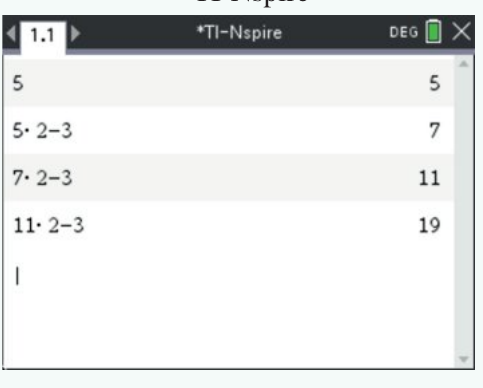
On a TI-Nspire calculator, you'll see calculations like "" displayed. On a ClassPad, it shows "ans" where "ans" represents the answer from the previous calculation.
Note
Different calculator models may display the calculations slightly differently, but the underlying principle is the same: the calculator stores each result and applies the rule to that stored value when you press enter again.
Recurrence relations
A recurrence relation is a formal mathematical way to describe how to generate a sequence. It consists of two essential parts:
- A starting value - the first term in the sequence
- A rule - describing how to calculate the next term from the current term
Writing recurrence relations in words
Consider the sequence:
In words, the recurrence relation is:
- Start with
- To get the next term, add to the current term
Converting to symbolic notation
Rather than writing everything in words, mathematicians use a more compact symbolic form. We define a subscripted variable to represent the terms. The letter is commonly used, but any letter works.
Let be the term in the sequence after iterations (applications of the rule).
Here's how the word description translates to symbols:

Using this notation, we write the complete recurrence relation as:
This reads as:
- : the starting value (before any iterations) is
- : the next term equals the current term plus
Important
Understanding Notation
The starting value uses subscript (written as ) because at the start, we haven't yet applied the rule - there have been zero iterations.
- = starting value (0 iterations)
- = after applying the rule once (1 iteration)
- = after applying the rule twice (2 iterations)
- And so on...
This is why we start counting from 0, not 1!
Worked example: Generating from a recurrence relation
Example
Worked Example: Finding Terms from a Recurrence Relation
Find the first five terms of the sequence defined by:
Step 1: Record the starting value:
Step 2: Use the rule to find :
Step 3: Apply the rule to find three more terms:
Answer: The first five terms are
Using a calculator for recurrence relations
Calculators can generate sequences from recurrence relations very efficiently.
Example
Worked Example: Calculator Method for Recurrence Relations
Generate the sequence from and determine how many terms are positive.
Steps:
- Start with a blank screen
- Enter and press enter
- Enter and press enter to generate the next term
- Continue pressing enter until a negative term appears
- Count the positive terms
Calculator output:
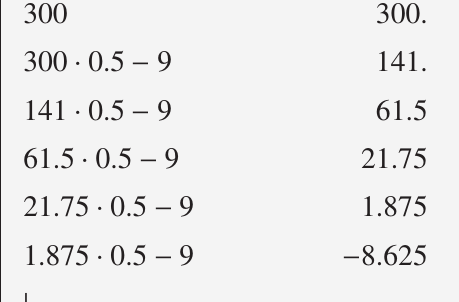
Answer: The first five terms of the sequence are positive.
Naming and numbering terms in a sequence
When working with recurrence relations, each term has a specific name using subscript notation.
Example
Worked Example: Identifying Terms by Subscript
Consider
The sequence generated is:
We label each term:
| Value | ||||||
|---|---|---|---|---|---|---|
| Name |
So if asked to find:
The subscript tells us which position the term occupies in the sequence, counting from as the starting position.
Summary
Key Points to Remember:
- A sequence is an ordered list of numbers; each number is called a term
- Recursion means repeatedly applying the same rule to generate the next term from the previous one
- To create a sequence recursively, you need a starting value and a rule
- Calculators can generate sequences efficiently by storing the previous answer and reapplying the rule
- A recurrence relation has the form
- Terms are numbered using subscripts: is the starting value, is after one iteration, after two iterations, and so on