Solving Simultaneous Equations (VCE SSCE General Mathematics): Revision Notes
📚Revision Notes
Solving Simultaneous Equations
Introduction
When working with two linear equations, we often need to find where they meet. This meeting point is called the point of intersection, and finding it is known as solving the equations simultaneously.
Note
Key Concept: Simultaneous equations are two or more equations that we solve together to find values that satisfy all equations at the same time.
Understanding intersection points
Two straight lines will meet at a single point unless they are parallel (running in exactly the same direction and never meeting). The coordinates of this meeting point give us the solution to both equations.
Note
When we find the point of intersection, we are finding the values of and that make both equations true at the same time.
Method 1: Finding intersections graphically
The most visual way to solve simultaneous equations is to plot both lines on the same set of axes and identify where they cross.
Example
Worked Example: Graphical Solution
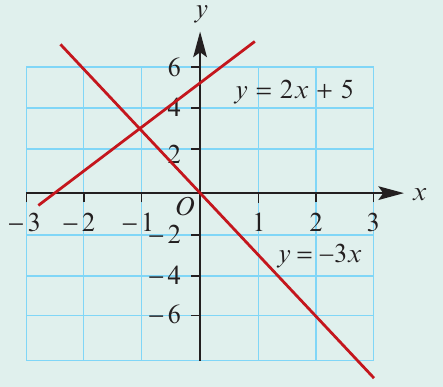
Consider the equations and .
Solution:
Looking at where the two lines cross, we can read off the coordinates of the intersection point: (-1, 3).
This means:
We can verify this works in both equations:
- First equation: ✓
- Second equation: ✓
Example
Practice Problem
The graphs of and meet at a single point. By examining where the lines cross on a coordinate plane, you would find their point of intersection.
Important
Exam Tip: When reading intersection points from a graph, always check both the and values carefully against the scale on each axis.
Method 2: Using a CAS calculator to find intersections graphically
Modern graphing calculators can plot the equations and find the exact intersection point automatically. This is more accurate than reading from a hand-drawn graph.
General process for graphical calculator method
Note
General Steps:
- Enter both equations into the calculator's graphing function
- Plot both graphs on the same screen
- Use the calculator's intersection-finding tool
- Read off the exact coordinates
Example
Worked Example: Calculator Solution
Let's solve and using a graphing calculator.
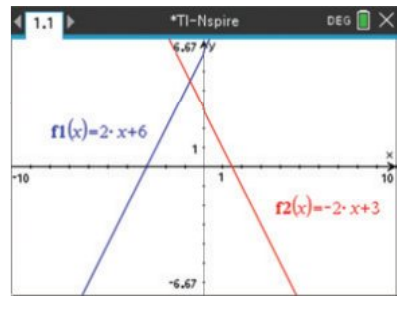
After entering both functions and using the intersection tool:
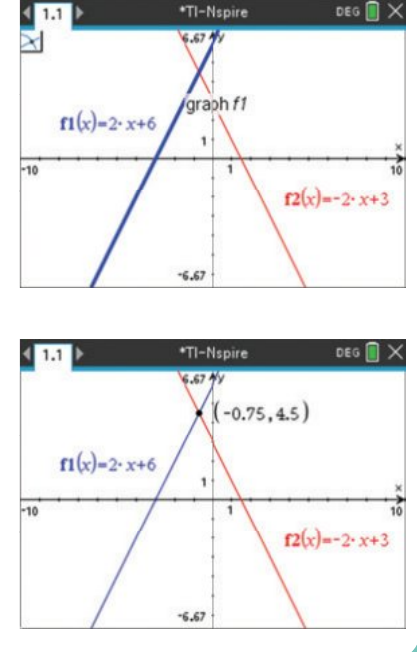
Solution: The calculator shows the intersection point is at x = -0.75 and y = 4.5.
Written as coordinates: (-0.75, 4.5)
Note
Different calculator brands have different menu systems, but the underlying principle is the same - graph both equations and use the built-in intersection finder.
Method 3: Solving algebraically with a CAS calculator
Instead of graphing the equations, we can use the calculator's algebraic solving functions. This is particularly useful for equations that aren't in form.
When to use algebraic methods
Note
Algebraic solving is especially helpful when:
- Equations are written in general form like
- You need an exact answer rather than reading from a graph
- The intersection point has awkward coordinates
Example
Worked Example: Solving a System Algebraically
Solve the simultaneous equations:
Using a CAS calculator's simultaneous equation solver:
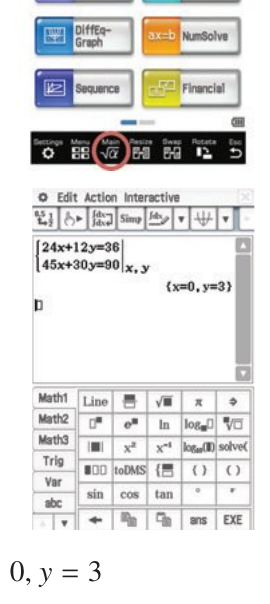
Steps:
- Access the simultaneous equation solving function on your calculator
- Specify that you have 2 equations with variables and
- Enter the first equation:
- Enter the second equation:
- Execute the solve command
Solution: x = 0, y = 3
Verification:
We should always check our solution works in both original equations:
- First equation: ✓
- Second equation: ✓
Choosing the best method
| Method | Best when... | Advantages | Disadvantages |
|---|---|---|---|
| Hand-drawn graph | Visual understanding needed | Easy to see the relationship | Less accurate, time-consuming |
| Calculator graph | Quick visual solution needed | More accurate than hand-drawn | Still requires reading coordinates |
| Algebraic (calculator) | Exact answer required | Most accurate, works with any form | Less visual understanding |
Important
Exam Tip: For exam questions, use the method that's most appropriate for the marks available. Simple intersections might be shown graphically, but exact answers typically require algebraic methods.
Summary
Key Points to Remember:
- Simultaneous equations are solved together to find values that satisfy all equations at once
- The intersection point of two lines gives the solution to both equations
- Graphical methods involve plotting both lines and finding where they meet
- Algebraic methods use calculation to find exact values without drawing
- Parallel lines never intersect, so they have no solution
- Always verify your solution by substituting back into both original equations
- CAS calculators can solve simultaneous equations both graphically and algebraically