Direct Variation (VCE SSCE General Mathematics): Revision Notes
📚Revision Notes
Direct Variation
Introduction to direct variation
When two variables are related so that one increases at a constant rate as the other increases, we call this a direct variation.
For two variables and , if we can write the relationship as where is a positive constant number, then we say that " varies directly as ".
Note
Another way to express the same idea is to say " is directly proportional to ". Both phrases mean exactly the same thing.
The positive constant in the equation is called the constant of variation. This number stays the same throughout the relationship and determines how quickly changes as changes.
Understanding direct variation notation
We use a special symbol to write direct variation more concisely. The symbol means is proportional to or varies as.
Important
When varies directly as , we write:
This is read as " is proportional to ".
An important characteristic of direct variation is that as increases, also increases. Both variables move in the same direction.
The constant of variation
The constant of variation tells us the rate at which changes compared to .
For direct variation where , we can find using:
Once we know the constant of variation, we can find any value for a given value, or find any value for a given value.
Note
For example, if , then and is the constant of variation. This means that is always three times as large as .
Graphical representation of direct variation
A key property of direct variation is that when we graph against , we always get a straight line that passes through the origin (the point ).
Real-world example: distance and time
Consider Emily who drives at a constant speed of km/h from Appleton to Brownsville, a distance of km. She records her progress each hour:

Looking at the data, we can see that as time increases, distance also increases. The relationship between time (in hours) and distance (in kilometres) is:
This is an example of direct variation. The constant of variation is , representing the constant speed in km/h.
We can say that distance travelled varies directly as time taken, or that is proportional to (written as ).
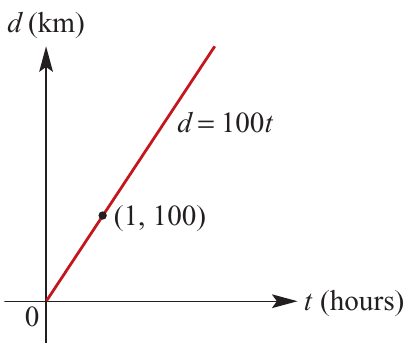
The graph shows that plotted against forms a straight line passing through the origin, confirming this is direct variation.
Key properties of direct variation
Summary
Key Properties to Remember:
- The variable varies directly as if , where is a positive constant
- The constant is called the constant of variation
- In direct variation:
- We write " varies directly as " symbolically as
- If , the graph of against is a straight line passing through the origin
Determining the constant of variation
If varies directly as , we can write where is the constant of variation.
Important
The constant of variation can be found if we know just one value of and its corresponding value of .
Example 1: Finding the constant of variation
Example
Worked Example: Finding the Constant of Variation
Problem: Use the table of values to determine the constant of variation , and complete the table, given that :
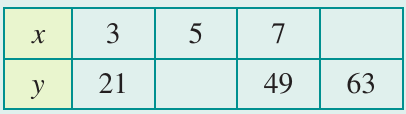
Solution:
Step 1: Rewrite the variation expression as an equation with as the constant of variation.
Step 2: Substitute corresponding values for and , then solve for .
When , :
Step 3: Substitute into .
Step 4: Substitute the value for to find the corresponding value.
When :
Step 5: Substitute the value of to find the corresponding value.
When :
Step 6: Complete the table.
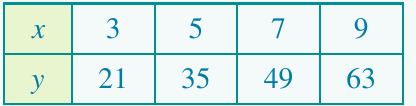
Variation involving powers
Sometimes in direct variation, one of the variables is raised to a power. The concept remains the same, but the relationship involves an exponent.
Example: falling object
Consider a metal ball dropped from the top of a tall building. The distance it falls (in metres) is recorded each second:

As increases, also increases. The relationship between time and distance is:
This is another example of direct variation. Here, we say that the distance fallen varies directly as the square of the time taken. In other words, is proportional to . We write this as .
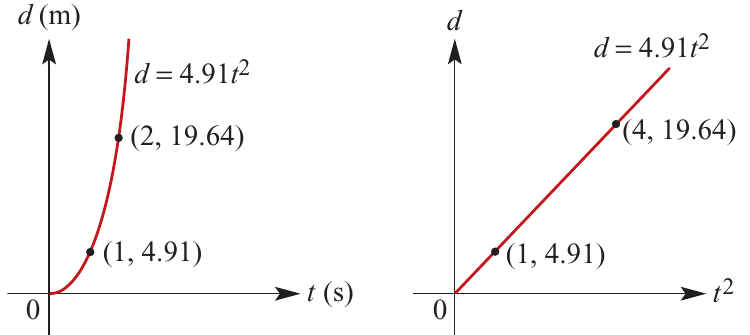
Notice that:
- The graph of against is a parabola (curved)
- However, the graph of against is a straight line passing through the origin
This confirms that varies directly as .
General rule for powers
Note
Direct Variation with Powers:
- If , then , where is a constant of variation
- If , then the graph of against is a straight line passing through the origin
Important
Important note: For all examples of direct variation, when one variable increases, the other also increases. However, not all increasing trends are examples of direct variation.
Example 2: Finding the constant of variation involving powers
Example
Worked Example: Direct Variation with Squares
Problem: Given that , use the table of values to determine the constant of variation , and complete the table:
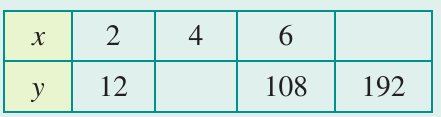
Solution:
Step 1: Rewrite the variation expression as an equation with as the constant of variation.
Step 2: Substitute corresponding values for and , then solve for .
When , :
Step 3: Rewrite the equation for , substituting .
Step 4: Check with other values that the correct value for has been found.
When :
✓
Step 5: Substitute values for to find corresponding values.
When :
Step 6: Substitute the value of to find the corresponding value.
When :
Step 7: Complete the table.

Solving practical problems
Direct variation appears in many real-world situations. The key is to identify the relationship, find the constant of variation, and use it to solve for unknown values.
Example 3: Wire resistance problem
Example
Worked Example: Real-World Application - Wire Resistance
Problem: In an electrical wire, the resistance ( ohms) varies directly as the length ( m) of the wire.
a) If a m wire has a resistance of ohms, what is the resistance of a m wire?
b) How long is a wire for which the resistance is ohms?
Solution:
Part a:
Step 1: Write down the variation expression.
Step 2: Rewrite the expression as an equation with as the constant of variation.
Step 3: Find the constant of variation by substituting given values for and .
When , :
Step 4: Substitute the value for and write down the equation.
Step 5: Substitute and solve to find .
Step 6: Write your answer.
A wire of length m has a resistance of 3.75 ohms.
Part b:
Step 1: Write down the equation.
Step 2: Substitute and solve to find .
Step 3: Write your answer.
A wire of resistance ohms has a length of 4.56 m.
Remember!
Summary
Key Points to Remember:
- Direct variation means two variables are related by where is a positive constant
- The symbol means is proportional to or varies as
- The constant of variation () is the fixed multiplier that relates the two variables
- In direct variation, as one variable increases, the other also increases
- The graph of direct variation is always a straight line through the origin
- Direct variation can involve powers: if , then
- To solve problems: find using known values, then use the equation to find unknown values