The Advantages and Limitations of the Human Development Index (VCE SSCE Health and Human Development): Revision Notes
📚Revision Notes
The Advantages and Limitations of the Human Development Index
What is the Human Development Index?
Measuring the overall level of human development in a country is challenging because it involves many different aspects of people's lives. Collecting comprehensive data on all these aspects globally is not practical. To address this challenge, the United Nations developed the Human Development Index (HDI) as a measurement system to estimate and compare levels of human development across different countries and regions.
The HDI is a tool that measures and ranks countries based on their social and economic development. It combines three key dimensions and four specific indicators to create a single number that represents the level of human development in different countries.
Important
Key Definition: The Human Development Index is a tool developed by the United Nations to measure and rank countries' levels of social and economic development. It provides a single statistic based on three dimensions and four indicators.
Understanding the components of the HDI
The HDI is built on three broad dimensions that represent important aspects of the UN's understanding of human development. Each dimension is measured using specific indicators that provide concrete, measurable data.
Note
The HDI's power lies in its ability to transform complex, multi-faceted development data into a single, comparable measure. By carefully selecting dimensions and indicators that capture essential aspects of human wellbeing, it creates a framework for understanding development that goes beyond simple economic measures.
The three dimensions
The three dimensions of the HDI represent fundamental aspects of human wellbeing:
- A long and healthy life - This reflects people's ability to live long, healthy lives without premature death or significant illness.
- Knowledge - This represents people's opportunities to learn, develop skills, and access information that enhances their capabilities and choices.
- A decent standard of living - This indicates people's ability to access the resources needed for a comfortable life, including food, shelter, and other necessities.
The four indicators
Each dimension is measured using specific, quantifiable indicators:
For a long and healthy life:
- Life expectancy at birth - This shows how long a person can expect to live. It represents the number of years of life remaining to a person at birth if death rates stay constant. Higher life expectancy suggests better health conditions and healthcare systems.
For knowledge:
- Mean years of schooling - This measures the average number of years of education completed by people aged 25 years and over. It reflects the educational attainment of the current adult population.
- Expected years of schooling - This indicates the number of years of education a child entering school can expect to receive. It represents future educational opportunities and access.
For a decent standard of living:
- Gross National Income (GNI) per capita - This represents the total income of a country after expenses owed to other countries have been paid, divided by the population. It indicates the economic resources available to people for maintaining their standard of living.
How the HDI works
The HDI produces a single number between 0 and 1 for each country. The closer a country's HDI is to 1, the higher its level of human development. This scale allows for easy comparison between countries and tracking of progress over time.
Note
Because the HDI considers more than just economic factors (unlike measures that only look at income), it provides a more complete picture of how people actually live in different countries. This multi-dimensional approach is what makes the HDI such a valuable tool for understanding global development.
Classification of countries
The United Nations classifies countries into four groups based on their HDI scores:
- Very high human development
- High human development
- Medium human development
- Low human development
This classification helps identify which countries are experiencing the highest and lowest levels of development.
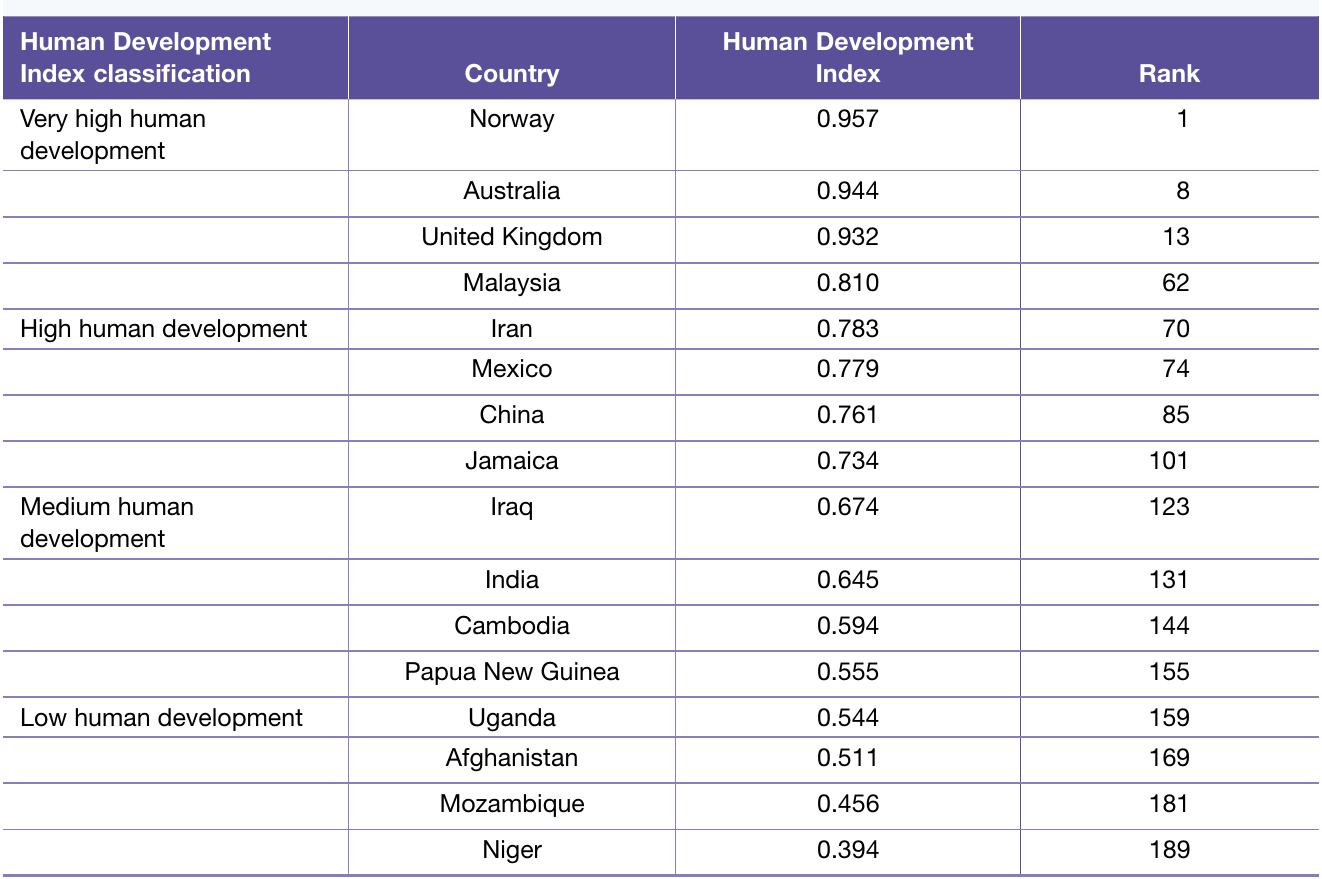
The table above shows examples of countries in each category. For instance, Norway ranks first globally with an HDI of 0.957, while Niger ranks 189th with an HDI of 0.394. Australia, with an HDI of 0.944, ranks eighth globally in the very high human development category.
Income doesn't tell the whole story
While many countries with higher average incomes tend to have higher HDI scores, this relationship doesn't always hold true. High income doesn't automatically translate to better education and health opportunities. This is an important advantage of the HDI over measures that only consider economic factors.
Example
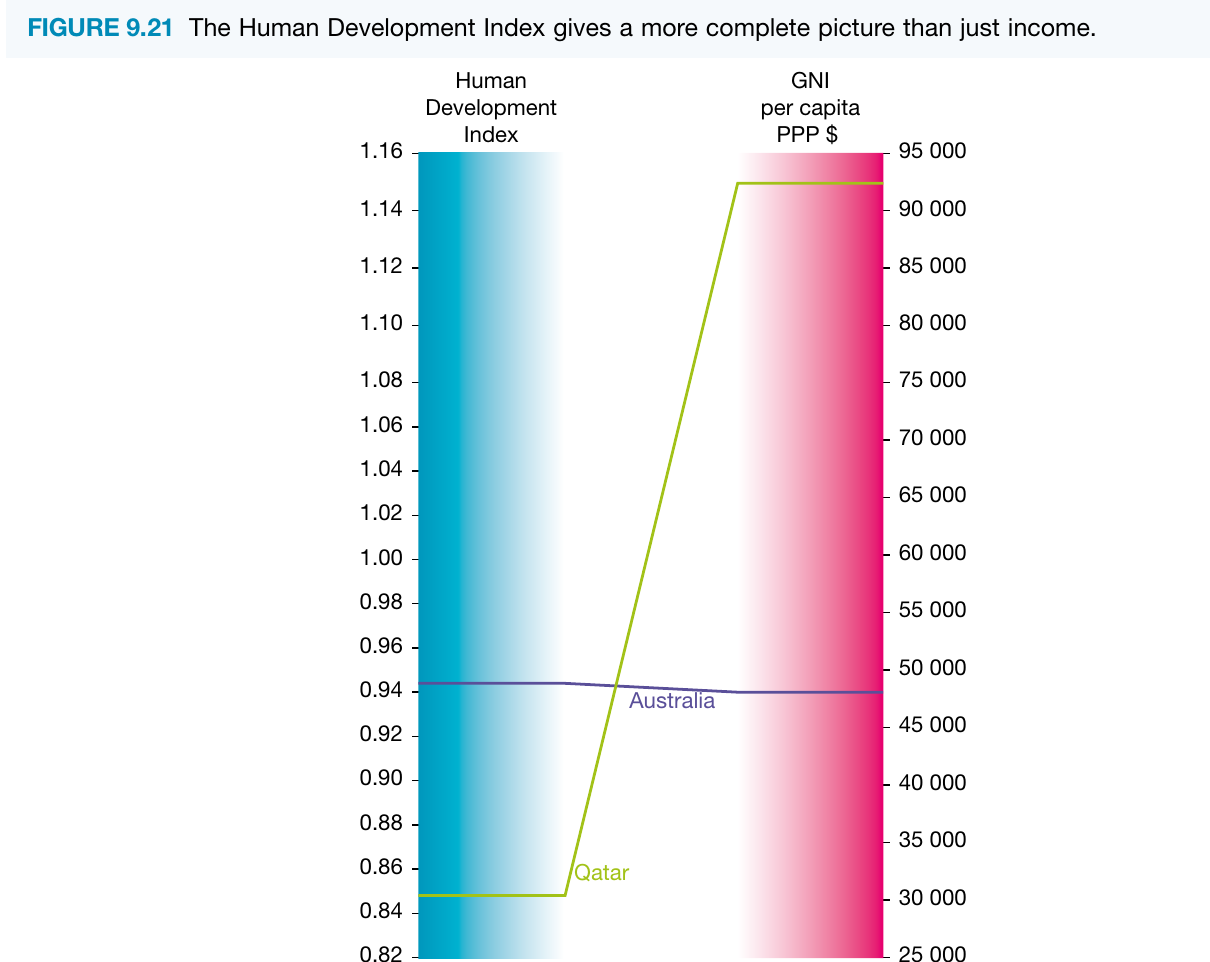
Comparing Australia and Qatar: When Income Doesn't Equal Development
The comparison between Australia and Qatar illustrates how income alone doesn't determine overall human development:
- Qatar's GNI per capita: approximately $95,000
- Australia's GNI per capita: approximately $48,000
- Qatar's HDI: approximately 0.85
- Australia's HDI: 0.94
Despite Qatar having nearly double the income of Australia, Australia achieves a higher HDI score. This demonstrates that factors like education and health outcomes also matter significantly in determining overall human development.
Important
Exam tip: When answering exam questions about the HDI, read carefully to determine whether you need to discuss indicators (life expectancy at birth, mean years of schooling, expected years of schooling, and GNI per capita) or dimensions (a long and healthy life, knowledge, and a decent standard of living). These are different components and shouldn't be confused.
Advantages of the HDI
The HDI has several important strengths that make it valuable for understanding and comparing human development globally:
1. Provides a comprehensive picture
The HDI goes beyond simple economic measures by incorporating health and education alongside income. This creates a more complete representation of how people actually live. Specifically:
- Life expectancy reflects people's ability to lead long and healthy lives
- Education indicators show access to knowledge and the ability to develop skills and make informed choices
- Income data reveals capacity to access resources needed for a decent standard of living
By combining these different aspects, the HDI captures multiple dimensions of wellbeing rather than focusing solely on economic prosperity.
2. Creates a single, easy-to-compare statistic
Because the HDI is a composite measure, it combines the three dimensions and four indicators into one number. This makes comparing countries much simpler. Rather than having to analyse and compare multiple separate statistics for each country, the HDI provides a single figure that summarises overall development. This simplification helps policymakers, researchers, and the public understand and compare development levels quickly.
3. Enables monitoring of progress over time
The HDI is highly effective for tracking how countries improve over time. While the four individual indicators might change at different rates, the overall HDI provides a useful measure of total progress. Countries can use HDI trends to evaluate whether their development policies and programmes are working and to identify areas needing improvement.
Note
The ability to track progress over time is particularly valuable for governments and international organizations. It provides concrete evidence of whether development initiatives are working effectively or need adjustment, making the HDI an essential tool for evidence-based policymaking.
4. Raises awareness and influences policy
The HDI has successfully captured attention from media, government policymakers, communities, and individuals worldwide. By highlighting human development as a key concern, it has raised awareness about the importance of improving people's lives beyond just economic growth. This increased awareness encourages people to question existing policies and advocate for changes that support broader human development goals.
5. Facilitates international comparisons
The standardised nature of the HDI allows meaningful comparisons between countries. This helps identify which countries are performing well and which need support. It also enables countries to learn from each other's successes and challenges in promoting human development.
Limitations of the HDI
Despite its usefulness, the HDI has several important limitations that must be understood:
1. Cannot capture the full complexity of human development
Human development is extremely complex and includes many aspects of people's lives. The HDI only reflects selected elements and therefore cannot fully represent the richness and depth of human development.
Important
Important aspects that the HDI does not measure include:
- Gender equality and women's empowerment
- Freedom of speech and expression
- Employment choices and job satisfaction
- Levels of discrimination and social inclusion
- Access to resources like clean water, social security, and public housing
- Political participation and democratic rights
- Environmental quality
These unmeasured factors significantly affect people's quality of life but remain invisible in HDI calculations.
2. Based on averages that hide inequality
Although the HDI moves beyond purely economic indicators, it still relies on average figures for each country. This means it doesn't reveal inequalities within countries. Certain groups often experience much lower human development than national averages suggest, including:
- Cultural and ethnic minorities
- Women and girls
- People with disabilities
- Rural populations
Note
A country might have a relatively high HDI, but this could mask significant disadvantages faced by particular groups within that society. This is one of the most significant limitations of using a single average figure to represent an entire nation's development.
3. Doesn't include people's own perspectives
The HDI doesn't collect survey data directly from people, so it fails to capture how people actually feel about their lives and the issues affecting their communities. Important aspects of wellbeing that are not reflected include:
- Social, emotional, mental and spiritual health and wellbeing
- Feelings about personal safety and security
- Satisfaction with life circumstances
- Community concerns and priorities
This limitation means the HDI may not reflect what people themselves consider most important for their development and wellbeing.
4. Data reliability and comparability issues
Collecting reliable data for the HDI is challenging. Different countries may use different definitions and methods when measuring the key components of the HDI, making international comparisons difficult. Additionally, data is often only collected at the national level, making it hard to compare different regions or groups within countries. These inconsistencies can affect the accuracy and usefulness of HDI comparisons.
5. Risk of oversimplification
In some cases, the concept of human development has become overly identified with just the three dimensions measured by the HDI. This neglects other crucial aspects of human development, particularly:
- Freedom of choice
- Expanding capabilities
- Having real opportunities to pursue different life paths
Important
When human development is reduced to only what the HDI measures, important elements of what it means to live a truly fulfilling life are overlooked. The index should be seen as a useful tool, not a complete definition of human development.
The relationship between HDI and sustainability
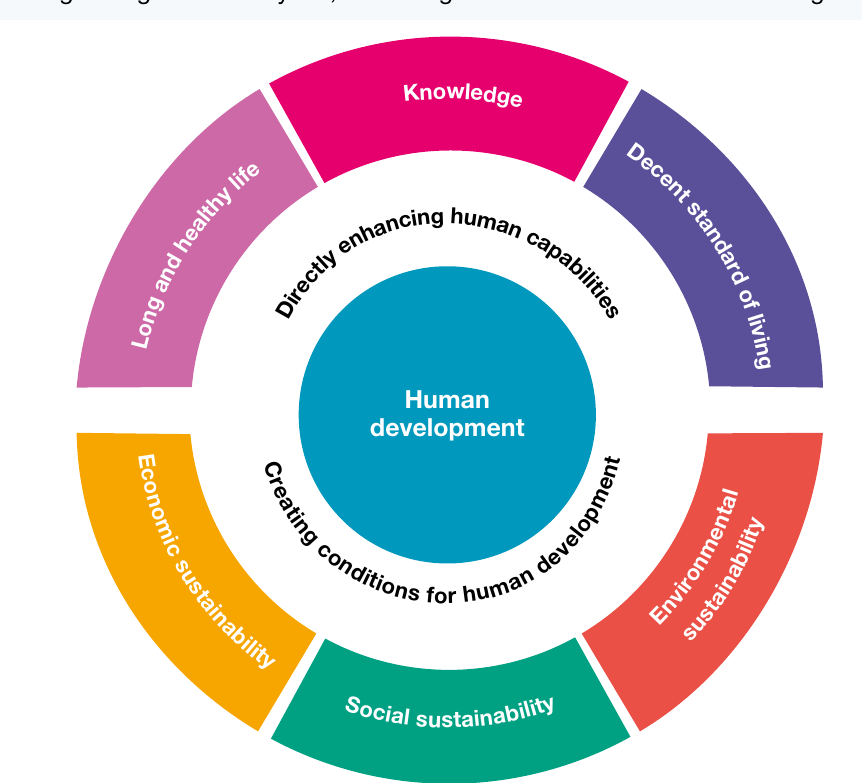
For human development to continue improving, the initiatives, policies and strategies implemented must be sustainable over long periods. If sustainability cannot be maintained, current levels of human development may decline for future generations.
The three dimensions of sustainability are crucial for all areas of human development:
- Environmental sustainability - Ensures natural resources and ecosystems are protected for future use
- Social sustainability - Maintains strong communities, social cohesion and equitable opportunities
- Economic sustainability - Creates economic systems that can continue functioning effectively over time
Note
These sustainability dimensions work together to create conditions that allow human development to flourish. They directly support the HDI dimensions by:
- Enabling people to maintain long and healthy lives
- Providing ongoing access to knowledge and education
- Ensuring decent standards of living can continue
Without sustainable practices, improvements in human development measured by the HDI cannot be maintained for future generations.
Case study: COVID-19's impact on human development
The COVID-19 pandemic provided a stark illustration of how quickly human development can decline and demonstrated both the usefulness and limitations of the HDI.
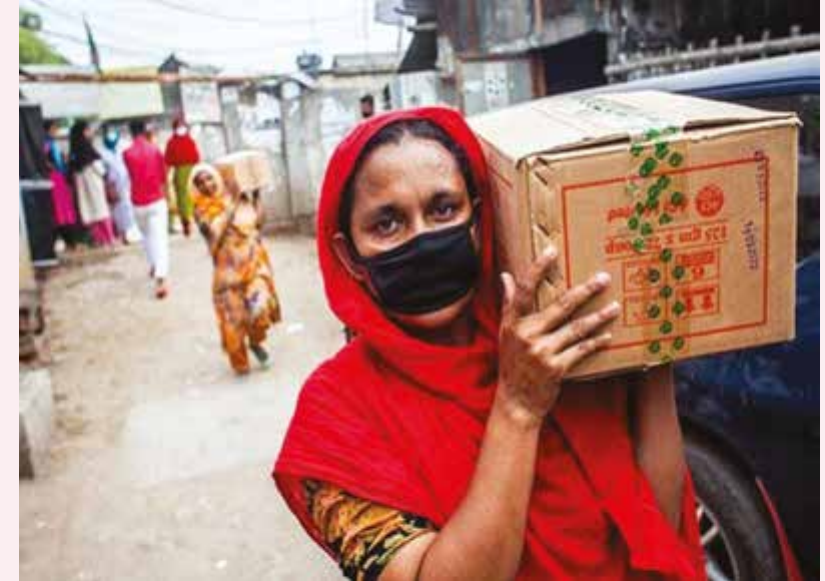
Unprecedented decline in HDI
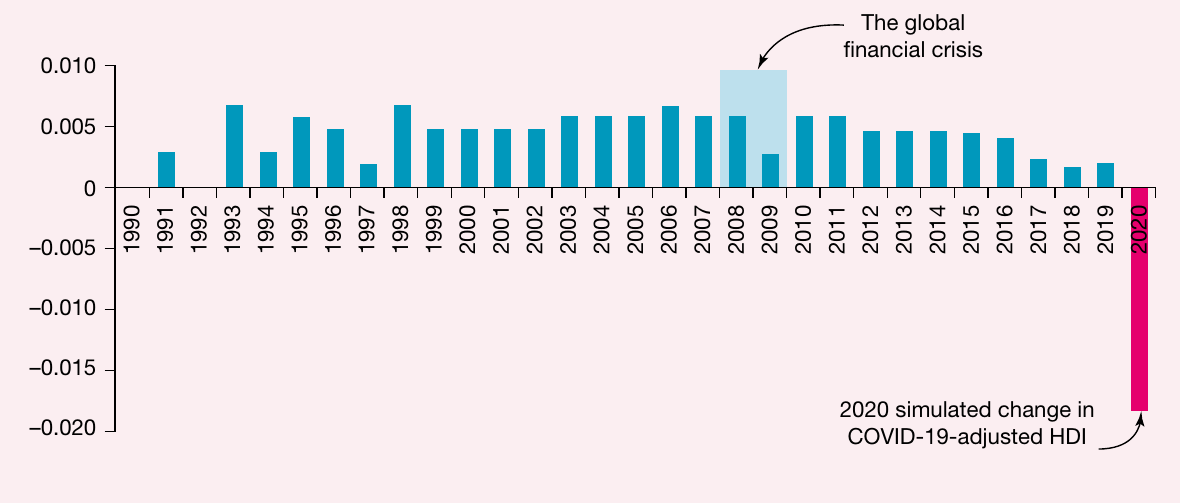
In 2020, the United Nations Development Programme warned that global human development could decline for the first time since the HDI concept was introduced in 1990. The pandemic created what was described as a "triple hit" to health, education and income - all three dimensions measured by the HDI.
Important
The graph shows that while the HDI had grown steadily year-on-year for three decades (even through crises like the 2007-09 Global Financial Crisis), the 2020 COVID-19-adjusted HDI showed a dramatic decline. This represented the largest reversal in human development on record.
Impact on HDI indicators
The pandemic affected all four HDI indicators:
Health (life expectancy):
- COVID-19's death toll exceeded 300,000 people globally (at the time of the case study)
- This directly reduced life expectancy figures
Education (years of schooling):
- School closures meant approximately 60% of children globally were not receiving education
- The "effective out-of-school rate" (which accounts for children without internet access) reached levels not seen since the 1980s
- This affected both current education (mean years) and future prospects (expected years)
Income (GNI per capita):
- Global per capita income was expected to fall by 4%
- Economic shutdowns and job losses reduced people's ability to maintain decent standards of living
Inequalities revealed and magnified
The pandemic acted as a "magnifying glass for inequalities," with the HDI decline expected to be much larger in developing countries than in wealthier nations. This highlighted a key limitation of the HDI - its inability to capture within-country inequalities.
Example
Education Disparities During COVID-19
The pandemic revealed stark differences in educational access based on development levels:
In countries with low human development:
- 86% of primary school children were effectively out-of-school
In countries with very high human development:
- Only 20% of children were out-of-school
The gap: This 66 percentage point difference was largely due to differences in internet access for online learning, demonstrating how crises can widen existing inequalities.
Important
Gender inequalities not captured by HDI:
The case study also noted significant impacts on women and girls that the HDI doesn't measure:
- Economic impacts: lower earnings and savings, greater job insecurity
- Reproductive health challenges
- Increased unpaid care work
- Rising gender-based violence
This demonstrates a critical limitation: the HDI's inability to capture gender-specific impacts and inequalities.
Solutions and recovery
The case study emphasised that equity-focused interventions could help mitigate COVID-19's impacts. For example:
- Improving internet access in low and middle-income countries would cost approximately 1% of global COVID-19 response packages
- More equitable access to technology could significantly reduce educational gaps
This demonstrates both the value of the HDI in tracking crisis impacts and its limitations in capturing all relevant aspects of human wellbeing.
Remember!
Summary
Key Points to Remember:
-
The HDI is a composite measure combining three dimensions (long and healthy life, knowledge, decent standard of living) and four indicators (life expectancy at birth, mean years of schooling, expected years of schooling, GNI per capita)
-
The HDI provides a more comprehensive picture than income alone, making it valuable for comparing countries and tracking progress over time
-
Key advantages include:
- Comprehensiveness (combines health, education, and income)
- Simplicity (single statistic for easy comparison)
- Effectiveness for monitoring progress over time
- Raising awareness of human development issues
-
Major limitations include:
- Inability to capture all aspects of human development
- Reliance on averages that hide inequality
- Lack of survey data on people's feelings and perspectives
- Data reliability challenges
- Risk of oversimplification
-
The COVID-19 pandemic caused the first decline in global HDI since 1990, demonstrating both the index's usefulness in tracking development setbacks and its limitations in capturing inequality and unmeasured aspects of wellbeing