Circles (VCE SSCE Mathematical Methods): Revision Notes
📚Revision Notes
Circles
Introduction to circles
A circle is the set of all points in a plane that are the same distance from a fixed point. This fixed point is called the centre of the circle, and the constant distance is called the radius.
Let's look at a circle drawn on a coordinate plane with its centre at the origin and radius . If is any point on the circle, then the distance from to the origin is . Using Pythagoras' theorem, we can write:
Note
This equation comes directly from Pythagoras' theorem: if a point is at distance from the origin, then the horizontal distance is , the vertical distance is , and we have .
Similarly, if a point in the plane satisfies the equation , then its distance from the origin is , which means it must lie on a circle with centre at the origin and radius .
The unit circle
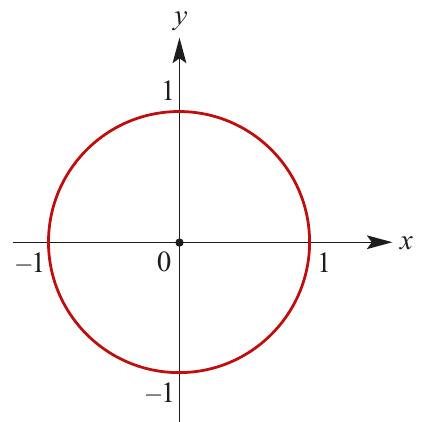
The unit circle is a circle with radius 1 centered at the origin. Its equation is:
Note
The unit circle is the most basic circle, and all other circles can be thought of as transformations of this fundamental graph. It's particularly important in trigonometry and other areas of mathematics.
Standard equation of a circle
Just like other graphs you've studied, the basic circle can be shifted horizontally and vertically through translations. When we translate the unit circle, we get circles with different centres.
The standard equation (or centre-radius form) of a circle is:
where:
- is the centre of the circle
- is the radius of the circle
This form makes it easy to identify the key features of a circle just by looking at the equation.
Important
Watch the signs! In the equation, the centre coordinates appear with opposite signs. For example, means the centre has -coordinate (not ). Similarly, means .
Finding the equation of a circle
If you know the radius and the coordinates of the centre, you can write down the equation of the circle directly by substituting into the standard form.
Example
Worked Example: Writing the equation from centre and radius
Write down the equation of the circle with centre and radius 2.
Solution
Since the radius is 2 and the centre is the point , we substitute into the standard form:
Finding the centre and radius from an equation
When the equation is given in standard form, you can identify the centre and radius by comparing with .
Example
Worked Example: Finding centre and radius
Find the centre and radius of the circle .
Solution
Comparing with the standard form :
- Centre:
- Radius: , so
The equation represents a circle with radius 2 and centre at .
Sketching circles and finding intercepts
To sketch a circle accurately, it's helpful to find where it crosses the coordinate axes. These are called the intercepts.
Note
Finding intercepts:
- To find the -intercepts, set in the equation and solve for
- To find the -intercepts, set in the equation and solve for
These points help you draw a more accurate sketch of the circle.
Example
Worked Example: Sketching with y-intercepts
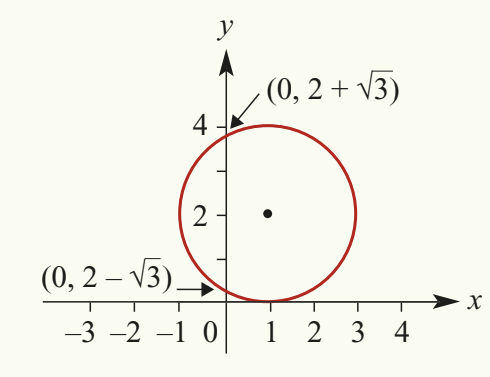
Sketch the circle , showing the -intercepts.
Solution
From before, we know the centre is and radius is 2.
To find the -intercepts, set :
So the -intercepts are at and .
Example
Worked Example: Another sketching example
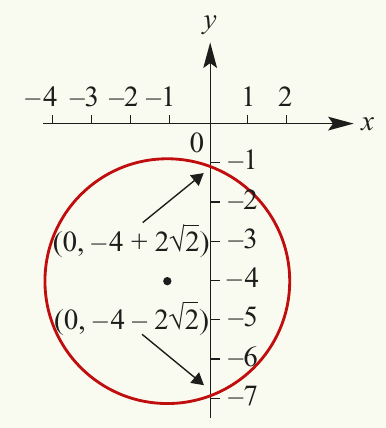
Sketch the graph of the circle .
Solution
The circle has centre and radius 3 (since means ).
To find the -intercepts, set :
The -intercepts are at and .
General form of the circle equation
A circle equation may not always be written in the standard form. If we expand the standard equation, we get a different form called the general form.
Starting with the standard equation:
Expanding:
Rearranging:
If we let , we get:
This is the general form for the equation of a circle.
Note
Key features of the general form:
- The coefficients of and are both 1
- There is no term
- It looks similar to the general form of a straight line,
If you see an equation with these features, you know it represents a circle!
Converting from general form to standard form
To sketch a circle given in general form, you need to convert it to standard form. This is done using a technique called completing the square for both and .
Example
Worked Example: Converting to standard form
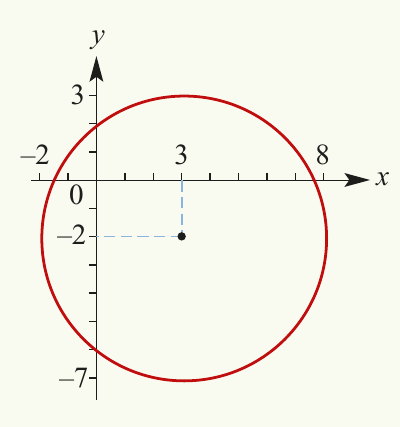
Find the radius and the coordinates of the centre of the circle with equation and sketch the graph.
Solution
We complete the square for both and :
For terms: , we add and subtract
For terms: , we add and subtract
Therefore:
- Centre:
- Radius: 5
Important
Completing the square tip: When completing the square, remember to add the same value to both sides of the equation. The value you add is always:
This is a common exam question, so make sure you can do this confidently!
Semicircles
A semicircle is half of a circle. We can obtain semicircle equations by rearranging the circle equation to make either or the subject.
Starting with the basic circle equation , we can make the subject:
This gives us two separate rules:
Similarly, making the subject:
Note
Understanding semicircles:
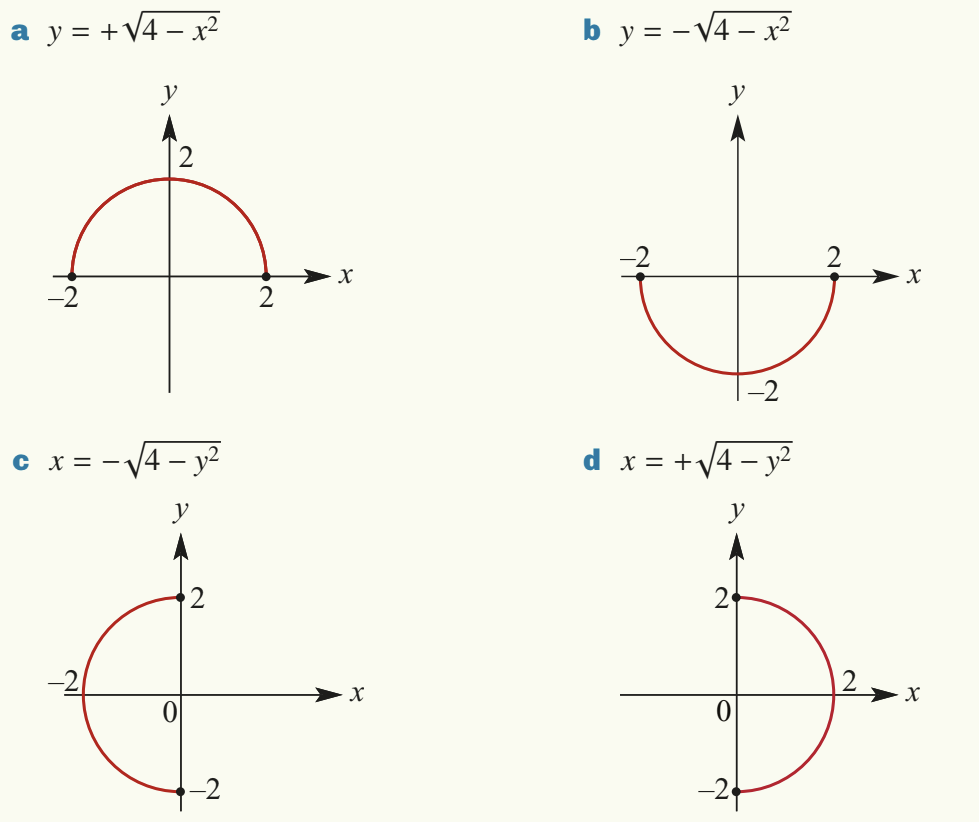
- The positive square root gives the top half (for ) or right half (for )
- The negative square root gives the bottom half (for ) or left half (for )
This is because the square root function only gives positive values, so we need to choose the sign to get the half we want.
Example
Worked Example: Basic semicircles
Sketch the graphs of:
a)
This represents the top half of the circle (radius 2, centered at origin).
b)
This represents the bottom half of the circle .
c)
This represents the left half of the circle .
d)
This represents the right half of the circle .
Semicircles with transformations
Semicircles can also be translated, just like full circles.
Example
Worked Example: Semicircle with transformations
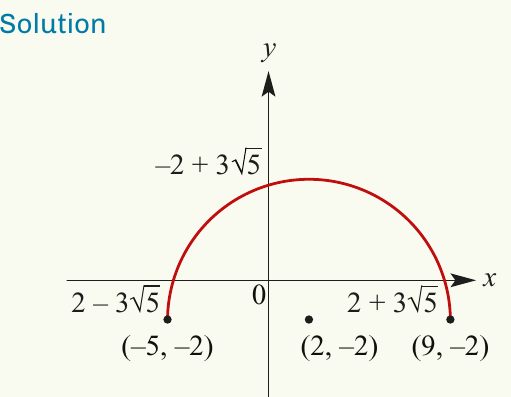
Sketch the graph of .
Solution
This is a semicircle. Let's identify the full circle first:
Rearranging:
Squaring both sides:
This is a circle with:
- Centre:
- Radius: 7
Since we have , we have the top half of this circle (the positive square root), shifted 2 units right and 2 units down.
To find the -intercepts, set :
To find the -intercept, set :
Summary
Key Points to Remember:
- The standard equation of a circle with centre and radius is:
- The general form of a circle equation is:
where the coefficients of and are both 1 and there is no term
-
To convert from general form to standard form, use completing the square for both and terms
-
Semicircles are obtained by solving for or : the positive square root gives the top/right half, and the negative square root gives the bottom/left half
-
When sketching circles, find the intercepts by setting (for -intercepts) or (for -intercepts) and solving the resulting equation