Analysing Straight-Line Motion With Uniform Acceleration (VCE SSCE Physics): Revision Notes
📚Revision Notes
Analysing Straight-Line Motion With Uniform Acceleration
Introduction: Real-world acceleration
When objects move in a straight line with constant acceleration, their motion can be precisely described using mathematical equations. To understand just how powerful these forces can be, consider the story of Colonel John Paul Stapp, who became the fastest man on Earth in the 1950s.
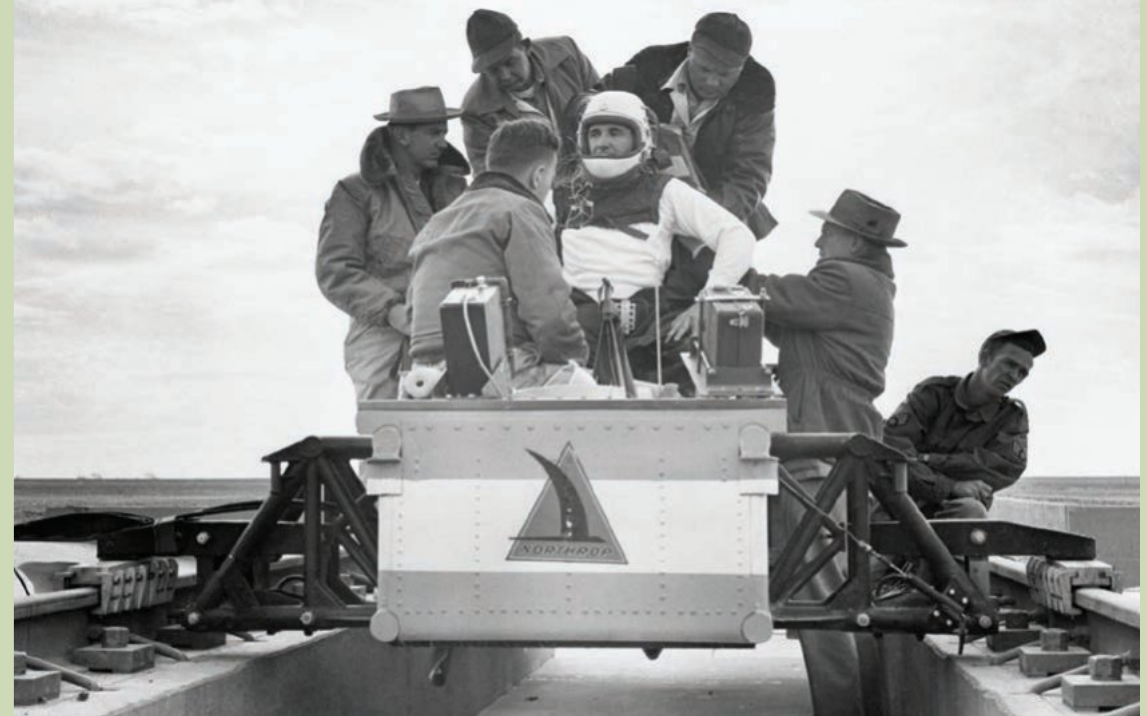
Stapp climbed into a rocket-powered sled at Holloman Air Force Base and accelerated from rest to 1015 km·h⁻¹ in just 5 seconds, then came to a complete stop in only 1.5 seconds. This subjected his body to forces up to 46.2g - the highest acceleration ever voluntarily experienced by a human. While his body suffered broken blood vessels and numerous injuries, Stapp's pioneering work led to major advances in seatbelt technology and vehicle safety.
Note
This extreme example demonstrates the importance of understanding motion with uniform (constant) acceleration, which occurs whenever an unbalanced force acts on an object. The mathematical tools we'll develop can analyze everything from everyday situations to extreme scenarios like Stapp's rocket sled.
Understanding velocity-time graphs
When an object experiences uniform acceleration, its motion can be represented on a velocity-time graph as a straight diagonal line with constant gradient. The steepness of this line indicates how quickly the velocity is changing.
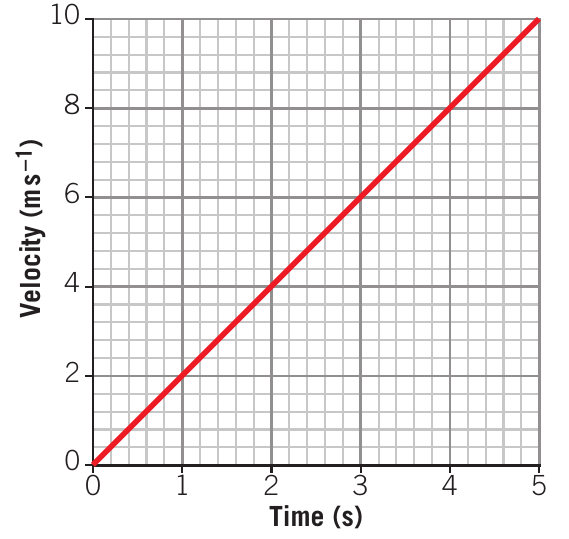
For example, the graph above shows a cyclist accelerating at a constant rate of for 5 seconds. The straight red line indicates that the velocity increases by the same amount each second.
Finding displacement from graphs
An important principle is that the area under a velocity-time graph represents the displacement (distance travelled). Even though the cyclist's velocity changes throughout the motion, we can calculate their average velocity to find the total displacement.
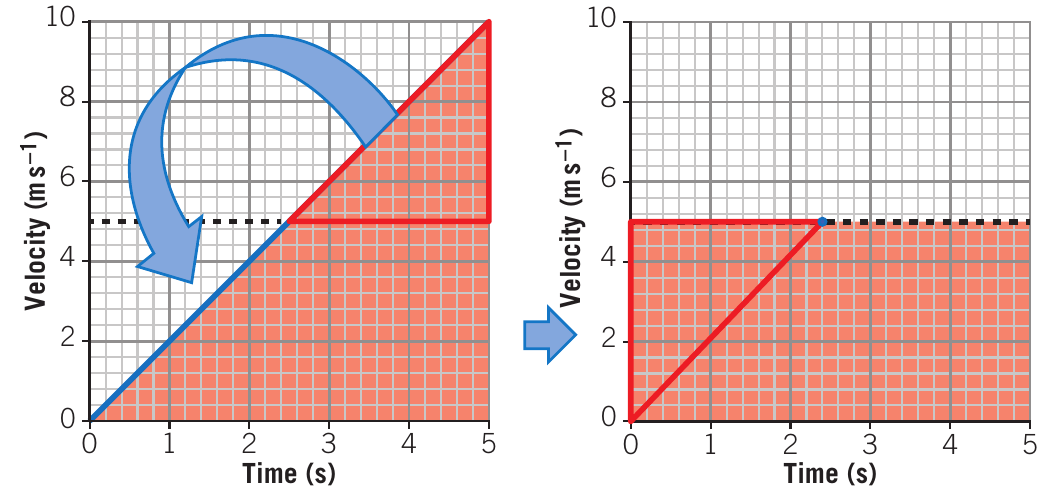
To find average velocity, divide displacement by time: .
Note
The average velocity only applies for the full 5 second journey. If the cyclist travelled for less time, the average would be lower; for more time with the same acceleration, it would be higher. This is because the velocity is continuously changing throughout the motion.
The equations of motion
When analysing motion with constant acceleration, five key equations can be derived from velocity-time graphs. These equations allow you to solve problems when different combinations of variables are known.
Deriving the first equation:
The gradient (slope) of a velocity-time graph equals the acceleration:
Rearranging this gives our first equation:
This tells us that final velocity equals initial velocity plus the change caused by acceleration over time.
Deriving the second equation:
Consider a cyclist initially travelling at who accelerates at for 5 seconds:
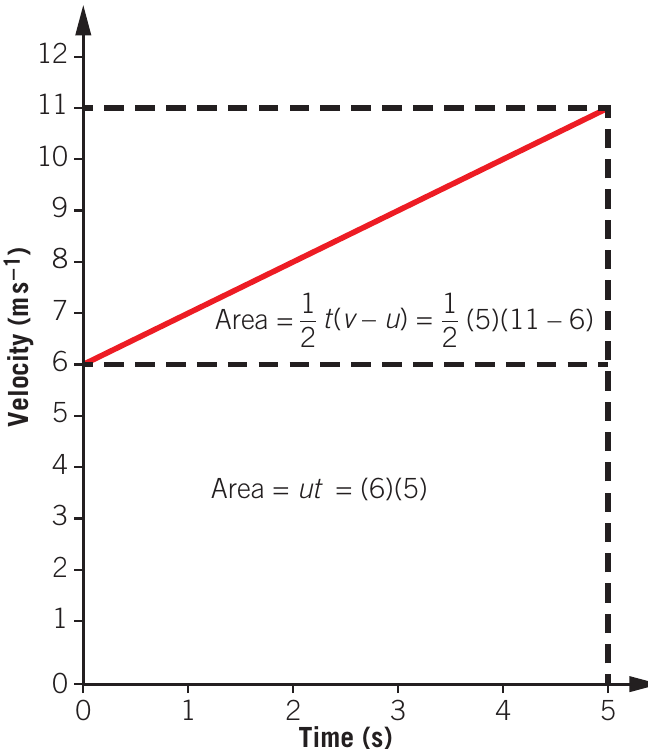
The displacement is the area under the graph, which consists of a rectangle plus a triangle:
Expanding and simplifying:
This equation is useful when you know both initial and final velocities.
Deriving the third equation:
Starting from and using the fact that , we can substitute to eliminate :
This equation is particularly useful when you don't know the final velocity.
Deriving the fourth equation:
From the acceleration formula, we can write:
Substituting this into :
Rearranging gives:
This equation is extremely useful when time is unknown or not needed.
Deriving the fifth equation:
Rearranging the acceleration formula differently:
Substituting into :
Summary of equations
Important
The Five Equations of Motion for Constant Acceleration
The five equations of motion for constant acceleration are:
Where:
- = final velocity ()
- = initial velocity ()
- = acceleration ()
- = time ()
- = displacement ()
Each equation contains four of the five variables. Choose your equation based on which variables you know and which you need to find.
Horizontal motion
Newton's first law states that an object in motion or at rest will maintain its state unless acted upon by an unbalanced force. This means that horizontal motion only involves acceleration when a net force is applied - such as a car accelerating, a sprinter leaving the blocks, or friction slowing a moving object.
Note
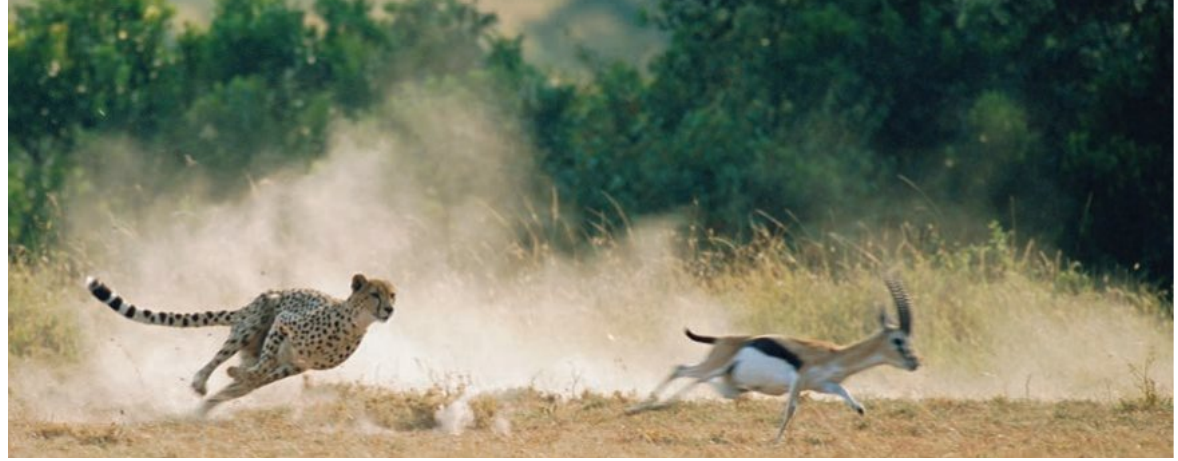
Cheetahs are among the fastest accelerating animals on Earth, reaching speeds comparable to high-performance sports cars through the constant force generated by their muscles. Their ability to generate such powerful forces demonstrates the same physics principles we use in our equations.
Solving horizontal motion problems
When tackling problems involving constant straight-line acceleration, follow these steps:
- Draw a diagram showing the situation with all known information labelled in SI units
- Choose an appropriate equation based on what you know and what you need to find
- Apply sign conventions carefully - choose one direction as positive; the opposite direction is negative (note: time is always positive)
- Calculate and round your answer to three significant figures, including units and direction if it's a vector quantity
Worked example: Horizontal deceleration
Example
Worked Example: Ball Rolling to a Stop
Problem: A ball travels forward with velocity . As it rolls over the ground, friction causes it to slow to a stop in seconds. Calculate the distance the ball travels before stopping.
Solution:
Step 1: Create a diagram with known information:
- Initial velocity:
- Final velocity: (stopped)
- Time:
- Displacement:
Step 2: Since we know , , and , and need to find , use:
Step 3: Substitute values and calculate:
Answer: The ball travels 4.07 metres before coming to rest.
Vertical motion
When an object moves vertically (ignoring air resistance), only one force typically acts on it: gravity. Close to Earth's surface, this force causes all free-falling objects to accelerate at downward, regardless of their mass.
Free-falling refers to any object falling under gravity alone, with no other forces acting on it.
Key principles of vertical motion
Consider two masses - 1 kg and 2 kg - dropped from rest:
- After 1 second: both reach downward
- After 2 seconds: both reach downward
Now imagine throwing both masses upward at :
- After 1 second: both have velocity upward
- After 2 seconds: both have velocity (momentarily stationary)

Note
Peregrine falcons use gravity to their advantage when hunting, diving at speeds up to - about 30% faster than a civilian helicopter's top speed. They achieve this by combining their initial velocity with gravitational acceleration.
Important
Three Crucial Principles of Vertical Motion:
- Acceleration due to gravity is constant: Always downward, regardless of mass or velocity
- Mass is irrelevant: All objects accelerate equally under gravity (when air resistance is negligible)
- Direction matters: Upward velocities are positive; gravity (downward) is negative (or use the opposite convention, but be consistent)
Historical evidence
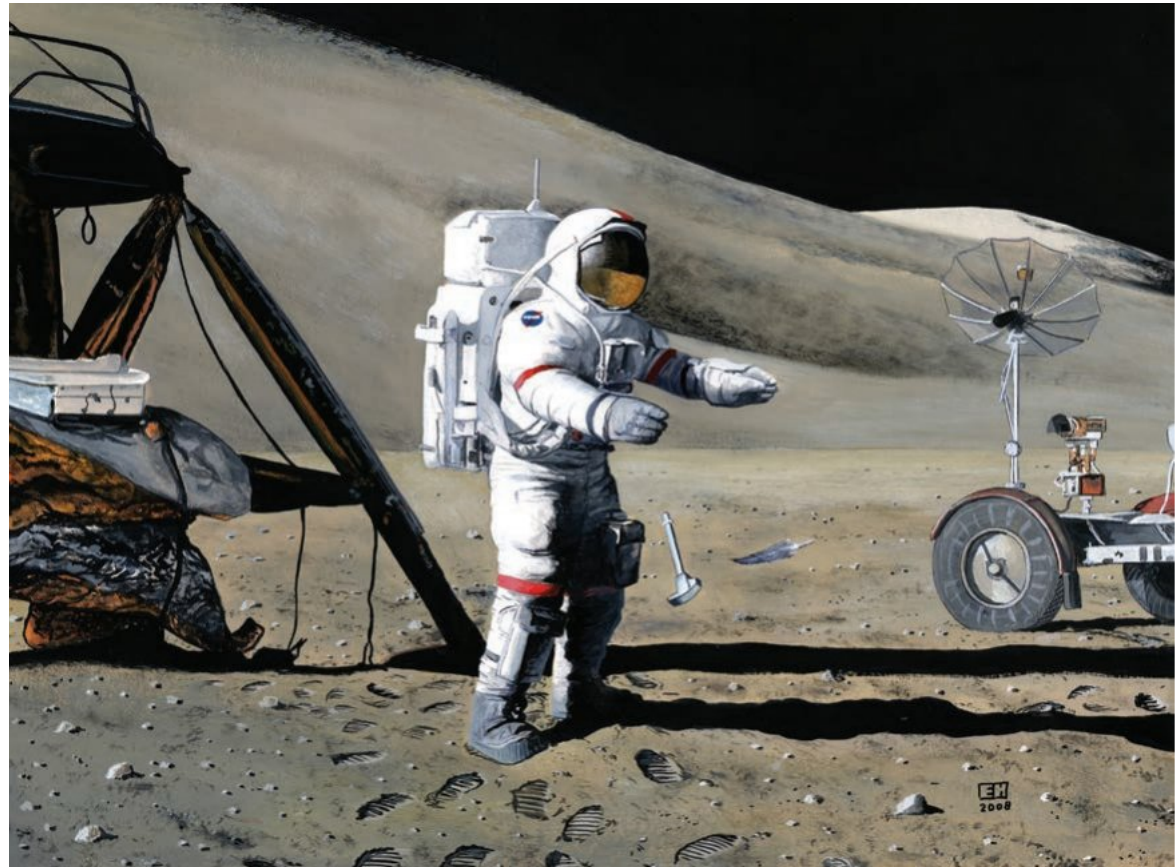
While the story of Galileo dropping objects from the Leaning Tower of Pisa may be apocryphal, the principle was definitively proven in 1971 during the Apollo 15 moon landing. Astronaut David Scott simultaneously dropped a feather and a geology hammer on the Moon's surface. With minimal air resistance, both objects hit the ground at exactly the same time, confirming that acceleration under gravity is independent of mass.
Solving vertical motion problems
The same five equations apply to vertical motion, but remember these additional points:
- Constant acceleration: For free-falling objects, downward
- Sign convention: Typically, upward velocities are positive and gravity is negative (or vice versa - be consistent)
- At maximum height: Velocity equals zero momentarily
- Symmetry: For objects launched and landing at the same height, time to peak equals time from peak, and launch speed equals landing speed
Worked example: Vertical drop
Example
Worked Example: Cliff Diver
Problem: A cliff diver of mass 76 kg jumps from a cliff m tall with zero initial velocity. Calculate the diver's velocity just before hitting the water. Ignore air resistance.

Solution:
Step 1: Choose downward as positive direction.
Step 2: List known information:
- Mass: kg (not needed - gravity acts equally on all masses)
- Displacement: m
- Initial velocity:
- Acceleration:
- Final velocity:
Step 3: Since time is not known or needed, use:
Step 4: Substitute values and calculate:
Answer: The diver's velocity just before impact is 17.2 m·s⁻¹ downward.
Note: Since both gravity and displacement act downward, both values are positive in this calculation.
Worked example: Vertical throw
Example
Worked Example: Ball Thrown Upward
Problem: A student throws a 200 g ball vertically upward with initial velocity . When released, the ball is already m above the ground.
a) Calculate the maximum height above ground reached by the ball b) Calculate the total flight time, assuming the student catches the ball at m above ground
Solution:
Let upward be the positive direction.
Given information:
- Mass: kg (irrelevant to calculation)
- Initial velocity: (upward, positive)
- Initial height: m
- Acceleration: (downward, negative)
Part a) Maximum height
At maximum height, the ball momentarily stops, so .
Use:
Rearranging for displacement:
This is the distance travelled upward from the release point. The maximum height above ground is:
Answer: The maximum height above ground is 21.6 m.
Part b) Total flight time
Since the ball lands at the same height it was released, the time to reach maximum height equals half the total flight time.
Use:
Rearranging for time:
Total flight time = seconds
Answer: The total flight time is 4.08 s.
Alternative method: Due to symmetry in free-fall, the ball's velocity when caught equals its initial velocity but in the opposite direction: (downward).
Understanding gravity and force
A common misconception involves confusing force with velocity. When you throw a ball, it follows a parabolic path (a symmetric U-shaped curve) through the air.
Parabolic path describes the trajectory of a projectile moving only under gravity's influence when air resistance is negligible.
Net force is the sum of all forces acting on an object.
What forces act on a thrown ball?
Important
Common Misconception Alert
Some students incorrectly think that because the ball moves upward, there must be an upward force. This is not true. Once the ball leaves your hand, the only force acting on it is gravity, which is constant and always directed downward.
The ball's velocity changes throughout its flight:
- Initially moving upward (positive velocity)
- Momentarily zero at the peak
- Moving downward (negative velocity)
But the acceleration remains constant throughout: downward.
Important
Critical Distinction: Acceleration vs. Velocity
Acceleration and velocity are not the same thing. The constant downward acceleration changes the ball's velocity by every second, regardless of which direction the ball is moving.
Think of it this way: gravity is always pulling downward with the same strength, whether the object is moving up, down, or momentarily stationary at its peak.
Exam tips
- Always identify which direction is positive at the start of your solution
- For vertical motion, is always (or depending on your sign convention)
- Mass doesn't affect acceleration due to gravity - all objects fall at the same rate
- At maximum height, velocity equals zero - this is often a key piece of information
- Check your equation choice - ensure it contains the variables you know and the one you need
- Include units and direction in your final answers for vector quantities
Remember!
Summary
Key Points to Remember:
- Objects experiencing uniform acceleration can be analysed using five key equations relating , , , , and
- The area under a velocity-time graph represents displacement; the gradient represents acceleration
- In horizontal motion, acceleration only occurs when an unbalanced force acts on the object
- In vertical motion (free-fall), all objects accelerate at downward regardless of mass, if air resistance is ignored
- At maximum height, an object's velocity is momentarily zero, and this point represents half the flight time for symmetrical trajectories
- Gravity is a force that causes constant downward acceleration; it acts regardless of whether an object is moving up, down, or momentarily stationary