Comparing Fusion and Fission (VCE SSCE Physics): Revision Notes
📚Revision Notes
Comparing Fusion and Fission
Introduction to nuclear processes
Nuclear fusion and nuclear fission are two distinct nuclear reactions that both release enormous amounts of energy through the conversion of mass to energy, following Einstein's famous equation . Understanding these processes is fundamental to nuclear physics and has applications ranging from power generation to stellar processes.
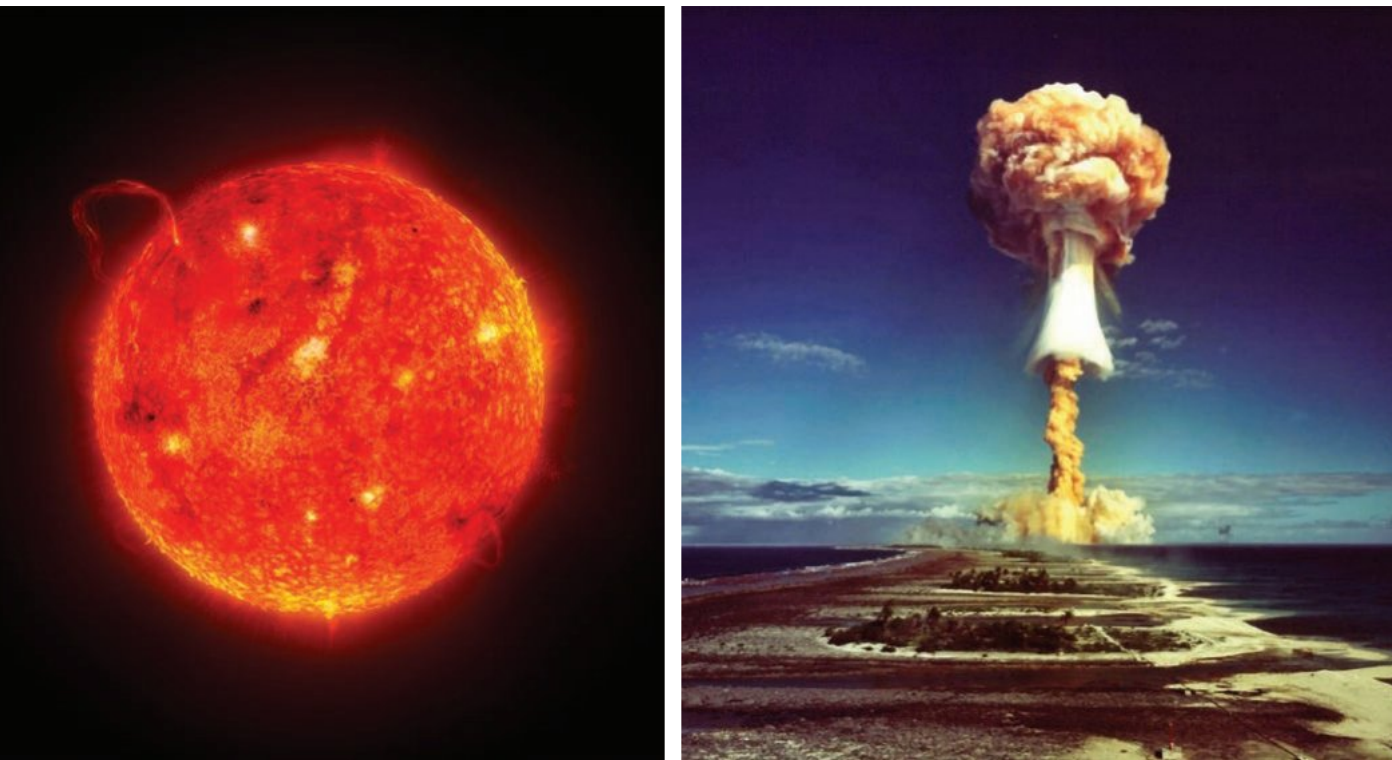
Fusion is the process where two light nuclei combine to create a heavier, more stable nucleus, releasing vast amounts of energy. This is the process that powers the Sun and other stars.
Fission is the splitting of a heavy, unstable nucleus into two lighter, more stable nuclei, again releasing vast amounts of energy. This process is used in nuclear power plants and was the basis of early nuclear weapons.
Note
A key difference between these processes is their efficiency of mass-energy conversion:
- In fusion reactions, approximately 0.7% of the matter is converted to energy
- In fission reactions, approximately 0.1% of the matter is converted to energy
These percentages apply whether the process occurs in nuclear weapons, nuclear reactors, in our Sun, or in distant stars. This means fusion is about seven times more efficient than fission in converting mass to energy!
Why both fusion and fission release energy
The explanation for why both processes release energy lies in understanding the binding energy curve, which shows how nuclear stability varies with the number of nucleons (protons and neutrons) in a nucleus.
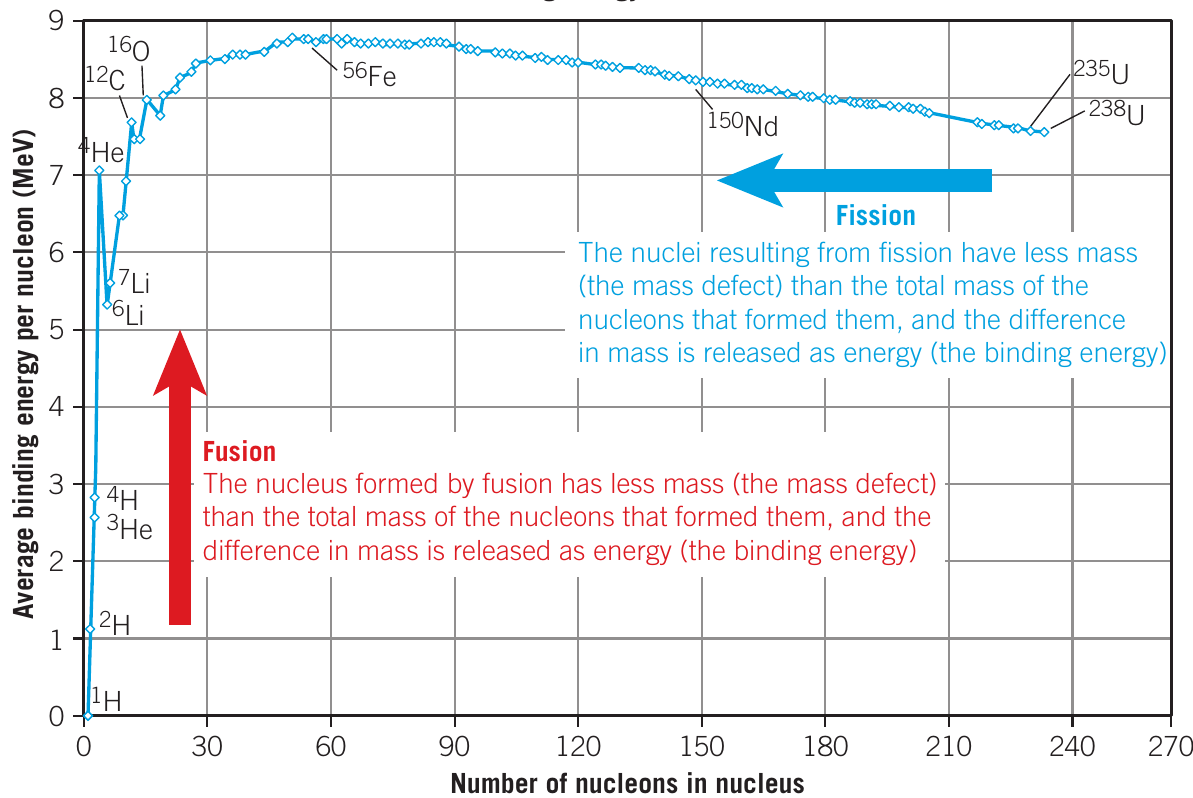
Understanding the binding energy curve
The binding energy curve plots the average binding energy per nucleon (measured in MeV) against the number of nucleons in the nucleus. This curve reveals several crucial insights:
Key features of the curve:
- The curve rises steeply for light elements
- It reaches a peak at iron-56 (Fe), which has 56 nucleons
- It gradually declines for heavier elements beyond iron
- Iron-56 is the most stable nucleus of all elements
Important
Understanding energy release from the binding energy curve:
For fusion (light elements):
- Light elements like hydrogen and helium are on the left side of the curve
- Moving up the curve towards iron means increasing the binding energy per nucleon
- When light nuclei fuse, the product nucleus has higher binding energy per nucleon than the reactants
- This increase in binding energy is released as energy
- The mass of the product is slightly less than the total mass of the reactants - this mass defect corresponds to the energy released
For fission (heavy elements):
- Heavy elements like uranium are on the right side of the curve
- Moving toward iron from the right means increasing the binding energy per nucleon
- When heavy nuclei split, the product nuclei have higher binding energy per nucleon than the parent nucleus
- This increase in binding energy is released as energy
- The total mass of the products is less than the mass of the parent nucleus - this mass defect corresponds to the energy released
Note
Important principle: Both fusion and fission result in products that are more tightly bound (higher binding energy per nucleon) than the reactants. This increase in binding energy represents the energy released in the reaction.
Think of it this way: both processes move nuclei toward iron-56 on the curve, and any movement toward iron releases energy because iron-56 is the most stable configuration.
Key definitions
Binding energy: The amount of energy required to completely separate a nucleus into its individual nucleons (protons and neutrons). It represents how tightly the nucleus is held together by the strong nuclear force. The higher the binding energy per nucleon, the more stable the nucleus.
Mass defect: The difference between the total mass of the individual nucleons and the actual mass of the nucleus formed (in fusion) or the difference between the parent nucleus mass and the total mass of the product nuclei (in fission). This "missing mass" has been converted to energy according to .
Plasma: A form of matter in which all the atoms are completely ionised, meaning electrons have been stripped from their nuclei. Sometimes called the fourth state of matter (after solid, liquid, and gas). Plasma exists at extremely high temperatures and is essential for fusion reactions.
Thermonuclear bomb: A two-stage nuclear weapon that uses an initial fission explosion to create the extreme temperature and pressure needed to trigger a much larger fusion explosion. Also called a hydrogen bomb.
Nuclear fusion in detail
Fusion in the Sun
The Sun is powered by nuclear fusion reactions occurring in its core. The conditions in the Sun's core make fusion possible:
- Temperature: 15 million kelvin (15 × 10 K)
- State: Dense plasma
- Pressure: Extremely high
Note
The combination of very high temperature and extremely high pressure allows hydrogen nuclei (protons) to overcome the strong electrostatic repulsion between them and fuse together. Without these extreme conditions, the positively charged protons would simply repel each other.
The primary fusion process in the Sun is called the proton-proton chain, which converts hydrogen into helium through several steps:
Element formation in stars
Understanding fusion also helps explain where all the chemical elements come from:
- Hydrogen, helium, and lithium were created during the Big Bang
- Elements up to iron are formed through fusion reactions during the normal lifetime of stars
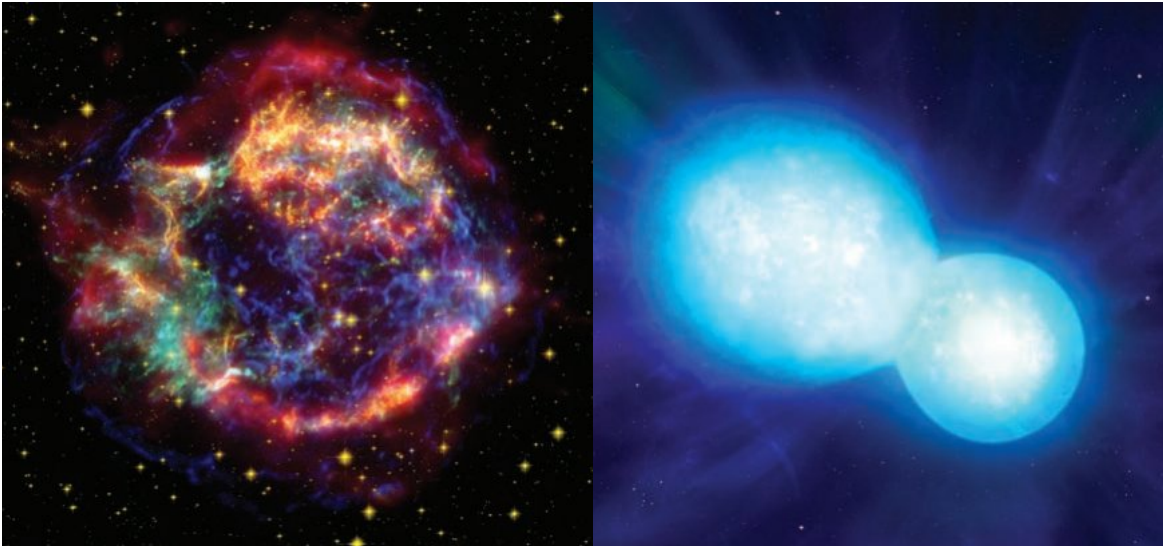
- Elements heavier than iron require additional energy input and are formed during supernova explosions or neutron star collisions
Note
The stellar nucleosynthesis process:
In massive stars, fusion proceeds through stages:
- Hydrogen fuses to helium (main sequence star lifetime)
- Helium fuses to carbon and oxygen
- Progressively heavier elements form up to iron and nickel
- Important: Fusion up to iron releases energy
- Formation of elements heavier than iron requires energy input
- When a massive star's core has exhausted its fuel and converted to iron, fusion stops
- The star collapses and explodes as a supernova
- Heavy elements are produced during the supernova explosion
Colliding neutron stars also produce enormous amounts of heavy elements, including gold, silver, and xenon. All the elements in our bodies and on Earth were made in stars - we are truly made of stardust!
Controlled fusion reactors
Achieving controlled fusion on Earth for power generation is extremely challenging. The most promising reaction uses deuterium (H) and tritium (H):
Advantages of fusion energy:
- Fuel (deuterium) is abundant in seawater
- Much more energetic than chemical reactions (about 12 million times more energetic than burning coal)
- A 1000 MW fusion plant would require only 250 kg of fuel per year
- No long-lived radioactive waste products
- Carbon-free energy source
Challenges:
- Requires temperatures of at least 150 × 10 K (ten times hotter than the Sun's core)
- The hot plasma cannot touch any material - must be contained by strong magnetic fields
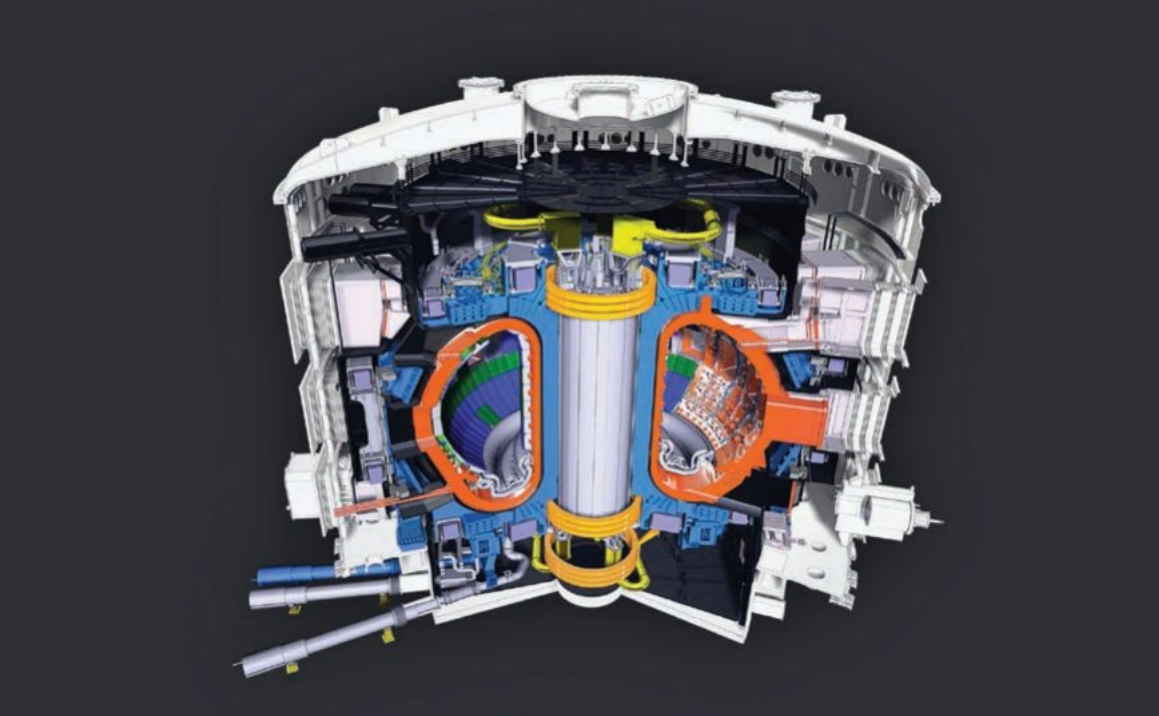
- A tokamak is a device that uses a toroidal (donut-shaped) magnetic field to contain the plasma
Note
The ITER (International Thermonuclear Experimental Reactor) project in France aims to demonstrate that fusion power is feasible. It is designed to produce 500 MW of fusion power from 50 MW of input heating power - a ten-fold energy return. The goal is to have a working fusion reactor by 2035.
Fusion weapons: thermonuclear bombs
A thermonuclear bomb (hydrogen bomb) is actually a two-stage weapon:
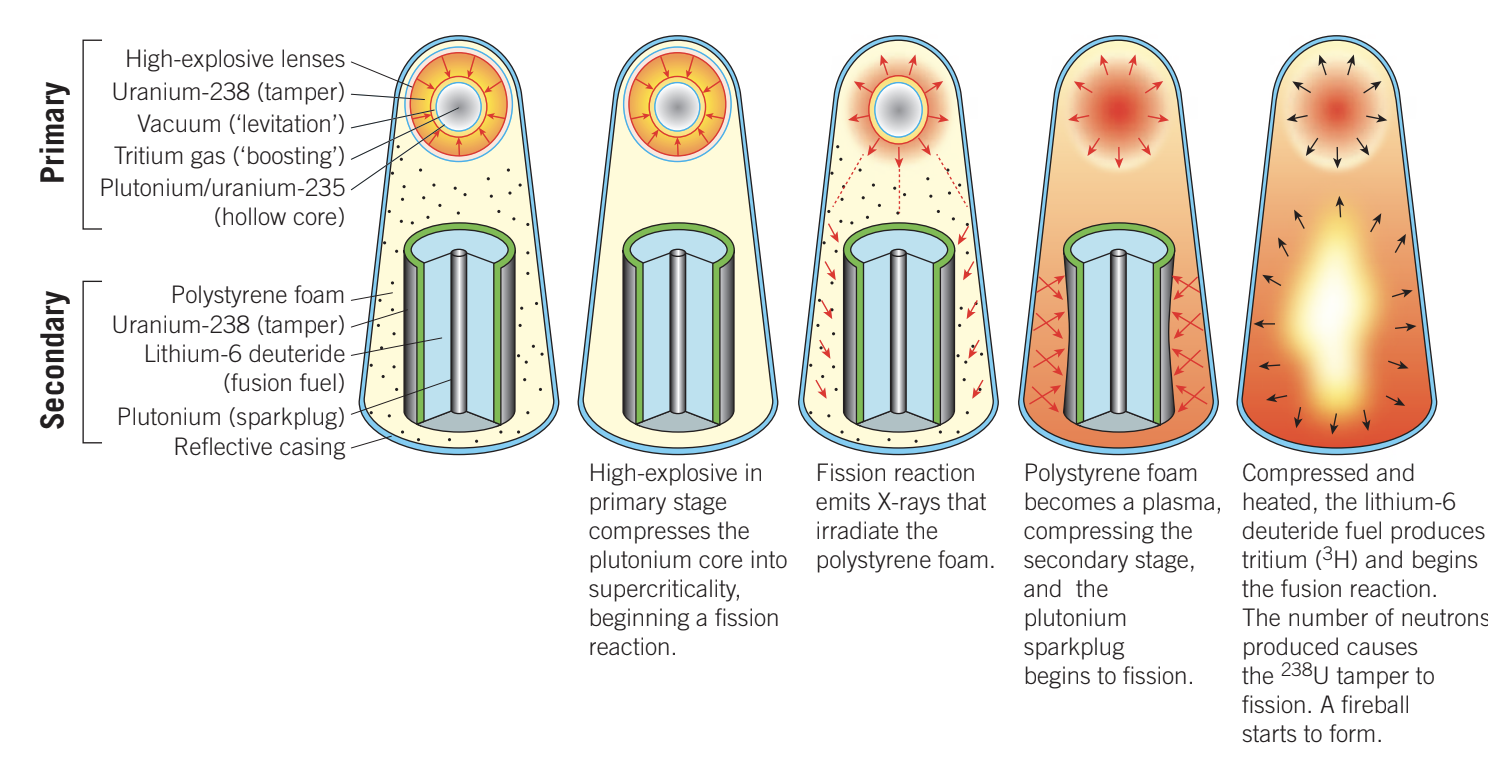
Note
Two-stage thermonuclear weapon design:
Stage 1: Fission primary
- A fission bomb explodes first
- Uses enriched uranium-235 or plutonium-239
- Creates extremely high temperature and pressure
Stage 2: Fusion secondary
- The fission explosion triggers the fusion fuel
- Lithium-6 deuteride is used as fuel
- It is converted to tritium during the process
- Fusion reactions produce enormous energy
- This can theoretically continue with additional stages
This design overcomes the challenge of achieving the extreme conditions needed for fusion. The fission explosion provides the necessary temperature and pressure to force hydrogen nuclei together despite their electrostatic repulsion.
Key difference from fission bombs: Thermonuclear bombs can theoretically be built to any size, as each fusion stage can ignite the next. Pure fission weapons are limited because too much fissile material in one place becomes dangerously unstable.
Nuclear fission in detail
Fission in nuclear reactors and weapons
In fission, a heavy nucleus (such as uranium-235) splits into two lighter nuclei when struck by a neutron. A typical fission reaction:
Key features of fission:
- Initiated by neutron bombardment
- Produces two medium-sized nuclei (fission fragments)
- Releases additional neutrons (which can cause further fissions - chain reaction)
- Releases large amounts of energy
Nuclear waste
Nuclear fission produces radioactive waste that must be carefully managed. There are three categories:
Low-level waste:
- Items like tools and work clothing
- Accounts for 90% of total volume
- Contains only 1% of total radioactivity
- Usually stored on site briefly, then released to environment
Medium-level waste:
- Requires longer storage time
- Requires shielding but not cooling
- Intermediate radioactivity
Important
High-level waste - the major challenge:
- Mostly spent nuclear fuel rods
- Only 3% of total volume
- Contains 95% of total radioactivity
- Highly radioactive for very long periods
- Some isotopes (like plutonium-239) remain hazardous for up to a million years
- Takes about 1200 years to return to radioactivity level of original uranium ore
- Must be stored in shielded containers
- Requires continuous cooling to prevent overheating
- No universally accepted long-term storage solution
This represents one of the major challenges for nuclear fission power generation.
Calculating energy from mass defect
Fusion energy calculation
When nuclei undergo fusion, we can calculate the energy released using binding energy data.
Example
Worked Example: Deuterium-tritium fusion energy calculation
Consider the fusion reaction:
| Isotope | Deuterium | Tritium | Helium-4 |
|---|---|---|---|
| Average Binding Energy per nucleon (MeV) | 1.12 | 2.83 | 7.07 |
| Total Binding Energy (MeV) | 2.24 | 8.49 | 28.28 |
Calculation steps:
Step 1: Calculate Total Binding Energy (TBE) for each nucleus
- TBE = (number of nucleons) × (ABE per nucleon)
- Deuterium: MeV
- Tritium: MeV
- Helium-4: MeV
Step 2: Calculate energy released
- Energy released = TBE(products) − TBE(reactants)
- Energy =
- Energy =
- Energy = 17.55 MeV
Therefore, 17.55 MeV of energy is released as kinetic energy of the helium-4 nucleus and the neutron.
Fission energy calculation
For fission reactions, we use the actual masses of nuclei to calculate the mass defect, then convert to energy.
Example
Worked Example: Uranium-235 fission energy calculation
Consider the fission reaction:
| Nuclide/particle | ||||
|---|---|---|---|---|
| Mass (×10 kg) | 1.675 | 154.248 | 233.927 | 390.173 |
Calculation steps:
Step 1: Calculate total mass before reaction
Step 2: Calculate total mass after reaction
Step 3: Calculate mass defect
Step 4: Calculate energy released using
Step 5: Convert to MeV (using J eV)
Therefore, 181 MeV of energy is released in each fission reaction. Although this is more than the fusion example, on a per kilogram basis, fusion releases more energy than fission.
Calculating stellar power output
An important skill is calculating the power output of stars using mass-energy conversion data.
Key formulas:
- (energy from mass conversion)
- (power is energy per unit time)
Example
Worked Example: The Sun's power output
The Sun converts 600 million tonnes of hydrogen per second into helium, with a mass difference of 4.20 million tonnes per second.
Calculate the power output of the Sun (use ms).
Solution:
Step 1: Convert mass difference to kilograms
Mass difference =
Mass difference = kg
Step 2: Calculate energy using
Step 3: Note that this is the energy output every second (since mass difference is given per second)
Step 4: Calculate power using
Therefore, the Sun's power output is watts.
Exam tips
Note
Important exam strategies:
- Always check whether you're asked for energy (in joules or eV) or power (in watts)
- Remember that power = energy per second
- When using binding energy, remember: energy released = (final binding energy) − (initial binding energy)
- When using mass defect, remember:
- Keep track of units: convert tonnes to kg, and be comfortable converting between J and eV
- For the binding energy curve: fusion releases energy for elements lighter than iron; fission releases energy for elements heavier than iron
- Iron-56 is at the peak of the binding energy curve and is the most stable nucleus
- The neutron produced in fusion has no binding energy (it's a single nucleon)
Important
Common mistakes to avoid:
- Don't confuse energy and power - they have different units
- Don't forget to account for all particles in the reaction when calculating mass
- Remember that the binding energy curve shows average binding energy per nucleon, not total binding energy
- When calculating total binding energy, you must multiply by the number of nucleons
Summary
Summary
Key Points to Remember:
- Both fusion and fission release energy because they produce more stable nuclei with higher binding energy per nucleon
- Fusion converts approximately 0.7% of mass to energy, while fission converts approximately 0.1%
- The binding energy curve peaks at iron-56, the most stable nucleus
- Fusion of light elements (moving toward iron on the curve) releases energy
- Fission of heavy elements (moving toward iron from the other direction) releases energy
- Mass defect is the difference between the mass of reactants and products, which equals the energy released via
- Controlled fusion requires extremely high temperatures (150 × 10 K) and magnetic confinement in devices like tokamaks
- Both processes move nuclei toward iron-56 on the binding energy curve, releasing energy in the process