Nuclear Energy and Energy-Mass Equivalence (VCE SSCE Physics): Revision Notes
📚Revision Notes
Nuclear Energy and Energy-Mass Equivalence
Introduction to nuclear energy
Nuclear energy represents one of the most significant discoveries in modern physics. Albert Einstein's famous equation , published in 1905, revealed that mass and energy are interchangeable. However, scientists initially believed it would be impossible to harness this energy from ordinary matter because atoms are so small and their nuclei so difficult to damage.

Note
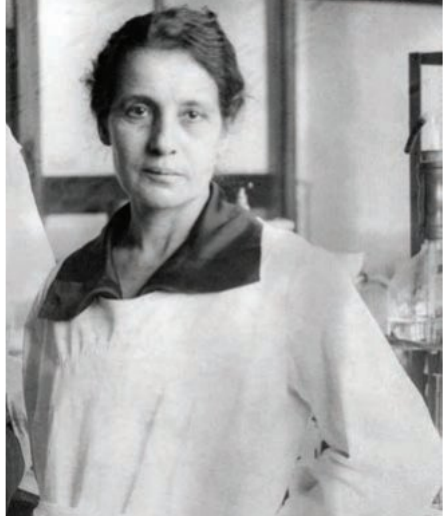
The breakthrough came with the discovery of the neutron in 1932. The Italian physicist Enrico Fermi experimented with bombarding uranium-235 with neutrons in 1934. Later, Lise Meitner (pictured below) and Otto Frisch correctly interpreted these results as nuclear fission - the splitting of uranium nuclei into two roughly equal parts. This discovery opened the door to both nuclear power and nuclear weapons.
Key historical milestones include:
- 1905: Einstein publishes
- 1932: Neutron discovered; first atom split by Cockcroft and Walton
- 1933: Mark Oliphant discovers nuclear fusion
- 1934: Fermi bombards uranium with neutrons
- 1938-39: Meitner and Frisch identify nuclear fission
- 1942: First controlled nuclear chain reaction (Fermi's pile)
- 1945: First atomic bombs used
- 1952: First hydrogen fusion bomb tested
- 1956: First commercial nuclear power station opens
What are nuclear fission and fusion?
Nuclear fission
Nuclear fission is the process of splitting a large, unstable nucleus into two smaller, more stable nuclei. When a heavy nucleus like uranium-235 undergoes fission, the mass of the resulting fragments is less than the original mass. This mass difference () is converted into energy according to Einstein's equation:
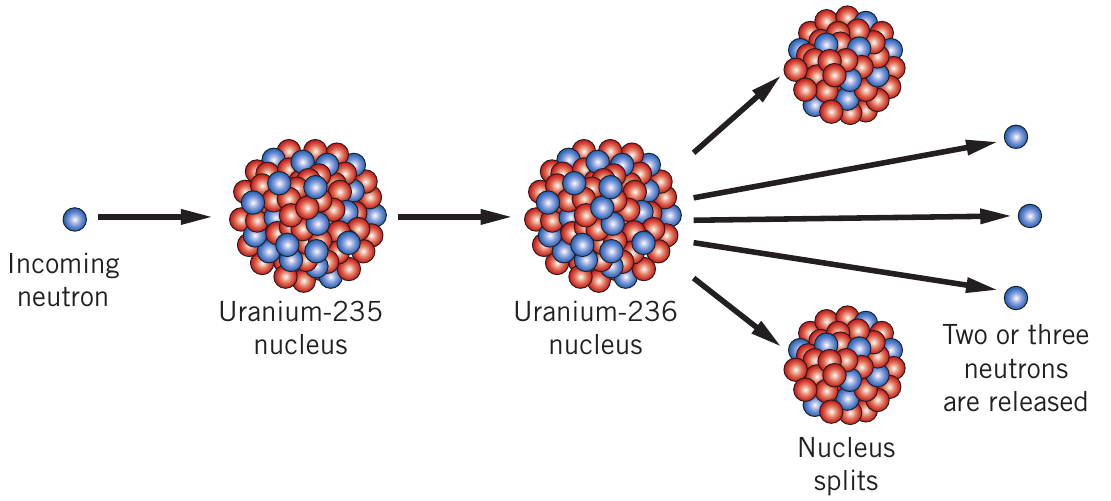
The process works as follows:
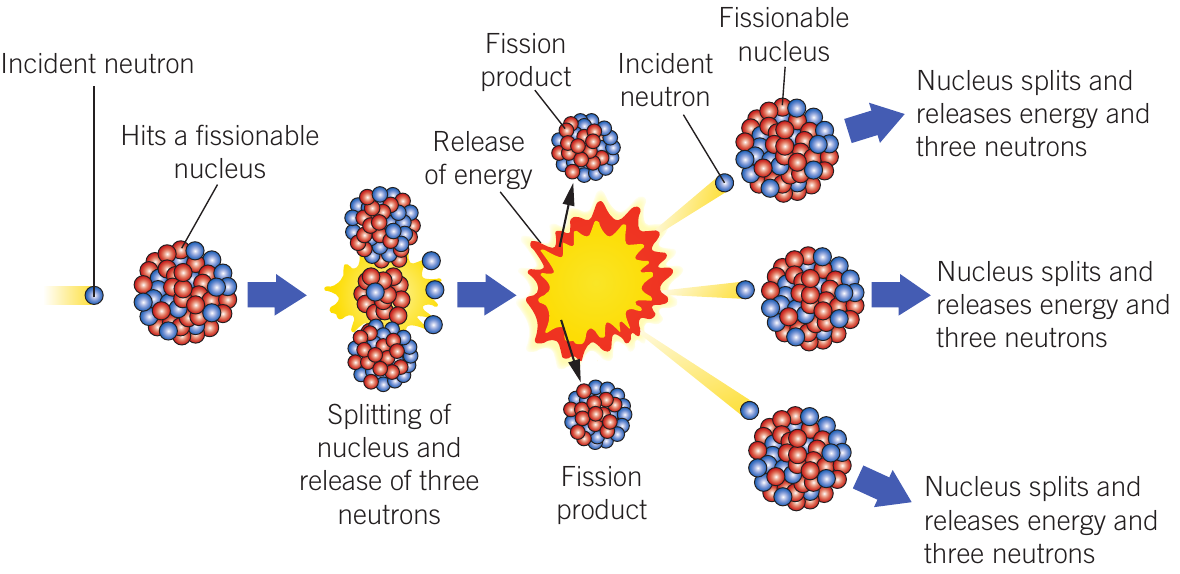
- An incoming neutron strikes a uranium-235 nucleus
- The nucleus briefly becomes uranium-236
- The unstable uranium-236 splits into two smaller nuclei (fission products)
- Two or three additional neutrons are released
- Large amounts of energy are released (approximately 200 MeV per fission)
A typical fission reaction can be written as:
Note
Important points about fission:
- Only certain isotopes are fissile (capable of undergoing fission), including uranium-235 and plutonium-239
- Slow-moving "thermal" neutrons are more effective at inducing fission than fast-moving neutrons
- Approximately 2.5 neutrons are released on average per fission event
- Fission fragments can have various mass numbers, typically around 95 and 137
Nuclear fusion
Nuclear fusion is the process where two light nuclei combine together to form a larger, more stable nucleus. Like fission, the mass of the final nucleus is less than the combined mass of the original nuclei, and this mass difference is converted to energy.
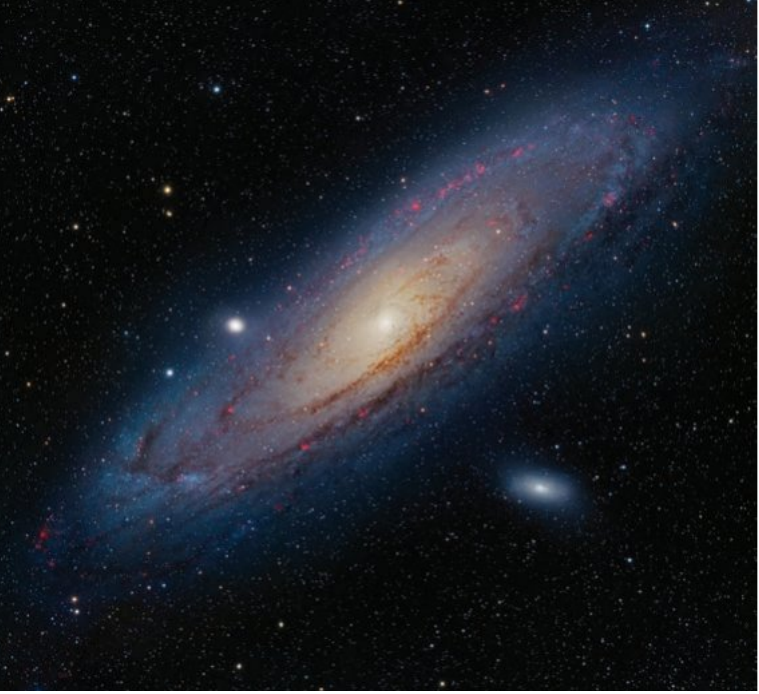
Fusion powers the Sun and stars. The Sun converts 600 million tonnes of hydrogen per second into helium through nuclear fusion, with a mass difference of 4.2 million tonnes per second, generating an output of watts.
Important
For fusion to occur on Earth, extremely high temperatures (around 150 million degrees Celsius) and pressures are needed. This is why controlled fusion reactors remain one of the greatest engineering challenges - the conditions required are far more extreme than those needed for fission.
Scientists are working to develop controlled fusion reactors, such as tokamaks, which use powerful magnetic fields to confine hot plasma.
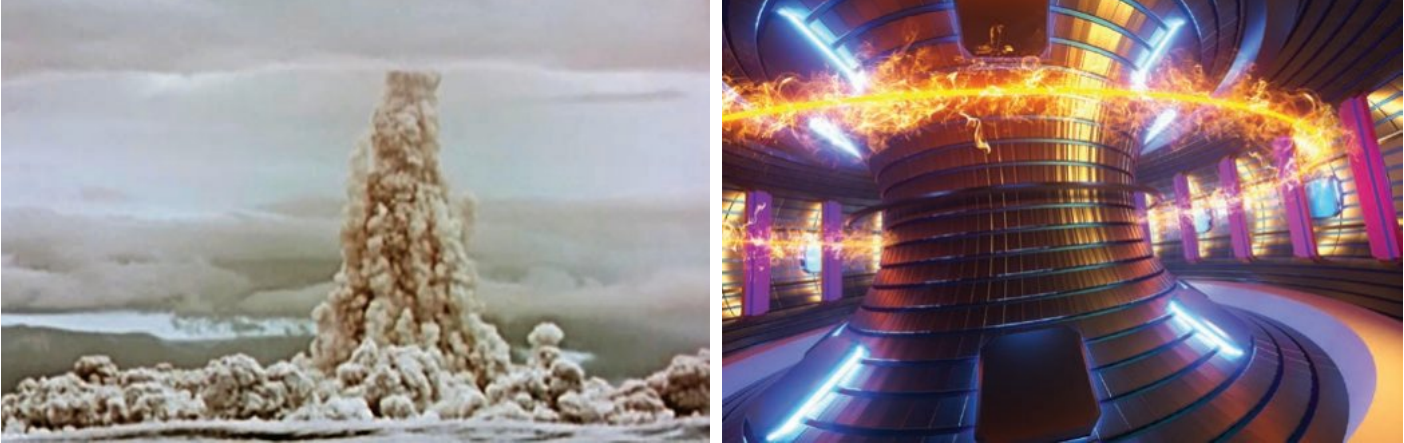
A tokamak is a device that uses a very strong magnetic field to confine plasma in the shape of a torus (a donut-shaped ring). The International Thermonuclear Experimental Reactor (ITER) in France is designed to demonstrate the feasibility of fusion as a large-scale, carbon-free energy source.
Energy from mass conversion
The energy stored in mass according to Einstein's equation is enormous because the speed of light () is , making .
Important
The scale of nuclear energy:
To understand the incredible energy density: if you could convert every atom in a 1.0 g paper clip into pure energy (leaving no mass), it would release 21 kilotonnes of TNT - approximately the size of the atomic bomb that destroyed Nagasaki.
This demonstrates why even tiny amounts of mass conversion produce enormous energy releases.
Comparing nuclear and chemical energy
The key difference between nuclear and chemical reactions is the fraction of mass converted to energy:
Chemical reactions (like burning coal):
- Involve rearranging outer electrons of atoms
- Electrons bound by electromagnetic force
- Takes only a few electronvolts to remove an electron
- Mass conversion: 0.000000033% (3.3 × 10⁻⁸%)
- 1 kg of carbon releases 3.0 × 10⁷ J
Nuclear fission reactions:
- Involve rearranging nucleons in the nucleus
- Nucleons bound by the strong force
- Takes millions of electronvolts to remove a nucleon
- Mass conversion: 0.1% (for complete fission)
- 1 kg of uranium-235 releases 9.0 × 10¹³ J
This means nuclear fission releases about 3 million times more energy per kilogram than coal combustion.
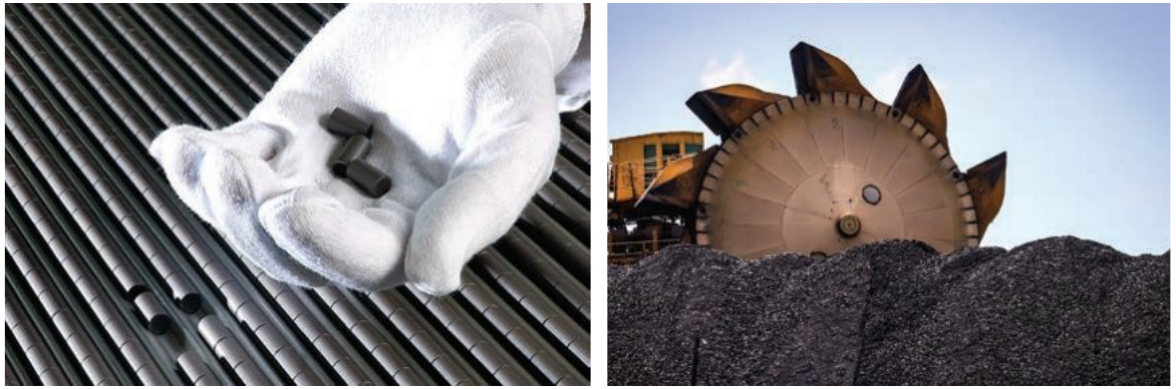
Energy comparison table
| Fuel type | Process | % mass converted to energy | Energy released from 1 kg (J) | Coal equivalent (kg) |
|---|---|---|---|---|
| Coal | Combustion | 3.3 × 10⁻⁸ | 3.0 × 10⁷ | 1 |
| 3.0% uranium-235 | Fission in reactor | 0.003 | 2.7 × 10¹² | 900,000 |
| 100% uranium-235 | Complete fission in bomb | 0.1 | 9.0 × 10¹³ | 30 million |
| Hydrogen bomb | Fission triggered fusion | 0.66 | 5.9 × 10¹⁴ | 200 million |
| Hydrogen→Helium | Fusion in Sun | 0.71 | 6.4 × 10¹⁴ | 210 million |
| Matter-antimatter | Complete annihilation | 100 | 9.0 × 10¹⁶ | 30 billion |
Note
What this table reveals:
- A single 0.33 g pellet of uranium-235 releases as much energy as burning 1 tonne of coal
- Nuclear fusion is slightly more efficient than nuclear fission at converting mass to energy
- Complete matter-antimatter annihilation converts 100% of mass to energy (though this is not practically achievable)
Example
Worked Example: Comparing uranium and coal
Question: When 1.0 kg of uranium-235 undergoes fission, the mass difference is 1.0 g. When 1.0 kg of carbon-12 combusts, the mass difference is 0.33 μg. Compare the energy released and determine how many kilograms of coal would release the same energy as 1.0 kg of U-235.
Solution:
Using where
For U-235 with :
For C-12 with :
Energy ratio:
Therefore, the combustion of 3.0 × 10⁶ kg (3 million kg) of coal releases the same amount of energy as the fissioning of 1.0 kg of uranium-235.
The role of neutrons in nuclear fission
Neutrons are crucial for nuclear fission because:
- They have no electric charge, so they are not repelled by the positive charge of the nucleus
- They can easily penetrate the nucleus and be absorbed
- Unlike protons (repelled by the nucleus) or electrons (blocked by electron shells), neutrons can directly interact with the nucleus
When Enrico Fermi and his team used neutrons to bombard uranium in 1934, they discovered that uranium-235 nuclei could capture an additional neutron and become uranium-236. This very brief intermediate state is unstable and splits (undergoes fission) into two new nuclei called fission products.
Note
Fissile vs. Non-fissile materials:
Fissile materials are elements capable of undergoing fission after capturing a neutron. The most important fissile isotopes are:
- Uranium-235
- Plutonium-239
- (Also uranium-233 and thorium-232, though less commonly used)
Non-fissile materials are elements that cannot sustain a fission chain reaction. For example, uranium-238 (which makes up 99.3% of natural uranium) is non-fissile.
An important discovery was that slow-moving neutrons (called "thermal" neutrons) are much more effective at causing fission than fast-moving neutrons. This is why moderators are essential in nuclear reactors.
Chain reactions
When a uranium-235 nucleus undergoes fission, it releases 2-3 neutrons along with energy. These neutrons can then strike other uranium-235 nuclei and cause them to undergo fission, which releases more neutrons, and so on. This is called a chain reaction - when neutrons emitted from the fission of one atomic nucleus initiate further fission in surrounding atomic nuclei.
Controlled chain reactions
In a controlled chain reaction, only one of the 2-3 neutrons released is allowed to cause another fission event. This maintains a steady, sustainable reaction suitable for power generation in nuclear reactors.
To achieve control:
- Moderators slow down fast neutrons to thermal speeds. Thermal neutrons have a much higher probability of being absorbed and causing fission. Common moderators include water, graphite, and beryllium.
- Control rods absorb excess neutrons. They are made of materials like boron, cadmium, silver, hafnium, or indium that readily absorb neutrons.
Note
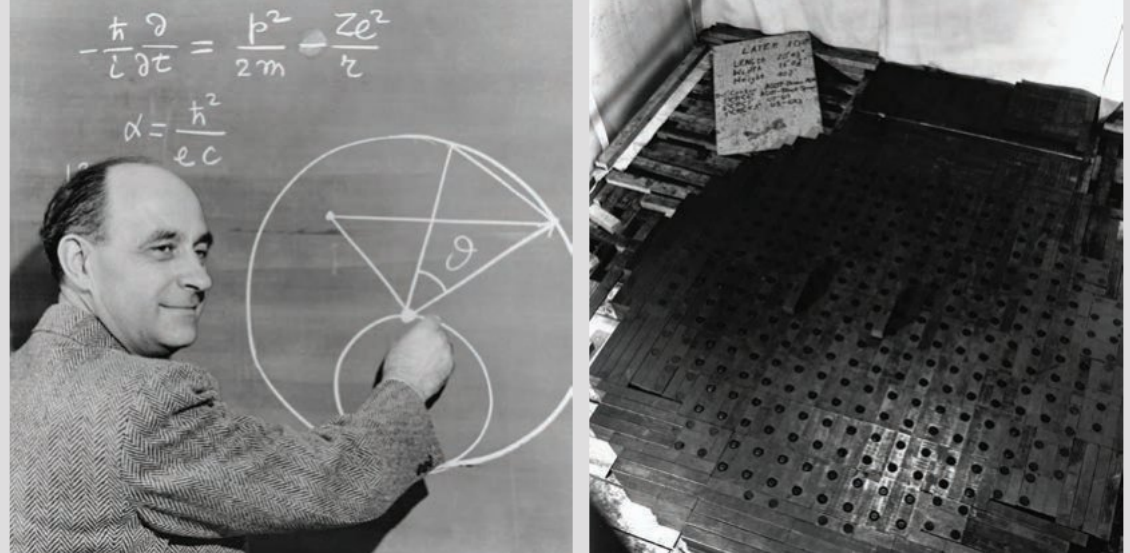
The first controlled nuclear chain reaction was achieved by Enrico Fermi on 2 December 1942 in his "atomic pile" beneath the University of Chicago's football stadium. This reactor used natural uranium oxide as fuel and very pure graphite as the moderator, with cadmium control rods.
Uncontrolled chain reactions
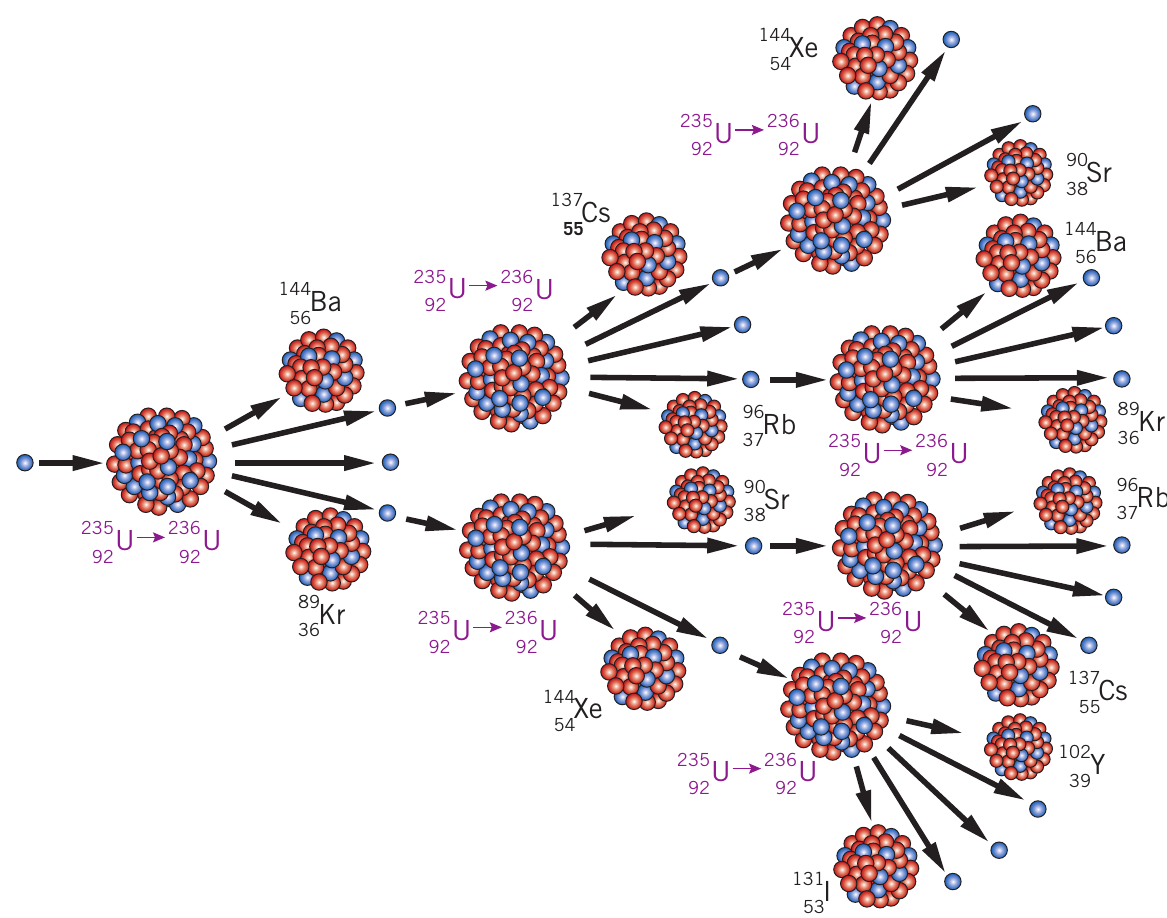
In an uncontrolled chain reaction, all 2-3 neutrons released from each fission are allowed to cause further fissions. This creates exponential growth:
- Generation 1: 1 fission releases 3 neutrons
- Generation 2: 3 fissions release 9 neutrons
- Generation 3: 9 fissions release 27 neutrons
- And so on...
Important
The explosive power of uncontrolled reactions:
After 80 generations (occurring in just a few microseconds), this produces a massive explosion releasing energy equivalent to tens of thousands of tonnes of TNT. This is the basis of nuclear weapons.
The radioactive fragments created by nuclear explosions are dispersed throughout the environment, creating long-term contamination. Some dangerous radioisotopes from atmospheric nuclear tests in the 1950s-1970s are still present in the world's atmosphere, land, lakes, and oceans.
Critical mass
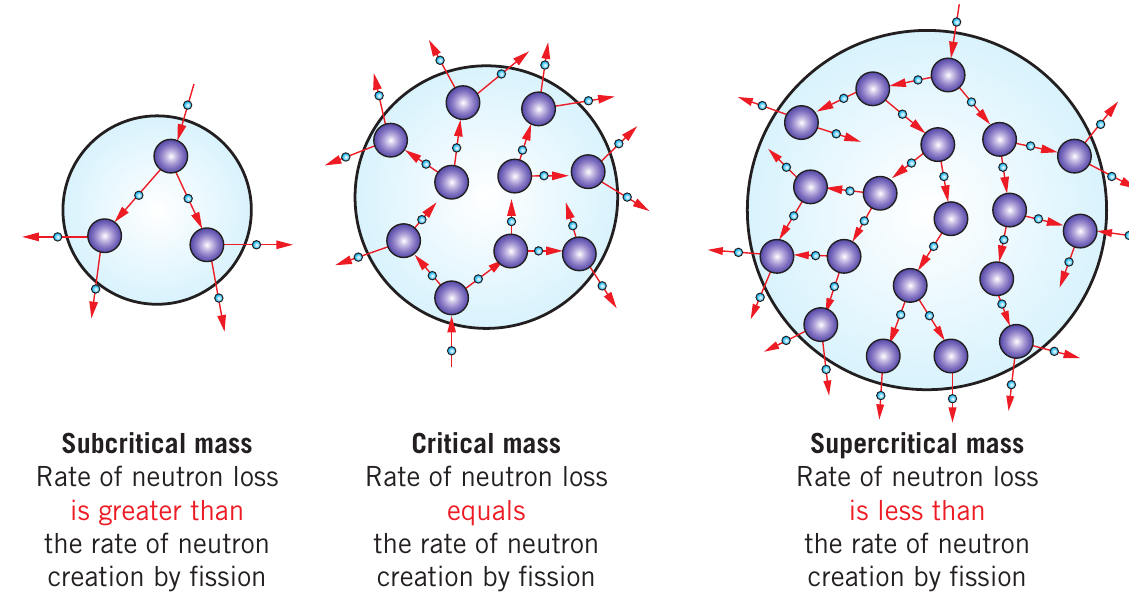
The critical mass is the smallest mass of a fissionable substance that will sustain a controlled chain reaction. At critical mass, the rate of neutron loss equals the rate of neutron release by fission.
Three states of criticality exist:
1. Subcritical: The rate of neutron loss is greater than the rate of neutron creation by fission. The reaction dies out. This is the safe state for storing fissile material.
2. Critical: The rate of neutron loss equals the rate of neutron creation by fission. A steady, self-sustaining reaction occurs. This is the desired state for nuclear reactors.
3. Supercritical: The rate of neutron loss is less than the rate of neutron creation by fission. The reaction grows exponentially. This is required for nuclear weapons.
Factors affecting critical mass
Critical mass depends on several factors:
Size and shape: The critical mass relates to the ratio of volume to surface area. For a sphere:
- Volume is proportional to
- Surface area is proportional to
If you double the radius, you get:
- 8 times the volume (more fissile material and fission events)
- Only 4 times the surface area (proportionally fewer neutrons escape)
A larger sphere has a greater chance of neutrons causing further fissions rather than escaping.
Purity: Higher concentrations of fissile isotopes (like U-235) reduce the critical mass needed.
Neutron reflectors: Materials like beryllium can reflect escaping neutrons back into the fissile material, reducing the critical mass needed and making it easier to achieve supercriticality.
Moderators: Materials that slow neutrons increase the probability of fission, affecting criticality.
Note
For pure uranium-235 in a spherical shape without reflectors, the critical mass is approximately 52 kg. With a beryllium reflector, this can be reduced to about 15 kg.
Case study: The Louis Slotin accident (1946)
Important
The dangers of working with critical masses:
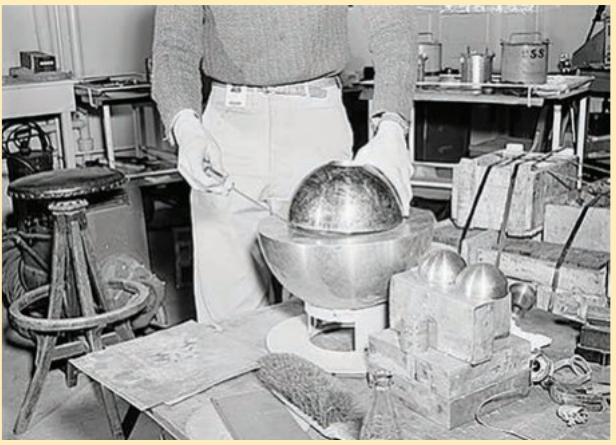
Louis Slotin performed experiments to determine critical mass values for uranium and plutonium cores as part of the Manhattan Project. On 21 May 1946, Slotin's screwdriver slipped while he was positioning beryllium reflector hemispheres around a plutonium-239 core. The reflector fell, bringing the assembly to a supercritical state, which released a burst of lethal neutron radiation. Scientists in the room observed a blue glow from air ionization and felt a heat wave. Slotin died nine days later from radiation exposure.
This tragic accident highlighted the extreme danger of working with near-critical masses of fissile materials.
Nuclear fission reactors for electricity generation
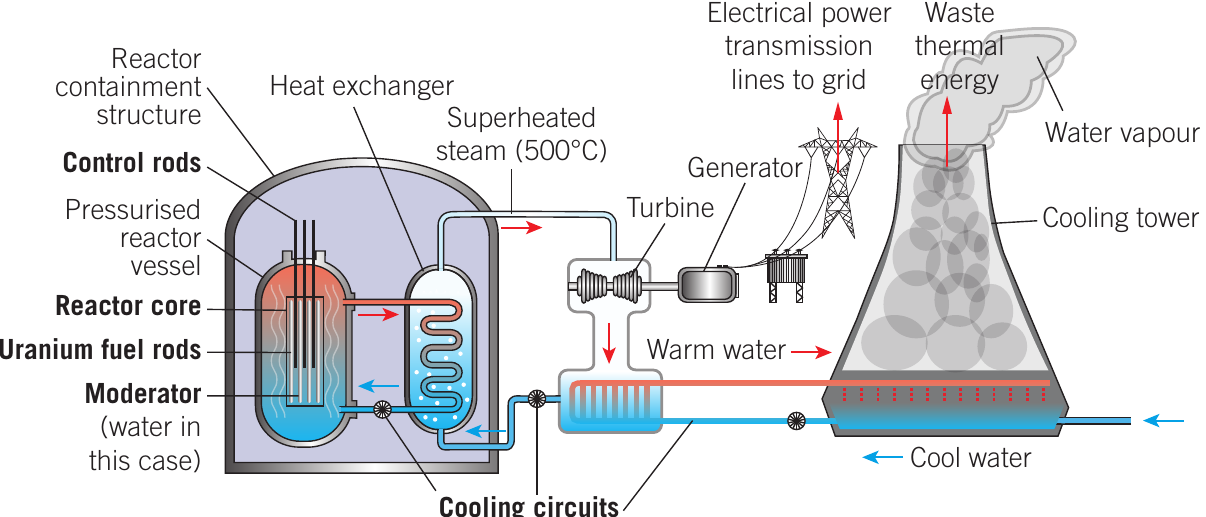
Nuclear reactors use controlled fission of uranium-235 to generate heat, which produces steam to drive turbines and generate electricity. A typical 1000 MW nuclear power station produces the same thermal output as burning 9000 tonnes of coal per day (which would release 27,000 tonnes of CO₂ into the atmosphere).
Key components of a nuclear reactor
Reactor core: This is where fission takes place to produce thermal energy. It contains the fuel rods, control rods, moderator, and coolant. A containment structure of concrete and steel surrounds the reactor to prevent radiation and material escaping in case of an accident.
Uranium fuel rods: These consist of thin tubes filled with pellets of enriched uranium-235 (typically 3.5-4.5% U-235). Fission occurs inside the fuel rods, releasing nuclear energy as heat and radiation.
Moderator: This material slows down the neutrons released during fission. Slow-moving "thermal" neutrons are much more likely to cause uranium-235 fission than fast neutrons. Water is the most common moderator, though graphite and heavy water are also used.
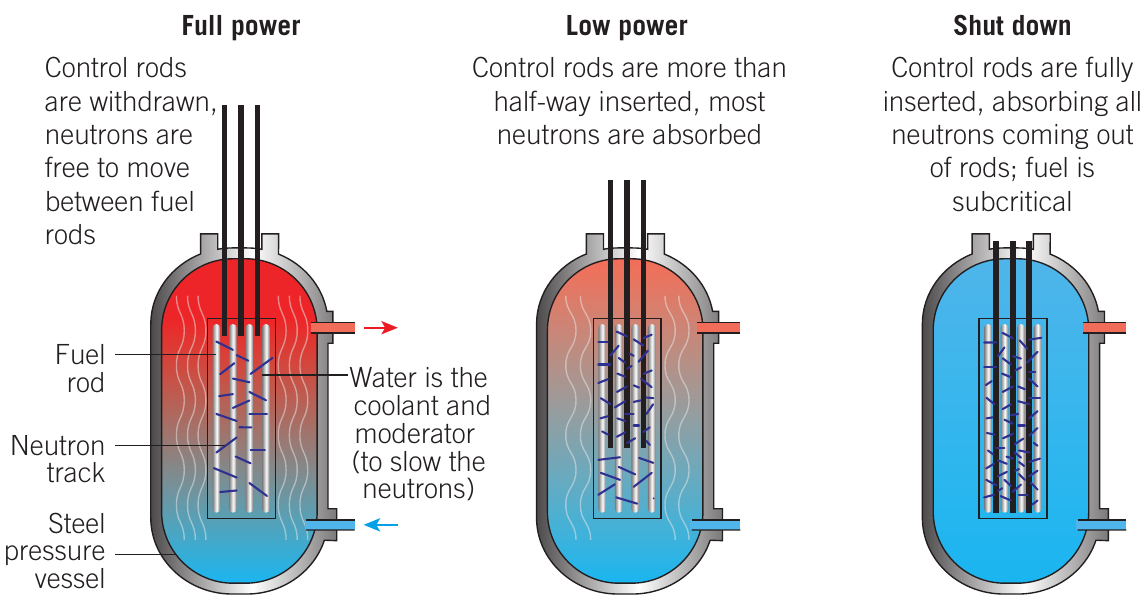
Control rods: These are made of materials that readily absorb neutrons, such as cadmium, boron, silver, hafnium, or indium. By inserting or withdrawing control rods, operators can regulate the chain reaction:
- Raised (withdrawn): More neutrons available for fission → increased power output
- Lowered (inserted): More neutrons absorbed → reduced power output
- Fully inserted: Chain reaction stops → reactor shutdown
Cooling circuits: Most designs use multiple cooling circuits:
- Primary circuit: Extracts heat from the reactor core
- Secondary circuit: Transfers heat to drive turbines
- Tertiary circuit: Removes waste thermal energy to the environment
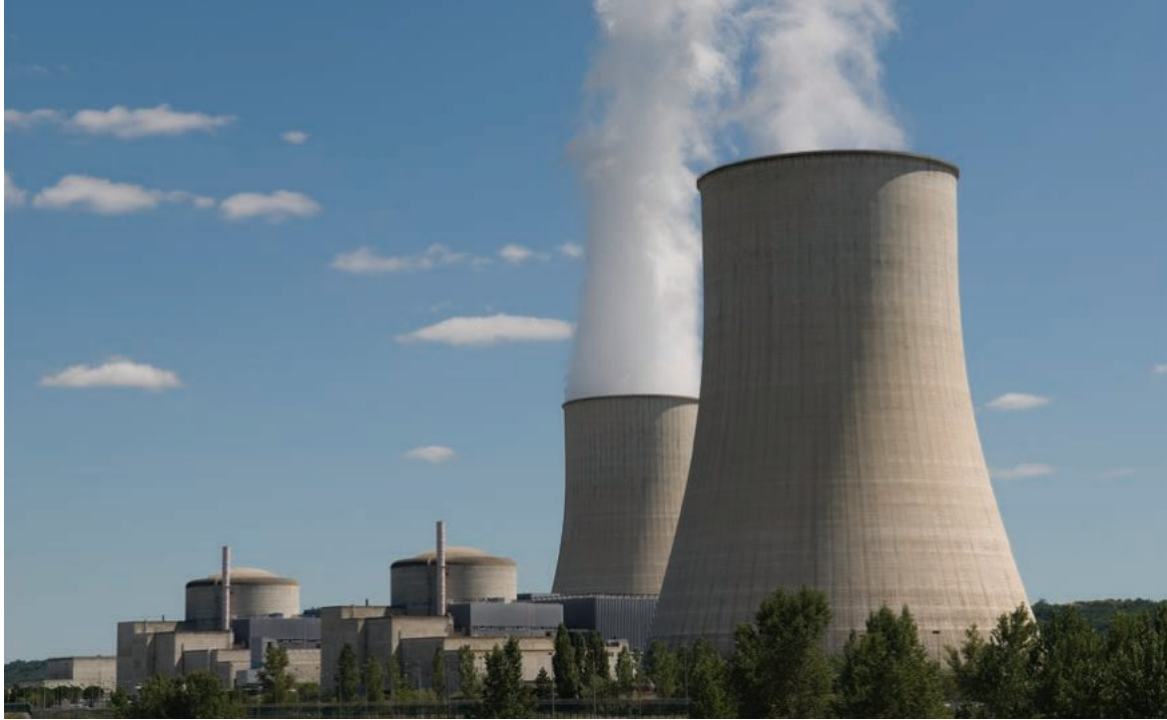
Pressurized water reactors (PWR)
Note
In the design shown above, water serves two purposes:
- As a moderator to slow neutrons
- As a coolant to extract heat
The water in the primary circuit is kept under very high pressure (about 150 atmospheres) so it remains liquid even at temperatures above 300°C. This superheated water transfers its heat to the secondary circuit through a heat exchanger, producing steam at 500°C to drive turbines.
Control rod operation
Control rods are essential for safe reactor operation:
Full power: Control rods are withdrawn, allowing neutrons to move freely between fuel rods. The reactor operates at critical state with maximum power output.
Low power: Control rods are partially inserted, absorbing many neutrons. The reactor remains critical but at reduced power level.
Shut down: Control rods are fully inserted, absorbing nearly all neutrons. The fuel becomes subcritical and the chain reaction stops.
Important
In an emergency, control rods and additional safety rods automatically drop into the core by gravity, rapidly shutting down the reaction. This fail-safe mechanism ensures the reactor can be shut down even if power is lost.
Uranium enrichment
Natural uranium consists of two main isotopes:
- Uranium-238: 99.3% (non-fissile)
- Uranium-235: 0.7% (fissile)
Enrichment is the process of increasing the percentage of the fissile uranium-235 isotope in nuclear fuel. Different applications require different enrichment levels:
- Natural uranium (0.7% U-235): Can be used in some reactor designs (like CANDU reactors that use heavy water moderators)
- Reactor-grade (3.5-4.5% U-235): Used in most commercial nuclear power reactors
- Weapons-grade (>90% U-235): Required for nuclear weapons
Important
Critical distinction:
Reactor-grade uranium fuel cannot be used to construct nuclear weapons because the U-235 concentration is too low. This is an important safeguard that separates civilian nuclear power from weapons proliferation.
Enrichment methods
Since uranium-235 and uranium-238 are isotopes of the same element, they have identical chemical properties. Separation must use physical methods that exploit the small mass difference:
- Electromagnetic separation: Uses magnetic fields to separate ions based on mass
- Ultracentrifuges: Rapidly spins uranium hexafluoride gas; heavier U-238 concentrates at the outside
- Gaseous diffusion: Lighter U-235 gas molecules diffuse through barriers slightly faster than U-238
Uranium fuel cycle
- Mining produces uranium ore
- Processing extracts uranium oxide (1 tonne of ore typically yields 3 kg of uranium oxide)
- Enrichment increases U-235 concentration to desired level
- Fuel fabrication forms enriched uranium into pellets and fuel rods
- Use in reactor for 3-5 years
- Storage or reprocessing of spent fuel
Nuclear weapons design
Important
Understanding nuclear weapons:
Nuclear weapons exploit supercritical masses to create uncontrolled chain reactions and massive explosions. The component pieces of fissile material must be kept subcritical until detonation to prevent premature reaction.
The following information is presented for educational purposes to understand the physics principles involved.
Gun-type design (Little Boy)
The uranium bomb dropped on Hiroshima on 6 August 1945 used a "gun-type" design:
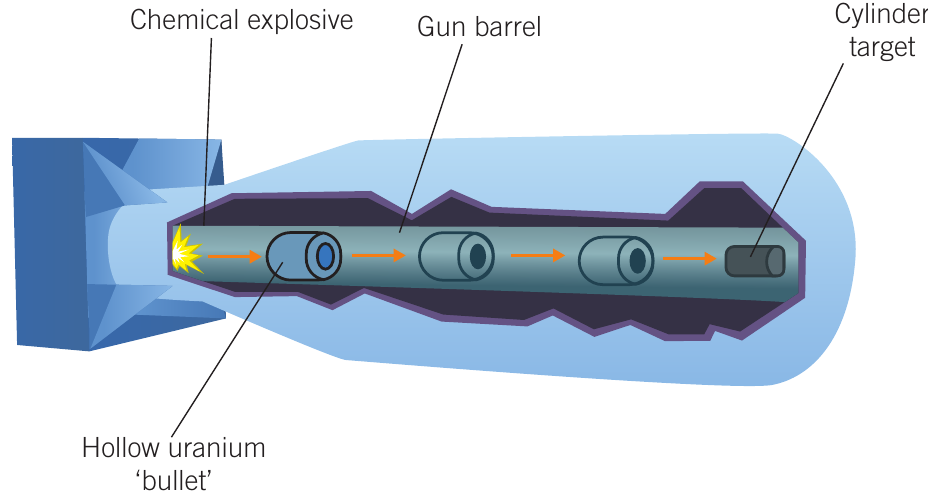
How it works:
- A conventional chemical explosive fires a hollow uranium "bullet" (39 kg of enriched U-235)
- The bullet travels down a gun barrel
- It strikes and surrounds a cylinder "target" (25 kg of enriched U-235)
- The two subcritical masses combine to form a supercritical mass
- An uncontrolled chain reaction occurs in less than a millisecond
Results:
- Total uranium-235: 64 kg (80% enrichment)
- Mass that underwent fission: Less than 1 kg
- Mass converted to energy: 0.7 g
- Energy released: 63 TJ (equivalent to 15 kt of TNT)
- Approximately 70,000 people killed immediately
Implosion-type design (Fat Man)
The plutonium bomb dropped on Nagasaki on 9 August 1945 used an "implosion" design:
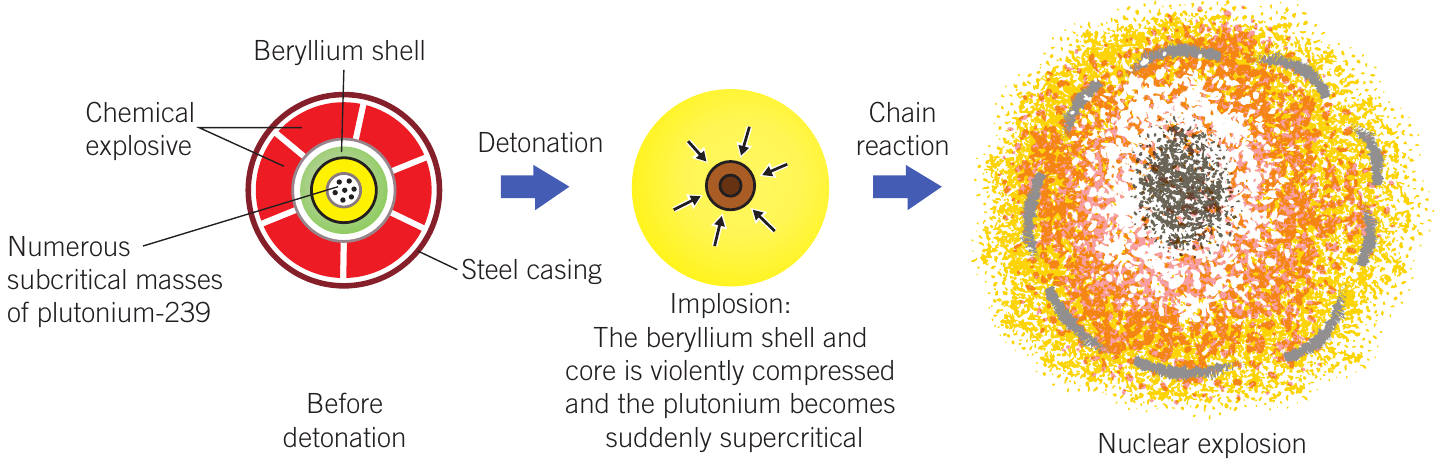
How it works:
- Numerous subcritical pieces of plutonium-239 are arranged in a sphere
- A spherical shell of chemical explosives surrounds the plutonium
- All explosive charges detonate simultaneously
- The implosion compresses the plutonium pieces together
- A beryllium shell reflects neutrons back into the core
- The compressed plutonium becomes supercritical
- An uncontrolled chain reaction produces a nuclear explosion
Results:
- Total plutonium-239: 6.19 kg
- Mass that underwent fission: About 1 kg
- Mass converted to energy: 0.97 g
- Energy released: 88 TJ (equivalent to 21 kt of TNT)
- Approximately 40,000 people killed immediately
Example
Worked Example: Nuclear bomb energy
Question: The Hiroshima bomb transformed 0.7 g of mass into energy. One kilotonne (kt) of TNT releases 4.18 TJ of energy. Using :
a) Calculate the energy released by this bomb in TJ
b) Calculate the equivalent TNT amount in kt
Solution:
a) Using :
b) TNT equivalent:
Summary
Key Points to Remember:
-
Einstein's equation shows that mass can be converted to energy. The enormous value of means even tiny mass changes release huge amounts of energy.
-
Nuclear reactions release millions of times more energy than chemical reactions because the strong force binding nucleons is millions of times stronger than electromagnetic forces binding electrons.
-
Nuclear fission splits heavy nuclei (like U-235) into lighter fragments, releasing energy and neutrons. Nuclear fusion combines light nuclei (like hydrogen) into heavier ones, also releasing energy.
-
Chain reactions require careful control. Controlled reactions (one neutron continuing per fission) power reactors safely. Uncontrolled reactions (all neutrons continuing) create exponential growth and explosions.
-
Critical mass depends on multiple factors including size, shape, purity, and the presence of moderators or neutron reflectors:
- Subcritical masses are safe
- Critical masses sustain steady reactions
- Supercritical masses produce growing reactions and explosions
-
Nuclear reactors use moderators to slow neutrons (increasing fission probability) and control rods to absorb excess neutrons (regulating the reaction rate). This allows safe, sustained energy generation.
-
Uranium enrichment increases the U-235 concentration from 0.7% (natural) to 3.5-4.5% (reactor-grade) or >90% (weapons-grade). Reactor-grade uranium cannot be used for weapons.